
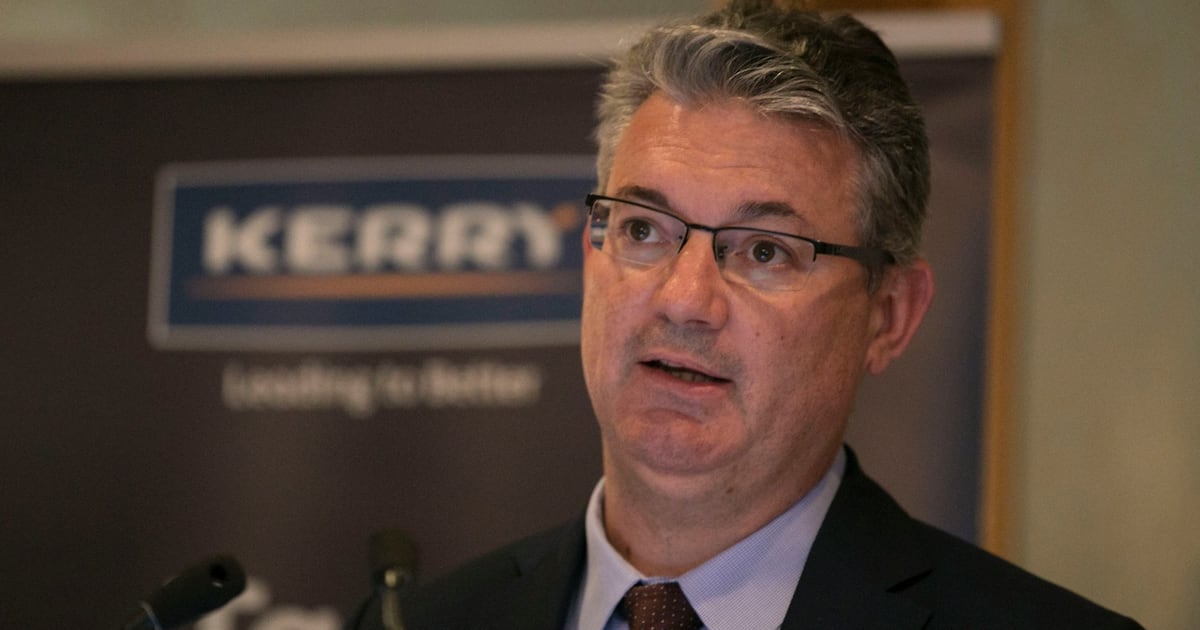
Top executives at Irish food ingredients multinational Kerry Group saw their take-home pay cut by 18 per cent last year following shortcomings in the company’s short-term targets, its annual report shows.
Kerry Group, which floated on the stock market in 1986 and is led by chief executive Edmond Scanlon, saw revenue drop 2.5 per cent to €6.8 billion in 2025, while profit after tax fell 10 per cent to €659 million.
The report, which was released to shareholders on Thursday morning, shows Scanlon got a 3 per cent bump in his basic salary to bring it up to €1.42 million, but his take-home pay fell 18 per cent from more than €6 million to just over €5 million.
The drop in Scanlon’s take-home pay can largely be attributed to a fall in his bonus under the company’s short-term incentive plan from €2.6 million in 2024 to €1.4 million last year. His basic pay will increase by 3 per cent again in 2026.
The short-term incentive plan sees executives rewarded if they meet certain goals related to the company’s performance in a given year, while the long-term incentive plan is linked to growth in earnings-per-share ratio, return on capital employed, and other metrics.
Kerry Group chief financial officer Marguerite Larkin also enjoyed a 3 per cent rise in her basic pay to bring it to €878,000, but her take-home pay also fell 18 per cent from more than €3.5 million to €2.9 million.
[ Kerry Group shares plunge 6.4% as profit and revenue decline amid weaker dollarOpens in new window ]
The reduction in her pay was again linked to the company’s short-term incentive plan, where her bonus was down more than 45 per cent to €882,000. Larkin will see her basic pay increase by 3 per cent this year.
Gerry Behan, the US-based chief executive of Kerry’s global taste and nutrition business – where about 70 per cent of the group’s revenue is generated – saw his basic salary increase 3 per cent to $1.1 million (€960,000).
However, his total remuneration was down 16 per cent from $4.7 million to $3.95 million after his bonus under the short-term incentive plan dropped from $2.1 million to $1.2 million.
However, Behan, who retired at the end of the year, is to get an “associated payment” of $2.3 million as part of a 12-month “non-compete and non-solicitation restriction” in his contract designed to “protect the group’s customer base, employees, and intellectual property”.
 The difficult choices that could dramatically increase housing supply in Dublin
This payment is equivalent to 12 months “on-target annual cash opportunity, plus health insurance cover for the same period”, payable in monthly instalments throughout 2026.
The share price used to calculate the value of the long-term incentive plan is the average share price for the three months up to the end of the year.
The company, which employs about 1,500 people in Ireland, has seen its share price plunge by more than 30 per cent over the past 12 months.
The negative share price movement in 2025 reduced the valuation of the awards that will vest in 2026 over a three-year period by €338,000 for Scanlon, €174,000 for Larkin and €219,000 for Behan.
Group chairman Tom Moran saw his fee rise from €435,000 to €448,000 in the year. Pay to non-executive directors rose from €95,000 to €98,000. Both Moran and non-executive directors will again benefit from 3 per cent increases this year.
Emer Gilvarry, chairwoman of Kerry Group’s remuneration committee, said salary increases for the wider workforce in 2026 will “again be aligned to market movements on a country-by-country basis”.
“We continue to have flexibility in our pay review process to facilitate higher increases for lower-paid positions and to allow for more frequent reviews in inflationary economies,” she said.
In setting remuneration levels, she said the committee has regard to FTSE 100 companies of “comparable scale and complexity” and also to US and European sector peer companies to “reflect the markets in which we compete for leadership talent”.
She said the targets the committee set for executive directors were “challenging and stretching” in the context of the economic environment and subdued market growth rates.