
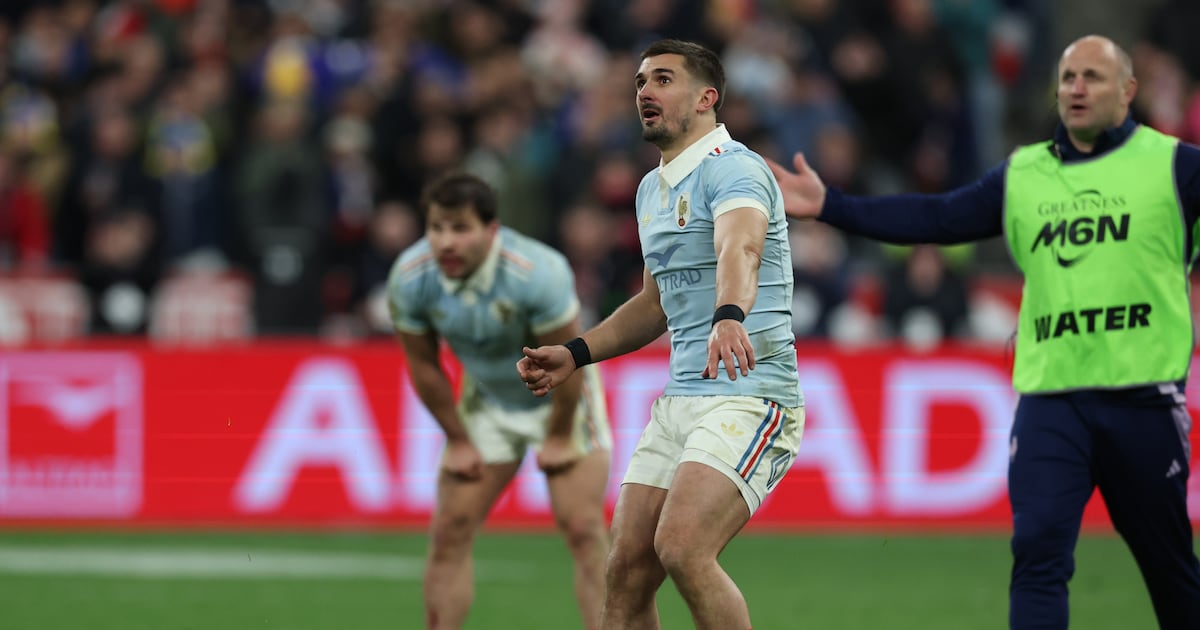
There’s a widely held misconception out there that Thomas Ramos’ 45-metre penalty in the last kick of the 2026 Six Nations to beat England, sealing the title for France, was effectively worth an additional €3-3.5 million for the French Federation, which the IRFU therefore missed out on.
This is based on the premise that the prize fund for the Six Nations was in line with last year’s tournament, which has also been misconstrued as being in the region of €20.83 million. This would have represented a significant increase on, say, the 2023 prize fund of €13.7 million when Ireland won the Grand Slam.
In actual fact, it is understood that the prize fund for both the 2025 and 2026 Six Nations decreased from 2023, not due to reduced revenue for the Six Nations but seemingly as a consequence of a slight redistribution of funds.
The Six Nations appears to be setting aside less than 10 per cent of its overall profits for an ‘incentive pool’, a prize fund in all but name, which this year is likely to be in the ballpark of €11.5 million.
That would mean the champions would have received a figure of around €3 million, with the runners-up earning around €2.5 million, representing a difference of roughly €500,000-600,000, ie the ‘value’ of that Ramos penalty. That is not derisory, but it’s nowhere near the €3-3.5 million which has been reported, and it would be surprising if the Six Nations would agree to an ‘incentive pool’ which would lead to such a discrepancy in financial returns based on one kick.
The Six Nations is very much the financial driver for all six competing unions; far more so than the autumn internationals, summer tours or World Cups. Accordingly, the six have evidently sought to ensure a greater return for each of them by reducing the prize fund.
Even though Ireland are the only nation to finish in the top half of the table each season since 2012, the IRFU conservatively budget for a fourth-or-better finish. Therefore, a top-two finish in four the last five seasons represents a positive return.
The share of the prize fund is, of course, decreed by a meritocracy-based formula, ranging from first to sixth place, and from around €3 million to, say, €750,00+. This year, each of the six participating nations would also receive a share of the bonus set aside for any team that wins the Grand Slam as the feat was not achieved this season.
For example, as was previously reported in The Irish Times, the IRFU received roughly €5.15 million after Andy Farrell’s side won the 2023 Six Nations.
The reward for winning that title was then swelled by a bonus of around €900,000 as Ireland has also completed the Grand Slam. That in turn meant the share received by the other five countries was reduced almost €200,000 apiece, with the IRFU receiving about €5.15 million in total.
As well as being its golden goose, this year’s championship reinforced the Six Nations’ status as the crown jewel of European rugby, maintaining its enormous reach on free-to-air television at a time when so much sport in Ireland and the UK has gone behind a paywall.
The tournament finale in Paris last weekend drew a record-breaking peak audience in France of over eight million viewers, while the Thursday-night opener between Les Bleus and Ireland drew almost seven million.
In Ireland, there was a peak audience of around 950,000 viewers for last Saturday’s Triple Crown shoot-out, while the peak audience for Virgin Media’s live television coverage of Ireland’s win over England was over one million, equating to 77 per cent of the available audience.
The pricing of tickets for games at the Aviva and their accessibility to the public may be an issue, but the demand also reflects the popularity of these fixtures, which is also reflected in viewing figures as rugby internationals accounted for five of the 10 most-watched programmes in Ireland last year.