
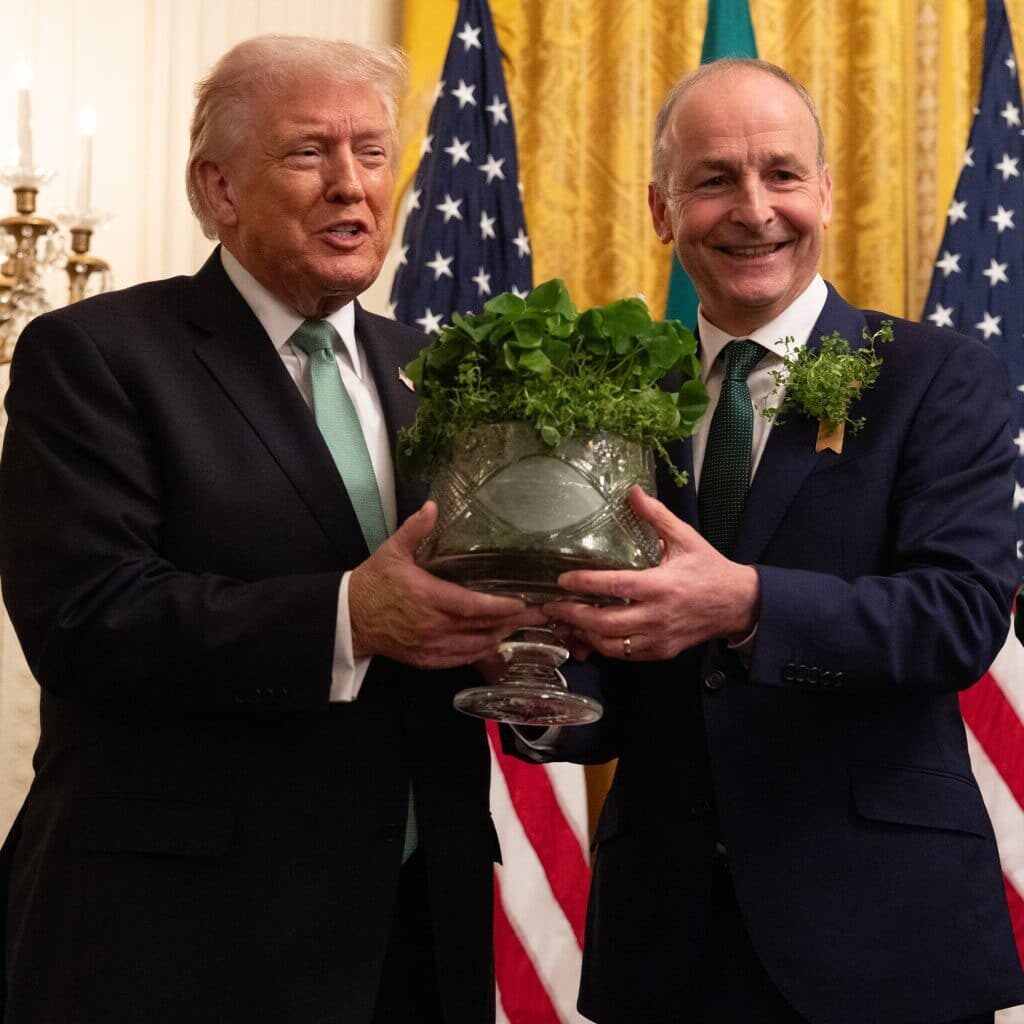
Taoiseach (Prime Minister) Micheál Martin spent most of the 41-minute Saint Patrick’s Day press conference sitting politely mute in the Oval Office, while Trump boasted about destroying Iran and criticized Europe for their unwillingness to send weapons to the Middle East. Interjecting only twice, Martin called for a peaceful resolution to the current conflict and later defended British Prime Minister Kiers Starmer, NATO, migration to Europe, and ironically, Winston Churchill, in front of whose bust the two leaders sat.
Every year since 1953, the Irish Taoiseach has led a coalition visit to the United States and presented the President with a bowl of shamrocks on March 17. Despite pressure from Irish citizens and opposition parties to boycott this year’s visit due to Trump’s enabling of the Gaza genocide and his attacks on Iran, Martin arrived in the United States last Friday.
“Are you seriously going to go over and hand this guy a bowl of shamrock?” asked member of Parliament Richard Boyd-Barrett in the Parliament chamber last week. “It’s disgusting.”
“They want to do to Iran what they did to Gaza,” he claimed and continued by lambasting “America and their cat’s paw called the Israeli state, the genocidal regime that has been ethnically cleansing the Palestinian people since 1948.”
Members of the Sinn Féin and Labour parties joined the chorus, while President Catherine Connolly, an outspoken critic of the genocide who was elected with 63% of the vote last October, encouraged Ireland to condemn the expanding violence in a statement. “What we have witnessed in recent days in the Middle East, and beyond, are not political disputes. They are deliberate assaults on international law, the international laws that have underpinned global peace for eighty years. We must name them as such, without euphemism and without equivocation. Ireland is uniquely positioned to do precisely that.”
When asked about her criticisms during the press conference, Trump responded by misgendering Connolly, saying, “Look. He’s lucky I exist.” Martin said nothing to correct him.
Public Opinion
While there are few numbers available assessing public opinion in Ireland regarding these issues, a 2024 poll showed that 79% of Irish people believed Israel was committing genocide in Gaza. Protests drew tens of thousands. Numerous city councils support Palestine, as do many local businesses. A Palestinian flag flew on top of Dublin City Hall last year. Irish artists and performers remain vocal regarding their support for Palestine, and over 2,400 have signed the Irish Artists Pledge to Boycott Israel, including best-selling author Sally Rooney, who donated part of her profits to the proscribed UK group Palestine Action and told fellow artists at the People’s Congress of the Hague Group recently, “it is the honor of our lives to stand with Palestine.”
Irish rap band Kneecap are perhaps the most outspoken, having had their U.S. visas revoked for flashing messages denouncing the U.S. and Israel at the Coachella Music Festival last year. Rapper Mo Chara explained his solidarity with Palestine after a High Court Judge dropped the appeal by the Crown Prosecution Service last week in a case which accused him of supporting terrorism. “As people from Ireland, we know oppression, colonialism, famine, and genocide,” he said in Belfast last Wednesday. “As people from the North of Ireland, we know it even more.”
“A Generational Obligation to Stop This”
Chairperson for the Ireland-Palestine Solidarity Campaign, Zoë Lawlor, echoes the sentiment. “Absolutely, we see similarities with Irish history. We’re a people who were occupied. We had starvation forced on us. Ireland is still not completely united and independent. We have a generational obligation to stop this.”
Occupied by England for 800 years, the island gained partial independence after a 1916 revolution. While 26 counties became the Republic of Ireland, six counties in the North remained part of the United Kingdom. There apartheid continued via unequal policies in jobs, housing, and voting. During a period from the late 1960’s through the 1990’s known as “The Troubles,” civil unrest led to separation walls, military patrols, checkpoints, and paramilitary violence, which continued until the Good Friday Agreement in 1998. Today the six counties remain a sovereign territory of the United Kingdom.
A History of Solidarity
Historically, Ireland has shown solidarity with Palestine. It was the last country in Europe to open an Israeli embassy and the first to call for a Palestinian state. In May of 2024, joined by Spain and Norway, the Republic formally recognized Palestinian statehood, prompting accusations of antisemitism from Israel and the withdrawal of their ambassador. After Ireland joined the South African genocide case against Israel in the International Court of Justice that December, Israel closed their embassy in Dublin.
Ireland increased its donations to UNRWA in two years ago, even while the European Union and several nations, including the United States, pulled support from the humanitarian aid organization due to accusations that some workers were members of Hamas. Last year, calls for Irish broadcaster RTÉ to refuse to broadcast Eurovision due to Israel being allowed to perform were successful and the ban was supported by the government.
Even Martin himself has condemned Israel. After nine members of the same family were murdered in Gaza last May, he called for a ceasefire in a public speech and condemned what he called Israel’s “genocidal actions,” using the term “genocide” for the first time. He also stated that withholding aid from civilians in Gaza is a war crime. His words ring somewhat hypocritical, however, given that he had passed the International Holocaust Remembrance Alliance (IHRA) definition of antisemitism almost immediately after taking office in January 2025. The definition equates criticism of Israel with antisemitism.
Mixed Messaging
Ongoing campaigns have continued to pressure the government to act and stop their “mixed messaging,” as Lawlor calls it. “What the Irish government has done comes from pressure, sustained democratic actions, and solidarity. Grassroots pressure is effective,” she says.
Activists hold regular standouts at Shannon Airport, where American planes refuel en route to the Middle East.
“We don’t know if arms have gone through Shannon because the government refuses to inspect the planes. We do know that over three million U.S. troops have gone through,” explains Lawlor. If weapons were found, their transport would violate both Irish and international law. Two U.S. war planes stopped at Shannon on the same day a girls’ school in Iran was bombed by the United States. On Sunday Martin claimed there was no evidence Shannon was being used to assist the Iran war.
Eight years ago, the Irish senate passed the Occupied Territories Bill, followed by the House in 2019. Despite being a key campaign promise during the 2023 election of Martin and his Fianna Fáil party, the Bill, which would ban Irish trade with the West Bank, East Jerusalem, and the Golan Heights, has yet to be enacted. Although close to 75% of the Irish favor its final passage, it has been diluted and remains stalled despite previous government claims it would likely be passed before the end of 2025.
Economic Ties
What can explain the reluctance of Martin and his government to heed the calls of the UN, humanitarian aid groups, and his citizens, while simultaneously making statements supportive of Palestine?
Not surprisingly, the answer seems to be primarily economic. Two-thirds of all foreign investment in Ireland is from companies headquartered in the United States, including several global tech giants who also operate in Israel and several large pharmaceutical companies. Twenty percent of Irish jobs are with American companies. Ireland is the United States’ largest source of new investments
American politicians have pushed back against the Occupied Territories bill, sixteen Republicans requesting that Ireland be added to the Israeli boycott list if it were passed, and stating in a letter to the U.S. Secretary of the Treasury last July that “Efforts to economically isolate Israel will carry consequences.” In a racist post on X, the US Ambassador to Israel, Mike Huckabee called the proposed legislation, “so stupid that it would be attributed to [an] act of diplomatic intoxication.” “Did the Irish fall into a vat of Guinness?” it asked, and concluded, “Sober up, Ireland!”
While the visit is touted as one of friendship and economic partnership, mentioning global politics is not without precedent. In 2024 Taoiseach Leo Varadkar told President Biden, “The people of Gaza desperately need food, medicine, and shelter. Most especially, they need the bombs to stop. This has to stop.”
Varadkar resigned immediately upon returning to Ireland.
In contrast, Martin praised Trump’s commitment to Middle East peace, telling the President, “You’re doing your bit there in terms of the work in Gaza.” As Ireland plans billions of dollars in future American investment and continues to rely on the tax base provided by American companies operating in Ireland, this year’s visit was a sycophantic repeat of 2024. Martin gave a polished speech, handed over the bowl of shamrocks with a smile, and refused to challenge Trump’s violations of international law, even as assaults on Iran and the genocide in Palestine continue.
“I wish Martin would say to Trump, ‘Stop funding genocide, dismantle the Board of Peace, let Palestine decide their own future,” says Lawlor. “We’ve never seen such a level of sustained activism as we have over the last 2½ years. It’s shameful that our government doesn’t reflect our will at all.”