
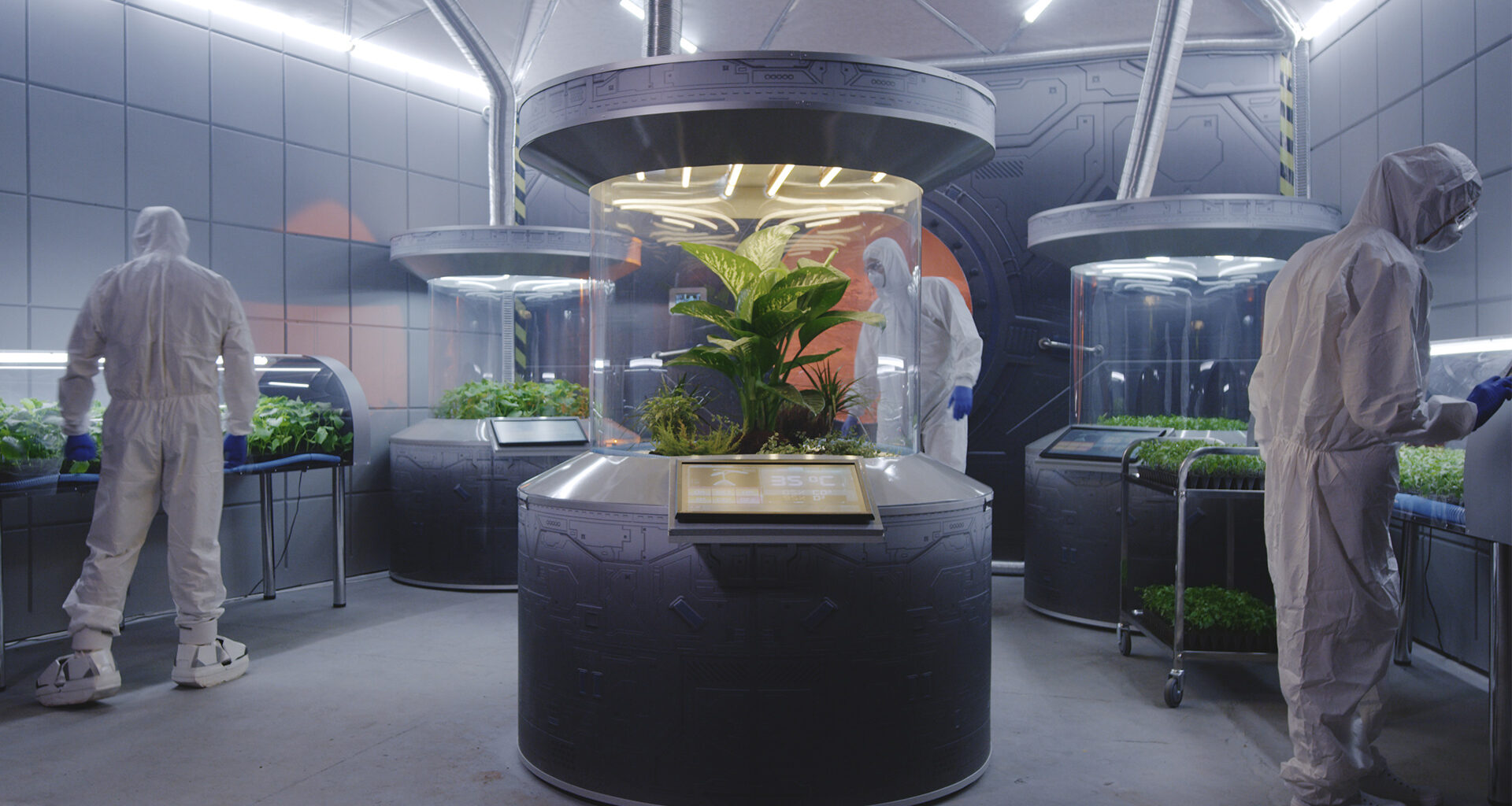
Imagine landing on Mars and growing your lunch—not with supplies from Earth, but using dust, air, and microbes already there. This idea has long sounded like science fiction, mainly because Mars lacks one critical ingredient, fertile soil. Its dusty surface contains minerals, but not the organic nutrients plants need to grow.
Now, researchers in Germany have found a clever solution that involves turning Martian-like dust and hardy microbes into a working fertilizer system that can produce edible plants. It’s a small but powerful step toward making Mars missions self-sustaining.
Our “findings advance the development of in-situ fertilizer production for sustainable crop farming on Mars,” the researchers note in their study.
From space dust to living biomass
At the heart of the proposed system are cyanobacteria, often called blue-green algae. These microscopic organisms are tough enough to survive in extreme environments. More importantly, they can use carbon dioxide, plentiful in the Martian atmosphere, to grow, while also producing oxygen and pulling nutrients out of mineral-rich dust.
To show how this idea could work, the researchers recreate Martian conditions using a regolith simulant called MGS-1, which mimics the composition of Martian soil. They cultivated cyanobacteria using this artificial dust along with carbon dioxide, allowing the microbes to build up biomass using only resources that could realistically exist on Mars.
Once enough cyanobacteria were grown, the next challenge was converting them into something plants could use. The team achieved this through anaerobic fermentation—a process where microbes break down organic matter without oxygen, releasing nutrients in the system.
They fine-tuned this step carefully. Heating the biomass beforehand helped it decompose faster, and maintaining the system at around 35°C produced the best results. The researchers also calculated the right balance between cyanobacterial biomass and ammonium output, ensuring the final product had enough of this key nutrient for plant growth.
The resulting fertilizer was then tested on duckweed (Lemna sp.), a fast-growing aquatic plant rich in protein and already consumed in some parts of the world. The outcome was impressive: just one gram of dried cyanobacteria generated enough nutrients to grow 27 grams of fresh, edible plant mass.
“Despite challenges, the digestate enabled high Lemna sp. biomass yields of 27 g wet mass per gram of cyanobacterial dry mass, demonstrating its potential as a hydroponic fertilizer,” the study authors added.
Moreover, as a bonus, the fermentation process produced methane—an energy-rich gas that could be captured and used as fuel, adding another layer of usefulness to the system.
A blueprint for living off-world
This research points toward a future where astronauts could rely far less on Earth. By combining microbes, local dust, and simple biological processes, it may be possible to create closed-loop systems that produce food, oxygen, and even energy on Mars.
“You can imagine a vegetable garden on Mars that is run entirely from local resources—without bringing soil, fertilizer, or water. This self-sufficiency is important to make future Martian settlements as sustainable as possible,” Tiago Ramalho, lead researcher and a PhD student at the University of Bremen, said.
However, the work is not complete. These experiments were carried out under controlled, Earth-based conditions, not the harsh realities of Mars, where radiation, low gravity, and extreme temperatures could affect the system.
Next, researchers aim to test and integrate this system with other life-support technologies, moving closer to a fully self-sufficient habitat. If it works, the same approach could also be used for sustainable farming on Earth—especially in regions where soil quality is poor.
The study is published in the Chemical Engineering Journal.