

Your support helps us to tell the story
From reproductive rights to climate change to Big Tech, The Independent is on the ground when the story is developing. Whether it’s investigating the financials of Elon Musk’s pro-Trump PAC or producing our latest documentary, ‘The A Word’, which shines a light on the American women fighting for reproductive rights, we know how important it is to parse out the facts from the messaging.
At such a critical moment in US history, we need reporters on the ground. Your donation allows us to keep sending journalists to speak to both sides of the story.
The Independent is trusted by Americans across the entire political spectrum. And unlike many other quality news outlets, we choose not to lock Americans out of our reporting and analysis with paywalls. We believe quality journalism should be available to everyone, paid for by those who can afford it.
Your support makes all the difference.Read more
Protein seems to be everywhere these days for Americans. It’s in your shakes, it’s in your pancakes and popcorn. Heck, it’s even in your mac and cheese.
Most Americans were already getting more than enough protein in their daily diet before the craze, according to experts. It just may not all be the best kind.
“While meat provides high-quality protein, some meats also provide unhealthy amounts of saturated fats and sodium,” Harvard Health says. “If you eat meat, it’s important to choose leaner meats and poultry.”
Protein has garnered new interest as political figures push Americans to eat more. But some proteins, such as those from red meat, come with an increased risk of other problems, such as heart disease.
 Experts say Americans are getting too much protein in their daily diet – and not enough of the sources that are the the best for their health (Getty Images)
The Trump administration recently made waves when it put meat back on top of the food pyramid, vowing to fight what Health Secretary Robert F. Kennedy, Jr., called the “war on protein.” Two-thirds of Americans’ daily protein already comes from meat, according to Johns Hopkins.
“The food system itself shapes our choices,” Johns Hopkins Bloomberg School of Public Health dietician Daphene Altema-Johnson said this week, including cultural messaging that emphasizes meat, convenience and cost.
But eating more red meat has been tied to an increased risk of heart disease: one of America’s top killers.
While Americans are consuming enough protein – the recommended amount is 0.8 grams of protein per kilogram of body weight, or between 10-35 percent of your daily calories, according to the University of Mississippi Medical Center – they’re not getting enough fiber and other crucial nutrients found in sources of lean protein, such as a chicken breast.
Fiber is good for digestive health and weight management.
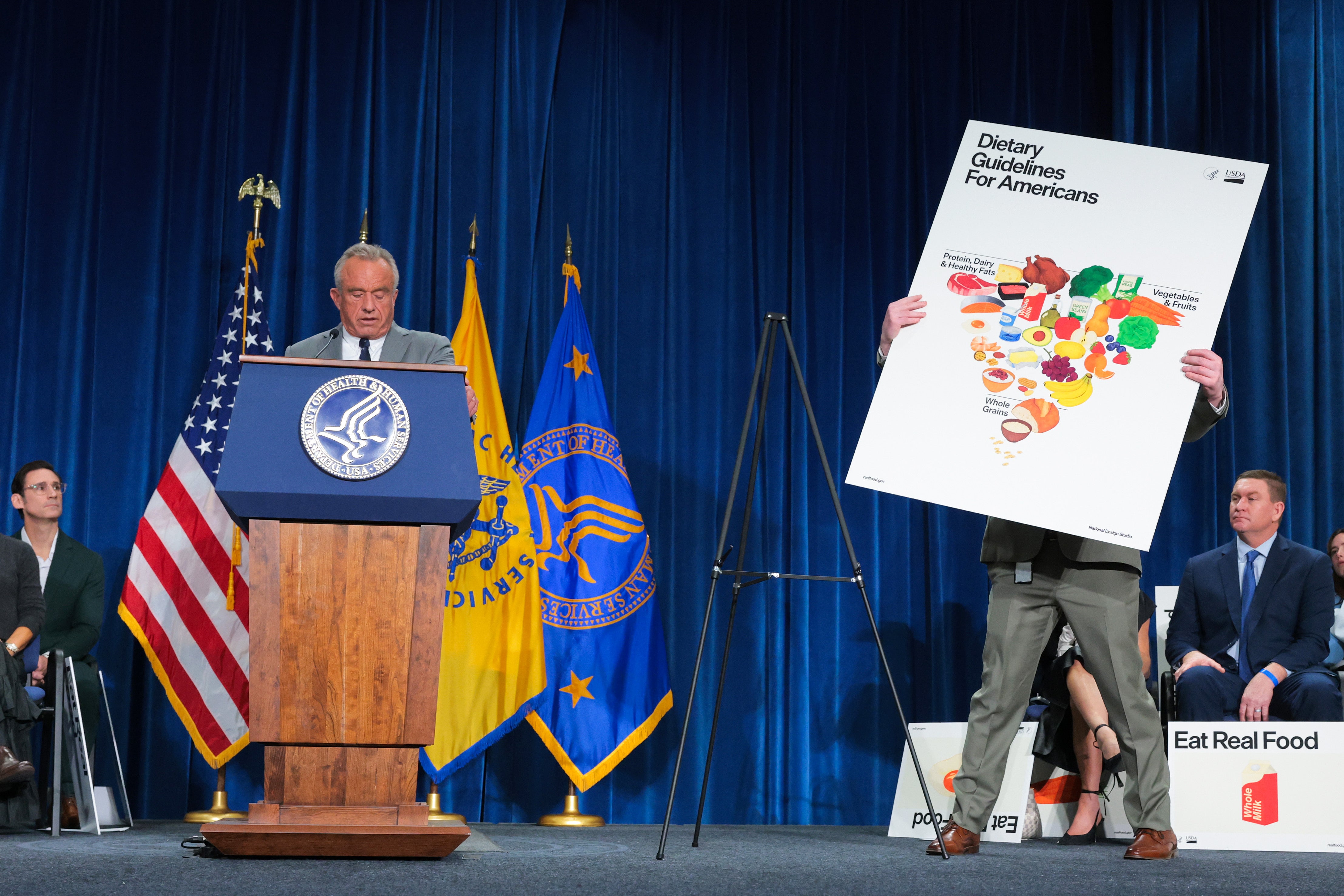 New federal dietary guidance places a renewed emphasis on red meat. But eating eating more red meat has been tied to an increased risk of heart disease (Getty Images)
Beans, legumes, vegetables and nuts can also help. Peanuts, which are technically a legume, have more than 37 grams of protein per cup, Rochester Medicine says, as well as more than 12 grams of fiber.
A cup of almonds and pistachios have around 30 and 25 grams of protein per cup, respectively, and pistachios have the same amount of fiber as peanuts.
A cup of cooked soybeans, the beans with the highest amount of protein, have 28.62 grams of protein and 10.32 grams of fiber, according to Rochester Medicine. A cup of cooked lentils has 17.86 grams of protein and 15.64 grams of fiber.
These fiber-rich protein sources also contain vitamins, essential minerals and compounds that regulate blood sugar and lower cholesterol.
The key is not necessarily cutting out meat altogether, but making small swaps to your meals, Johns Hopkins says.
“Vegetables, beans, peas, lentils, and soy are not only cheaper, but also better for health,” Johns Hopkins nutritional epidemiologist Andrew Thorne-Lyman said.