
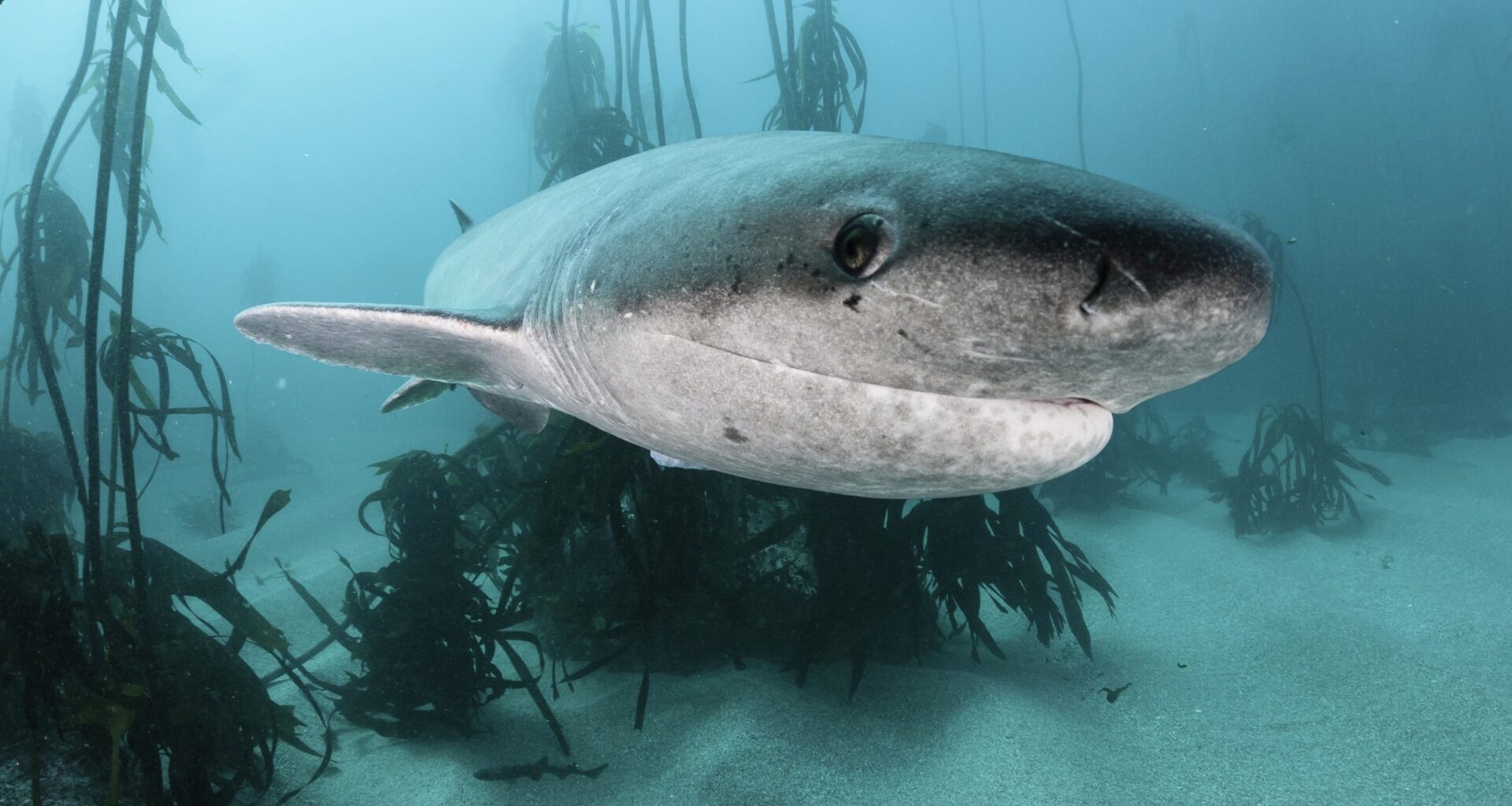
A new study has found that sharks fed on whales in the North Sea five million years ago, based on teeth fragments embedded inside fossilized whale skulls.
The finding shows that some sharks scavenged dead whales while others attacked more directly, revealing how these predators interacted with large prey in that ancient sea.
Shark teeth inside whale bones

Two fossil whale skulls from northern Belgium preserved the kind of evidence fossil bite marks almost never keep: broken pieces of the sharks themselves.
Analyzing the skills, Olivier Lambert at the Royal Belgian Institute of Natural Sciences (RBINS) matched the trapped fragments to two different sharks.
This allowed the fossils to do more than confirm feeding – they also linked each wound to a likely predator millions of years later.
What the bones preserve, however, still leaves an open question about whether both encounters began with a hunt or ended with scavenging.
Sharks fed on dead whales
On the smaller right whale skull, the deepest grooves sit high on the back of the head, not underneath.
Because a sixgill’s lower teeth would meet bone from below, those high grooves fit a whale already rolled over.
Modern whale carcasses can float, sink, and sometimes rise again as gases build, which makes belly-up scavenging plausible.
“The position of the bite marks in the upper part of the right whale skull tells us that the animal had probably already died when the shark scavenged its carcasses and that it was in a belly-up position, which is common for deceased whales,” said Lambert.
Evidence of active shark attacks
Far different damage marked the skull of a young whale related to today’s belugas and narwhals.
Across the snout, several angled cuts lined up as though one shark clamped down and dragged its teeth sideways.
Deep at the back of the skull, a second fragment matched Carcharodon plicatilis, an extinct close relative of the great white.
Such damage suggests an attempt to tear off the head, not a light scrape after the soft tissue was gone.
How sharks tore whale flesh
Feeding on a large body takes cutting power, and modern sixgills use broad lower teeth in a twisting, sawing motion.
In the fossil right whale, that motion could explain the row of parallel grooves and the snapped tip left behind. The shark was likely Hexanchus griseus, a deep-water predator alive today but absent from the southern North Sea.
Identifying the biter matters because it ties a living shark to a feeding scene from an ocean it no longer visits.
Why sharks targeted a whale’s head
Head wounds dominated the second fossil, and that focus may not have been random after all.
Behind the snout, toothed whales carry the melon, a fat-filled sound-focusing organ in the forehead.
In living belugas, that tissue helps shape sound and sits above neck muscles and other rich soft tissue.
A predator biting there could reach both energy-rich fat and a weak point for separating the head from the body.
The North Sea was once full of whales
Five million years ago, the southern North Sea supported whales and sharks that would look out of place now.
One victim was a tiny right whale, Balaenella brachyrhynus, probably shorter than 16 feet – much smaller than modern right whales.
Another belonged to Casatia sp., a beluga relative probably under 11.5 feet long when it died.
Those smaller bodies still offered thick fat, slow movement, and floating remains that could attract a hungry shark.
Why sharks left the region
Later cooling and ecological change rearranged who lived in these waters and which predators had enough prey to stay.
If medium-sized whales thinned out, the southern North Sea could have lost the meals that kept large hunters around.
Today, the bluntnose sixgill and great white are not regular southern North Sea visitors, even though both persist elsewhere.
Even so, prey loss alone does not prove the change, but it gives paleontologists a concrete link worth testing.
A rare glimpse into large predators
Most fossil bites leave scratches or chips, but they do not leave the predator’s tooth buried in the bone.
Without that fragment, paleontologists often know something violent happened yet cannot name the shark or the victim.
“These whale skulls provide a rare glimpse into the relationship between large predators and their prey off the coast of Northern Europe 5 million years ago,” Lambert said.
Because embedded teeth are so rare, two partial skulls from Belgium can carry unusual weight in a much bigger ecological story.
Implications for the future
One skull hints at cleanup after death, while the other raises the stronger possibility of active predation.
Neither case closes the file completely, because sharks often scavenge and attack the same carcass at different stages.
Yet these fossils show that predator ranges follow prey, climate, and habitat over deep time – not just temperature alone.
Seen over millions of years, this fossil record sharpens today’s debate over whether future North Sea food webs could again welcome large sharks.
Ultimately, the skulls tell the story of a vanished coastline – a place where sharks bit whales, lost teeth, and left records inside bone.
More dated fossils from the North Sea could show when those prey animals faded, and whether the sharks disappeared soon after.
The study is published in the journal Acta Palaeontologica Polonica.
—–
Like what you read? Subscribe to our newsletter for engaging articles, exclusive content, and the latest updates.
Check us out on EarthSnap, a free app brought to you by Eric Ralls and Earth.com.
—–