
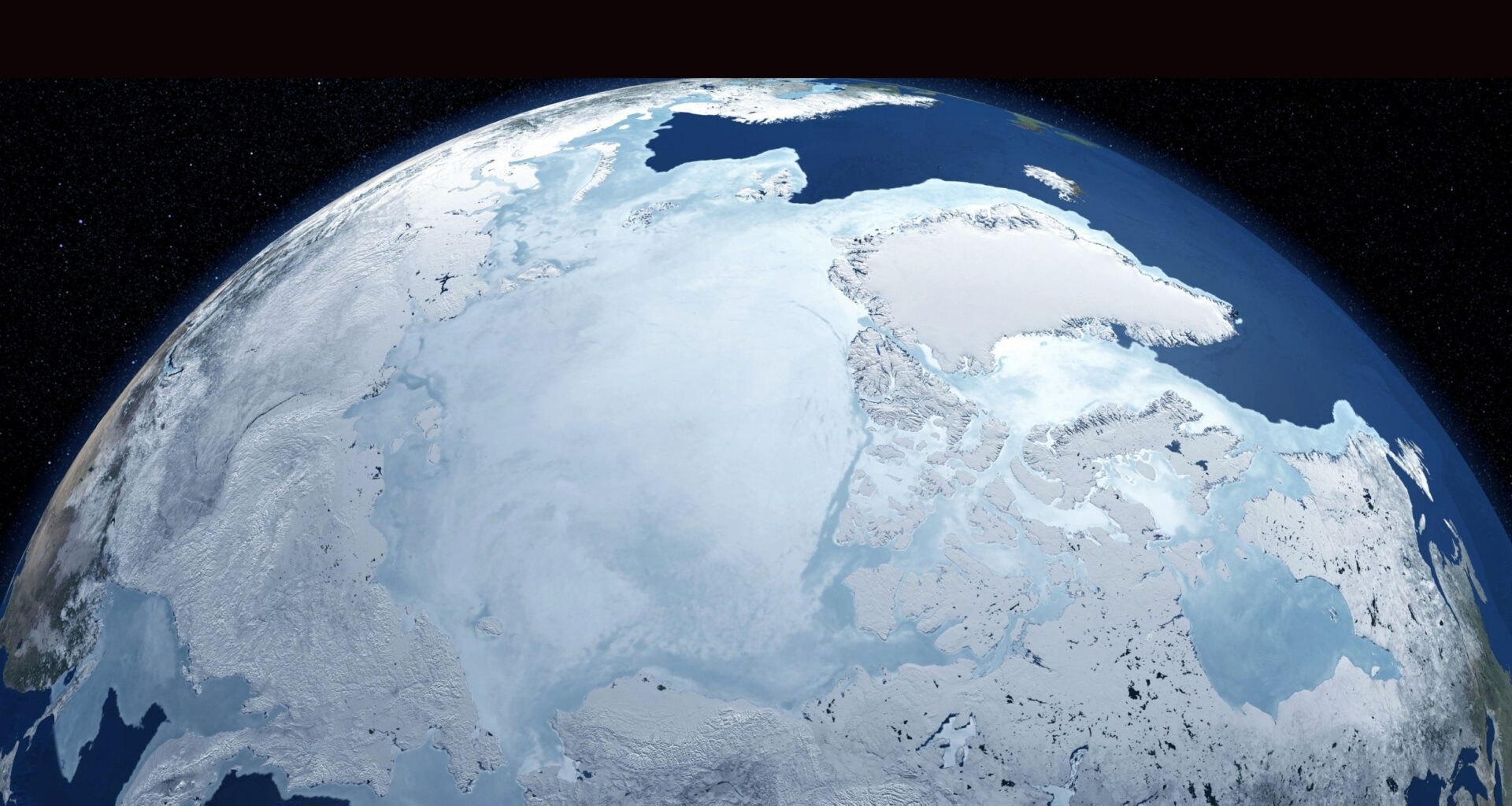
For more than a century, scientists have known that Earth wasn’t always the cooler, ice-capped planet we live on today.
As recently as three million years ago, temperatures and sea levels were higher – evidence that appears in everything from temperate forest fossils found in places like Alaska and Greenland to ancient beach lines along the U.S. Atlantic coast.

What has been harder to pin down is the “why.” What changed within the climate system to cool the planet over those millions of years?
Two new studies offer a rare, direct window into that mystery by reading the climate record stored in ancient Antarctic ice and the air trapped inside it.
The researchers show that Earth’s oceans cooled by about 2 to 2.5°C (3.6 to 4.5°F) over the last 3 million years, but that long-term cooling happened alongside only a modest decline in the heat-trapping greenhouse gases carbon dioxide and methane.
That combination is forcing scientists to think more carefully about what else was driving the planet’s slow shift toward colder conditions.
Searching for ancient Antarctic ice
The new work was led by scientists connected to the National Science Foundation Center for Oldest Ice Exploration (COLDEX). This large collaboration, headquartered at Oregon State University, is focused on finding and analyzing the oldest preserved ice on Earth.
The ice used in these studies comes from Allan Hills, near the edge of the East Antarctic Ice Sheet.
This is not a typical ice-core site where layers stack neatly year after year like a layer cake. Allan Hills is more like a place where old ice becomes stranded and deformed.
Ice flows from Antarctica’s interior toward the margins, and mountain ranges can disrupt those flows.
That process bends and twists what were once horizontal layers, making it difficult to recover one clean, continuous timeline. Instead, scientists get “snapshots” – chunks of ice that represent average conditions from specific time windows.
“Those snapshots extend climate records from ice much further than previously possible,” said COLDEX Director Ed Brook, a paleoclimatologist at Oregon State University.
He notes that these longer records aren’t just filling gaps – they’re raising new questions about how Earth’s climate evolved and how far back ice records can take us.
Tracking ancient ocean temperatures
One of the Nature papers, led by Sarah Shackleton – who was at Princeton University during the research – focused on tiny clues trapped inside ancient ice.
By analyzing the ratios of different noble gases preserved in the ice, the team uncovered a rare kind of evidence. Unlike many traditional methods, which reflect conditions at a single location, these gases capture changes in ocean temperature on a much broader scale.
“The noble gases in ice provide a unique way to look at ocean temperature change,” Shackleton said. “Other methods can give you information about ocean temperature at a single site, but this gives a more global view.”
Using these measurements, the researchers found that mean ocean temperature declined by about 2 to 2.5°C (3.6 to 4.5°F) over the past 3 million years. It wasn’t a sudden drop – but even gradual cooling of that magnitude represents a major shift when averaged across the entire ocean.
Earth’s ocean cooling was out of sync
The findings also reveal a more subtle but important pattern. The timing of ocean cooling did not unfold evenly between surface waters and the deep ocean.
Surface temperature records have long suggested a steady cooling trend that continued until around one million years ago. But the noble-gas data tell a different story.
According to the study, a large portion of the ocean’s overall cooling began much earlier – around three million years ago – and continued for roughly a million years. This period coincides with the formation of major ice sheets in the Northern Hemisphere.
That mismatch points to a deeper shift in how heat moved through the oceans. Rather than cooling uniformly, changes in ocean circulation and heat transfer likely altered how energy flowed between surface and deep waters.
This shift represents a key piece of the climate puzzle that researchers are now working to understand.
Ice shows ancient greenhouse gases
The second Nature study, led by Julia Marks-Peterson, a doctoral student at Oregon State University, turned to a different kind of evidence – the air itself.
By analyzing bubbles trapped inside the ice, the team made the first direct measurements of carbon dioxide and methane from samples dating back millions of years.
The results offer a striking headline: carbon dioxide levels appear to have remained below 300 parts per million throughout the entire three-million-year period.
Around 2.7 million years ago, CO2 levels were near 250 ppm. From there, they declined slightly – by about 20 ppm – until roughly one million years ago. Methane showed even less variation, holding steady at around 500 parts per billion over the long term.
Today’s atmosphere stands apart
The study also puts modern greenhouse gas levels in context, and the contrast is stark. According to NOAA, carbon dioxide averaged about 425 ppm in 2025, and methane averaged about 1,935 ppb in 2025.
Those numbers aren’t just higher than the three-million-year range suggested by the ice. They’re dramatically higher, and they’ve risen rapidly over roughly two centuries.
Whatever the exact drivers were behind Earth’s slow cooling over millions of years, today’s greenhouse gas levels sit in a different zone entirely.
Hidden forces behind Earth cooling
The researchers aren’t saying greenhouse gases don’t matter. CO2 and methane remain core drivers of Earth’s energy balance.
But if Earth cooled while those gases only declined modestly, other pieces of the climate system had to be doing heavy lifting too.
The studies point to likely contributors such as Earth’s reflectivity (albedo), changes in vegetation and ice cover, and ocean circulation.
If expanding ice sheets reflected more sunlight, that would amplify cooling, while shifts in ocean currents could change how heat is stored and transported. Changes in vegetation patterns could also play a role by affecting both Earth’s reflectivity and the carbon cycle.
“Our hope is that this work will refine our view of past warmer climates and sharpen our understanding of how different elements of the Earth system interact,” Marks-Peterson said.
Extending Earth’s climate record
These two papers are a milestone, but they’re also a preview of what COLDEX is aiming for next.
Brook notes that researchers have already found ice as old as 6 million years at the bottom of one core, and they’re now working to develop data from those even older samples.
New drilling projects have also been completed that should reach additional ancient ice.
Meanwhile, researchers are refining methods for verifying carbon dioxide reconstructions, studying other gases, and determining what conditions allow very old ice to survive without melting, mixing, or deforming.
The simplest way to describe what’s happening is this: scientists are stretching the ice-core record deeper into time, and the deeper it goes, the more it challenges tidy explanations.
Earth’s last three million years of cooling may not be a story of greenhouse gases alone, but of a whole climate system – oceans, ice sheets, reflectivity, ecosystems, and circulation – that cooled together.
—–
Like what you read? Subscribe to our newsletter for engaging articles, exclusive content, and the latest updates.
Check us out on EarthSnap, a free app brought to you by Eric Ralls and Earth.com.
—–