
Scientists have solved a decades-old cosmic mystery: why the stars of the Small Magellanic Cloud refuse to behave normally. The answer, it turns out, is a catastrophic collision with a neighboring galaxy, one that is still reshaping everything astronomers thought they knew about this celestial landmark.
The Small Magellanic Cloud, or SMC, is one of the Milky Way’s closest galactic companions, visible to the naked eye from the Southern Hemisphere. For more than half a century, researchers have catalogued its stars, mapped its gas, and tracked its motion, yet one fundamental question persisted: why don’t its stars orbit the galactic center the way stars in virtually every other galaxy do?
New research published in The Astrophysical Journal by a University of Arizona team has delivered a dramatic answer. The SMC didn’t drift into disorder on its own. It was smashed.
The Collision That Scrambled Everything
The culprit is the Large Magellanic Cloud, the SMC’s larger companion galaxy. According to the study, the SMC passed directly through the LMC’s disk a few hundred million years ago, a direct collision with an impact parameter of roughly two kiloparsecs. The gravitational forces involved were violent enough to tear apart the SMC’s internal structure and scatter its stars into chaotic, disordered motion.
Lead author Himansh Rathore, a graduate student at Steward Observatory, described the scale of the transformation. “We are seeing a galaxy transforming in live action,” he said. “The SMC gives us a unique, front-row view of something very transformative of a process that is critical to how galaxies evolve.”
The research team used hydrodynamic computer simulations modeled on the known properties of both galaxies, their gas content, stellar mass, and positions relative to the Milky Way, to reconstruct what happened. In the simulations, a pre-collision SMC had a well-defined rotating stellar disk. Post-collision, that rotation was almost entirely destroyed. The ratio of peak rotation speed to velocity dispersion dropped below 0.2, consistent with what telescopes actually observe today.
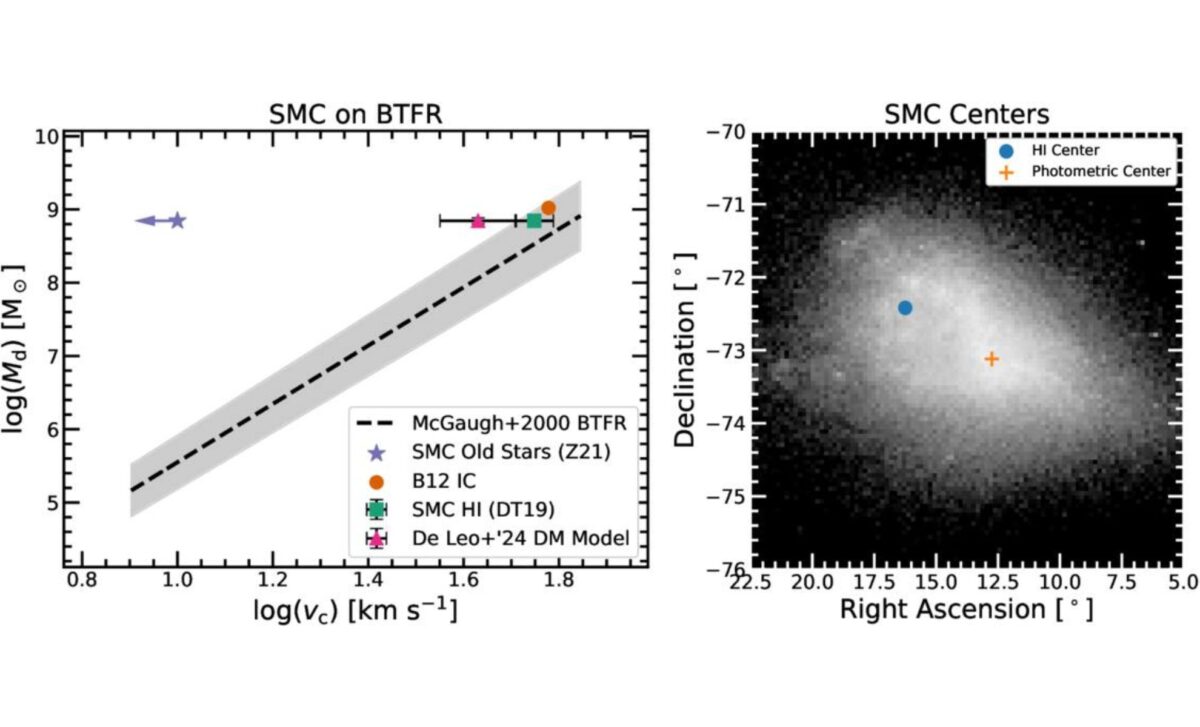 Misaligned Centers, Discrepant Kinematics The Smc’s Stellar And Gas Disequilibrium As Evidence Of A Recent Lmc Collision
© The Astrophysical Journal
The Illusion of Rotating Gas
Perhaps the study‘s most striking revelation involves the SMC’s gas, and a long-standing misinterpretation. For decades, radio telescope surveys detected a velocity gradient of 60 to 100 kilometers per second across the SMC’s gas, which astronomers interpreted as evidence of a rotating gas disk. That reading placed the SMC neatly on the Baryonic Tully-Fisher Relation, a standard benchmark linking galaxy mass to rotation speed.
The new analysis, according to the paper, shows that interpretation was an illusion of geometry. The collision stretched the SMC along a tidal tail, and gas moving toward and away from Earth along that elongated structure can appear to rotate when viewed from certain angles. The gas isn’t spinning, it’s flying outward.
A separate hydrodynamic mechanism made the gas disruption even more severe than what tidal forces alone could achieve. Senior author Gurtina Besla, an astronomy professor at Steward Observatory, explained that as the SMC punched through the LMC’s dense gas disk, the ram pressure, the force exerted by one gas medium moving through another, was more than an order of magnitude stronger than the SMC’s own gravitational restoring force.
Rathore illustrated the effect vividly: “Imagine sprinkling water droplets on your hand and moving it through the air — as the air rushes past, the droplets get blown off because of the pressure it exerts. Something similar happened to the SMC’s gas as it punched through the LMC,” The calculations suggest this ram pressure delivered an impulsive velocity kick of approximately 30 kilometers per second to the SMC’s gas, enough to wipe out any remnant rotation entirely.
A Benchmark Galaxy That May No Longer Benchmark
The findings carry implications that extend well beyond the Magellanic Clouds. For decades, the SMC’s small size, high gas content, and low abundance of heavy elements made it a go-to reference point for studying the kinds of primitive, gas-rich galaxies that populated the early universe. Researchers routinely used it as a calibration tool for understanding star formation rates, interstellar dust, and gas dynamics in low-metallicity environments.
That role is now in question. As Besla put it, “The SMC went through a catastrophic crash that injected a lot of energy into the system. It is not a ‘normal’ galaxy by any means.”
The paper further notes that standard mass-measurement methods, including rotation curve modeling and the virial theorem, can overestimate or underestimate the SMC’s actual enclosed mass by a factor of roughly two or more in the post-collision environment, making precision measurements of its dark matter profile unreliable by conventional approaches.
A companion study published by the same team in 2025 suggests an alternative path forward: the collision tilted the bar-shaped structure at the LMC’s center out of its galactic plane, and the degree of that tilt is mathematically tied to how much dark matter the SMC contains, offering a new, indirect method to probe a substance detected only through its gravitational influence. “We are used to thinking of astronomy as a snapshot in time,” Rathore said. “But these two galaxies have come very close together, gone right through one another, and transformed into something different.”