
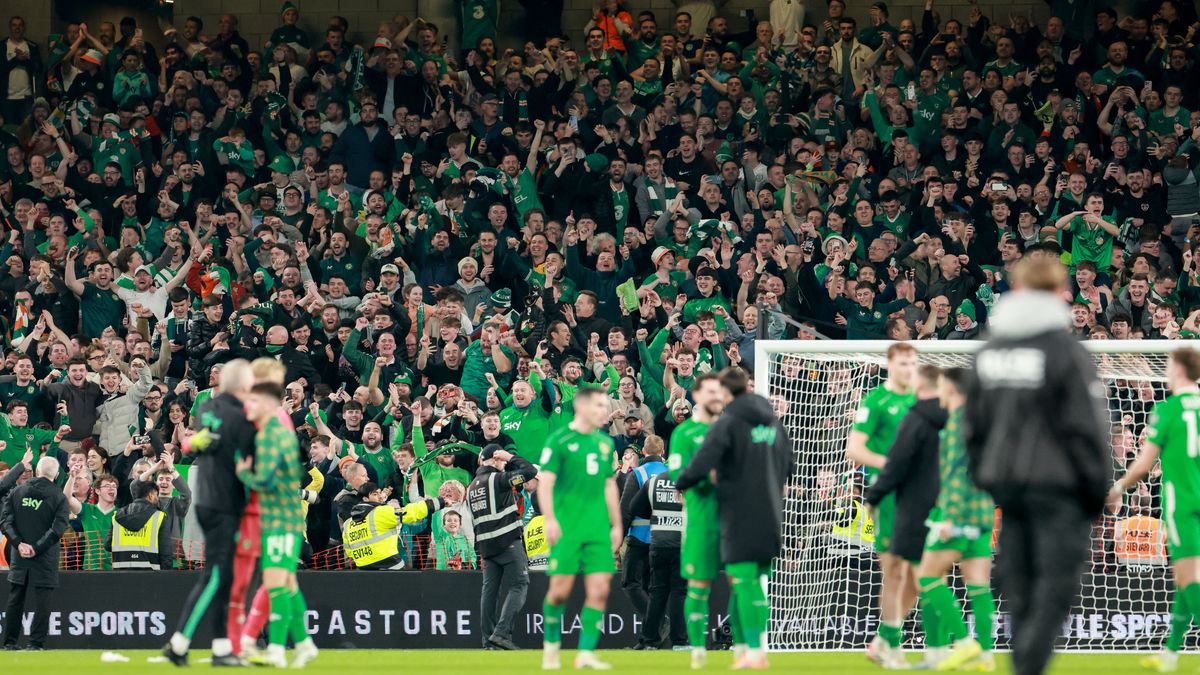
A World Cup play-off final at the Aviva Stadium against either Denmark or North Macedonia is the prize for Ireland on Thursday.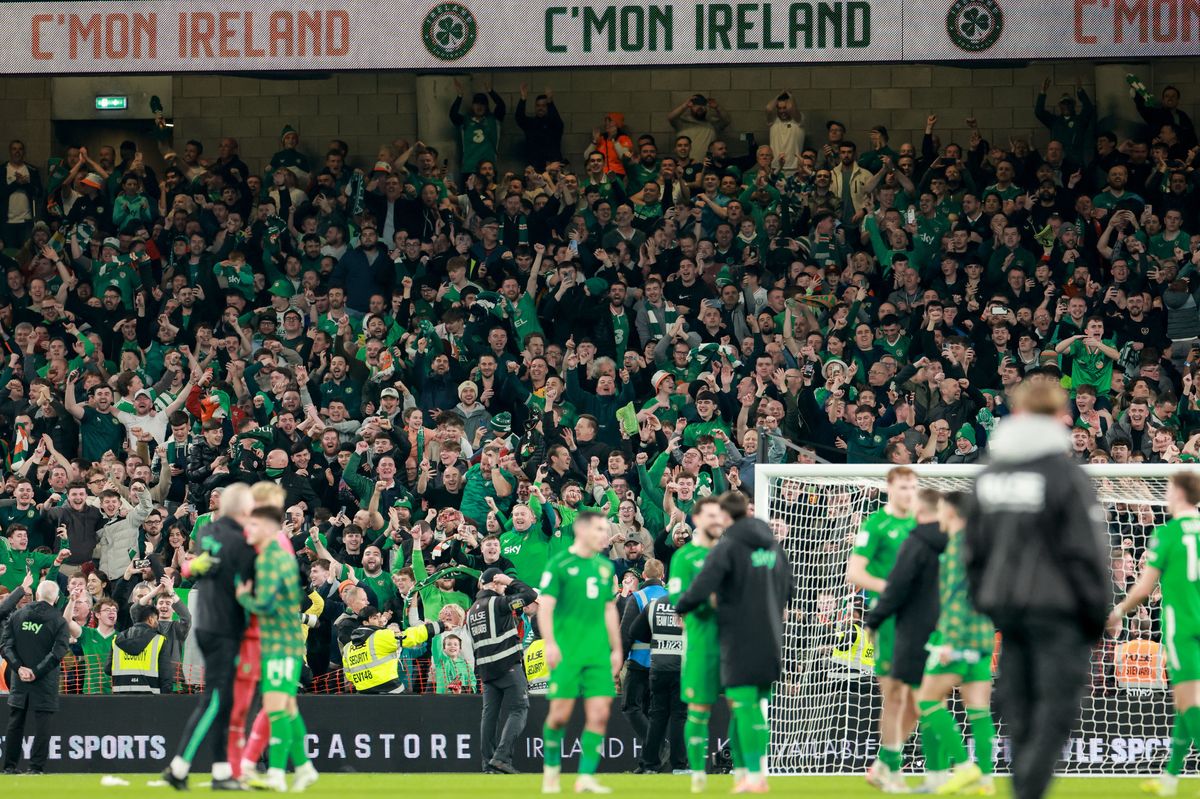
Ireland fans at the final whistle against Portugal(Image: INPHO/Morgan Treacy)
Ireland will be roared on by almost 99 percent of a sold out Aviva Stadium if they set up a World Cup play-off showdown against either Denmark or North Macedonia.
Both the Danes and Macedonian FAs have requested just 600 tickets for the game – meaning approximately 51,000 Irish fans will dwarf the travelling contingent.
Of course it all depends on Heimir Hallgrímsson’s men seeing off Czechia next Thursday.
But if they win in Prague, the Boys in Green boss will get his wish to pack the smaller north stand – usually reserved for visiting supporters – full of Irish fans.
“That [moving away fans from behind the goal] was a big problem, a big problem, because the access needs to be separate,” said Hallgrímsson.
“But luckily for us, both Denmark and Macedonia only requested 600 tickets so they would be in the corner and our fans would be behind the goal.
“At this game, we can move them from behind the goal and have our fans behind the goal.”
The reason for the tiny visiting allocation is because of the short time between the two semi-finals and the decider.
Hallgrímsson’s men were handed a huge potential advantage when the winners of the Czech/Ireland game were drawn as the home team in the play-off Path D final.
It means Danish and North Macedonian fans will be left scrambling for flights and accommodation after the outcome of the two matches next Thursday.
The Ireland boss acknowledged that it would be of a huge benefit for his side.
“Yeah, for me we should look at everything, every possible advantage to favour us in these moments,” he said.
“And if it comes to a penalty shoot-out, for example, in our home stadium and it looks like an away game [with visiting fans behind the goal], that would be shocking to have.
“It is something in the future they would promise us they would look at, but the ownership of the stadium is not just FAI, it is rugby as well, so it needs to change security routes etcetera, to make it happen.
“For this game, it would not affect much, but I would like them further up and further away as possible.”
If either game does go to penalties, Hallgrímsson plans to have a fair idea of the order of his takers in mind long before kick-off.
So when the squad meets this evening and tomorrow morning in Dublin, before Tuesday’s travel to Prague, players will be asked whether they fancy taking on the responsibility.
“Normally, the first day when we meet, if someone is not ready to take a penalty, I would like to know it now,” he said.
“There is no shame in that, if you don’t like to take a penalty. I don’t like to know that when it happens.
“Normally, we go with a list, one to 24 or 23, so we will rank in our mind and then we might tweak one or two, because once it happens, everybody is so high, it is difficult to focus at these moments.
“So, we will always have a list beforehand and then in game, think okay, maybe this one should be higher or lower. But it is always good to be prepared til the death.”
That doesn’t necessarily mean devoting any of their short time on the training pitch to practicing penalties, as Hallgrímsson doesn’t believe that “would be such an asset” for his players when “other things are more important.”
He spent some time last week with his predecessor Stephen Kenny discussing various issues, including the penalty shootout defeat to Slovakia in the Euro 2020 play-off.
Hallgrímsson also spoke about visualisation – and he can already see 51,000 Ireland fans dancing in the Aviva Stadium at the final whistle on Tuesday week.
“I haven’t prepared for anything else but that,” he insisted. “It is going to be huge, not just for this team, for the FAI, for Irish football, for everyone if we qualify. For so many reasons.
“It is such an opportunity for us to change how football is seen in this country if we qualify.
“Financially, for the Association, it will change a lot. For enthusiasm, for kids playing the game, it’s going to change a lot.
“For us as a team, maybe the biggest advantage for us as a team, if we qualify for the World Cup, we will stay together all of May, all of June and hopefully half of July, that’s two and half months together and that is the equivalent of two years of FIFA windows in one block.
“And just imagine what we can do in two years of FIFA windows, with the team, develop connections between players, knowing characters, doing things tactically.
“That’s one of the reasons one should qualify because it is always easier to qualify next because you have such a long period, working with the players and we can start thinking about fitness because we are club coaches for two months.
“So it just gives us as a team, so much chance to grow if we qualify.”
Want to see more of the stories you love from the Irish Mirror? Making us your preferred source on Google means you’ll get more of our exclusives, top stories and must-read content straight away. To add Irish Mirror as a preferred source, simply click here.