
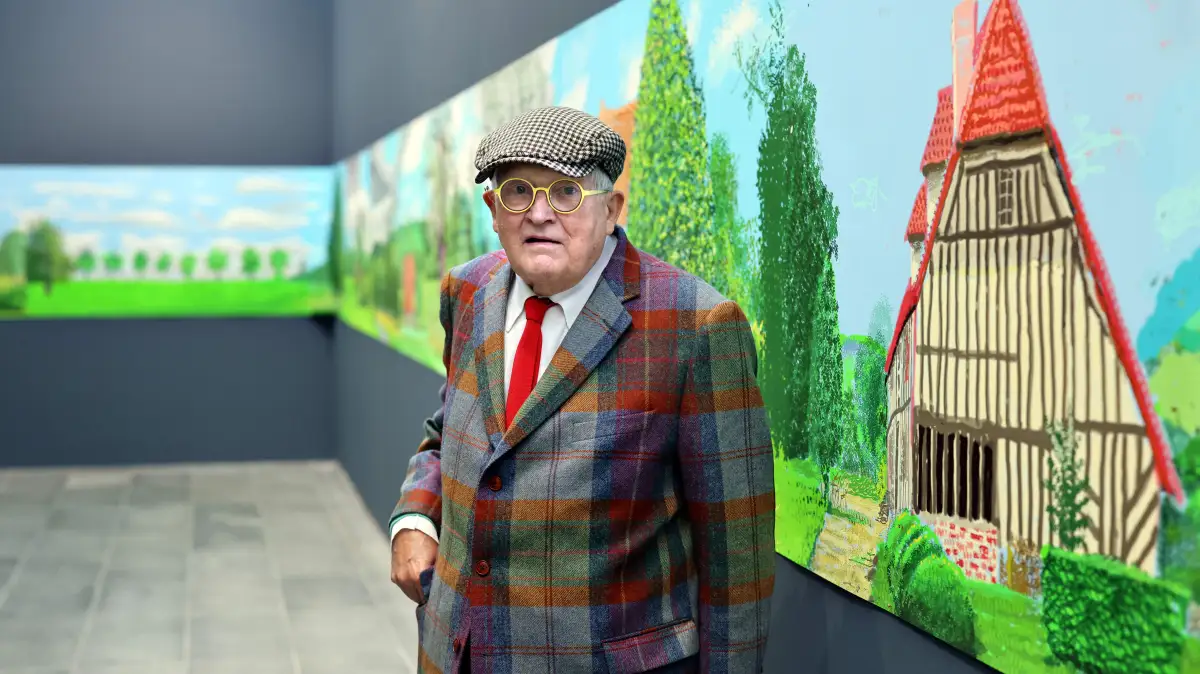
Hockneyland spreads far beyond any museum walls. On a cool, bright March morning, as I walk through Hyde Park in London past pollarded trees, much budding and detonations of white blossom over acid-green grass, the influence of the art inside the Serpentine North Gallery seems to have extended outside in every direction.
These days David Hockney, 88, is shrouded in the brightest of tweeds, looking out through canary-yellow spectacles, presently recovering from an infection and often in a wheelchair. Illness has prevented him from appearing in person at the opening of his new show, A Year in Normandie and Some Other Thoughts About Painting. But after I send him some questions, he replies over Zoom from his studio in Kensington, full of life and entirely undimmed.
I have known him on and off for two decades and have spent time with him in his beloved Yorkshire and at his London studio, and I can report that his mind remains extraordinarily curious, lucid and ambitious. Within minutes of my asking him about Picasso in old age, he sends me a recording of his lecture on the subject at the Guggenheim Museum, New York, in April 1984.
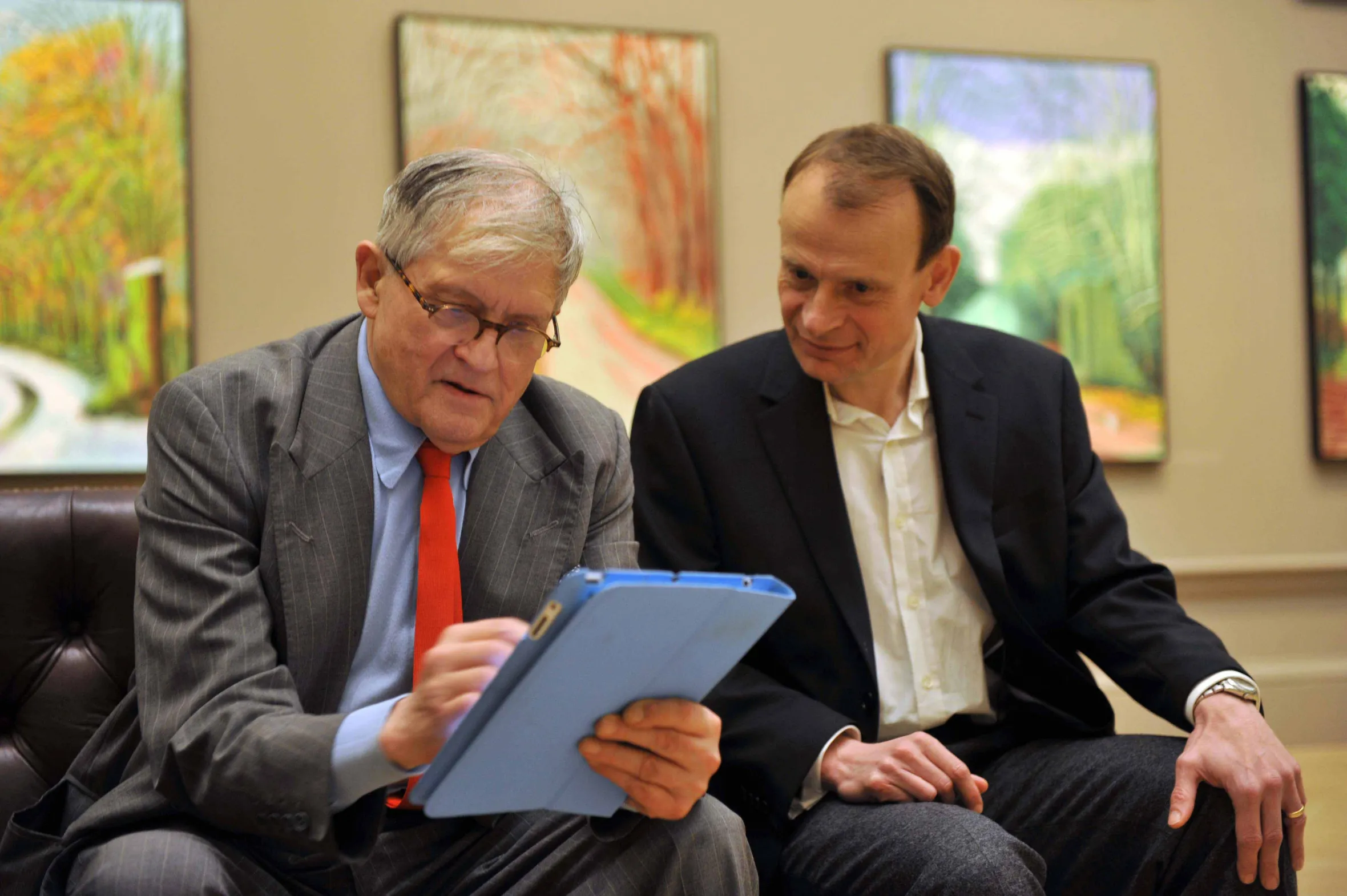 Hockney with Andrew Marr in 2012JEFF OVERS/BBC
He reads more widely than an autodidact half a century younger. When I last saw him, in the winter, surrounded by new paintings, he talked with great excitement about the Russian theologian, philosopher and mathematician Pavel Florensky, before the conversation spiralled on to Giotto, Vermeer, Caravaggio, Rubens and Picasso in old age.
At one point, when we talked about his designs for Stravinsky’s opera The Rake’s Progress, made for Glyndebourne in 1975 and still going strong, Hockney sang an aria straight through.
Later he recalled the time and place he had heard of Picasso’s death: April 8, 1973, while driving to see Jean Renoir, the film-maker, at his home in Beverly Hills. When Hockney told him the news, Renoir was silent for a moment before saying: “What a very un-Picasso thing to do.”
Picasso has always been important to Hockney, and in old age they share a lot of similarities. In his late eighties and early nineties Picasso produced a sunburst of work, a frantic outpouring of nudes, quotations and variations on the old masters, and musketeers who seemed to come from the rock music culture emerging around him. The point is, there was nothing “old” in the work. It was, if anything, even more ambitious than before.
I would say that Hockney, too, remains as ambitious as ever; deeply interested in perspective, in the relationship between photography and painting, in the latest technologies and in the philosophy of seeing. And it is not purely cerebral. When we spoke, he was also attentive to the different qualities of slow and fast-drying acrylic paint.
Cubistic assemblages of photographs; films taken on cameras mounted on racks in front of a car; the works on iPads; the use of fax machines; insights from Chinese art … All his working life he has wanted to expand and probe the meaning of picture-making. And to that extent, at 88, nothing has changed. Except perhaps a more forthright proclamation of the importance of representative painting against abstraction. “There’s much too much abstract painting being done now,” he tells me.
The new show contains a few images of abstract paintings resting on reverse-perspective tablecloths. One of them represents a Rothko. “I did that because they made a book of Rothko’s paintings and when you see a whole book … Well, Francis Bacon said when he committed suicide, ‘I’m surprised it took so long.’”
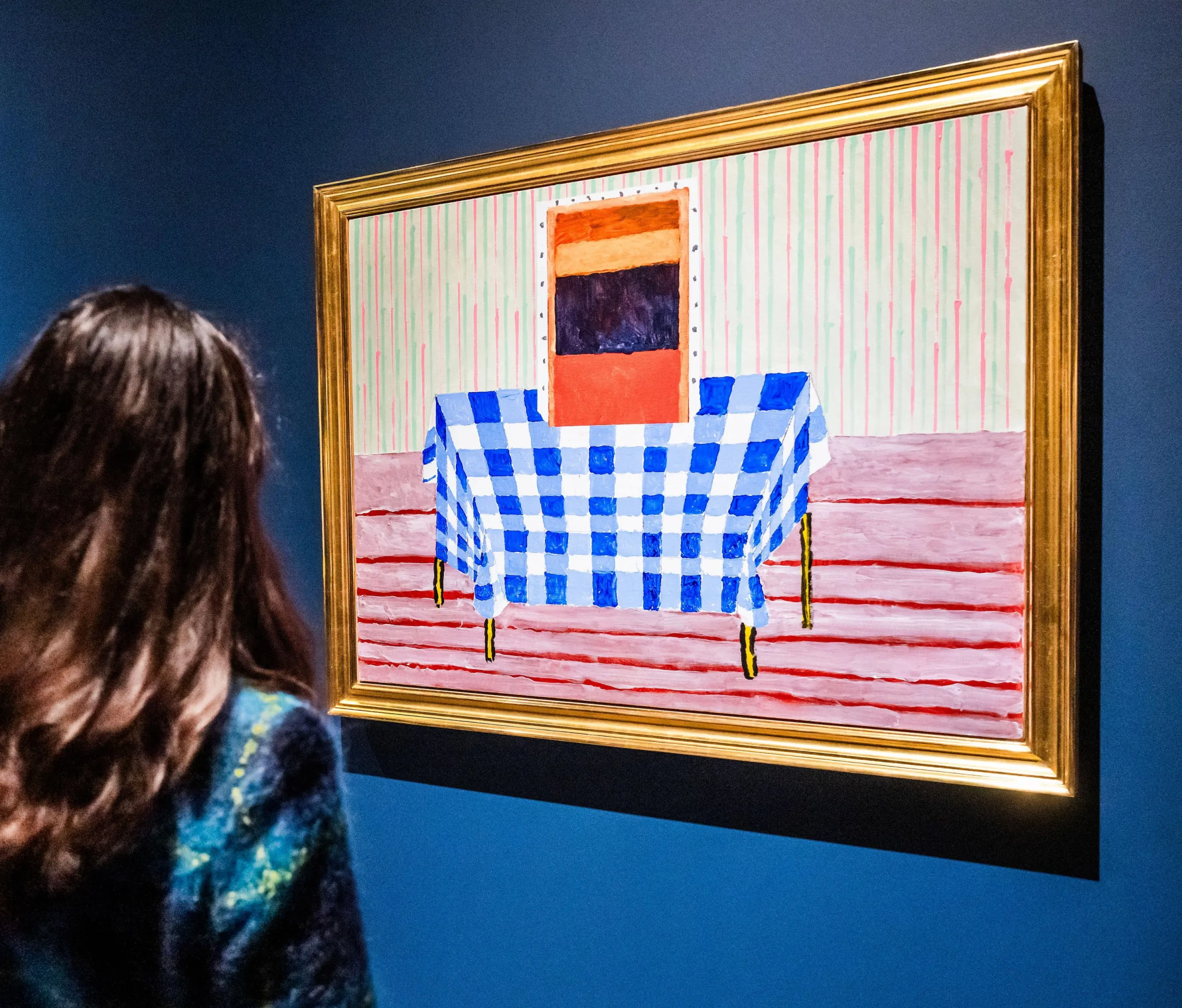 Another Abstraction Resting on a Blue and White Checkered Tablecloth, 2025Guy Bell/Alamy
Photography, Hockney says, “can’t replace painting at all, but painting has to be of something”.
Which takes us straight back to the exhibition. The first thing to say to any art-lover reading this article is that, honestly, you haven’t been to a show like this one. Around four sides of the gallery, in a flowing frieze, are printed iPad drawings of the garden around his Normandy house in 2019. The work is about 90m long and took me 150 slow paces to cover. Initially I thought it was made up of projections on the wall, but in fact it is composed of paper and cleverly lit.
Soon the pandemic was beginning to stalk France and Hockney was isolated in his farmhouse with two friends. He found this a curious blessing: “I could plan much more ahead because nobody was coming … If anybody came to see me, the day was gone, really, because I would talk to them, whereas with this I could plan what I was going to do ahead of time.”
He had long wanted to respond to the nearby Bayeux Tapestry. “It has no shadows and no reflections and that is like a Chinese or Japanese scroll.’’ And, indeed, this work is almost shadowless, pinging with pure colour.
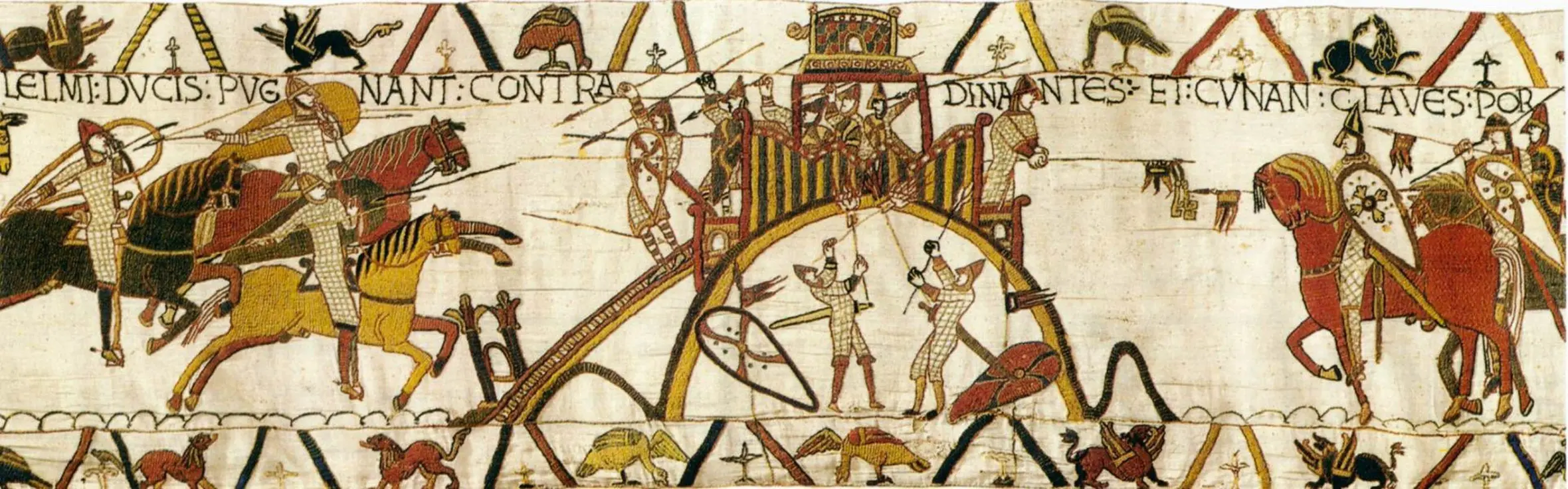 The Bayeux Tapestry (detail)Alamy
It begins with spare, bare January or February, with the coldest of chill greens in streaks, leafless trees and white skies. As you pace along, spring arrives and then erupts; then comes, in ever greater profusion and colour, the excitement and richness of summer and autumn, before we return to heavy rain, falling leaves, snow — and more or less where we started.
The radicalism of the project is difficult to explain in words, as art should be. In the ordinary world we walk through a landscape. In a conventional gallery we can stand in front of a painting and look at it. What we can’t do is walk through a landscape, watching it change with the seasons — that would be an impossibly accelerated journey at a speed unthinkable for human bipeds.
But, Hockney proposes, art can do it for us. As with his Californian mountain driving pictures, he is taking us on a trip that other forms of travel cannot match. And this is highly emotional: as the year strides towards fecundity and decay, the rhythm of the colour and the detail become more intense. As you walk, you can feel your heart rate rising.
All this is achieved with remarkably few motifs (Picasso also reduced motifs to essentials in his late art): trees, red-roof farm buildings, a treehouse, a half-timbered farmhouse, flowers, rain, a bubbling stream. There are no human figures — Covid, and his two companions are off buying food at the local market. The only faint indications of human activity are a road, hay bales, Hockney’s signature stacks of cut logs and an eloquent lonely metal chair.
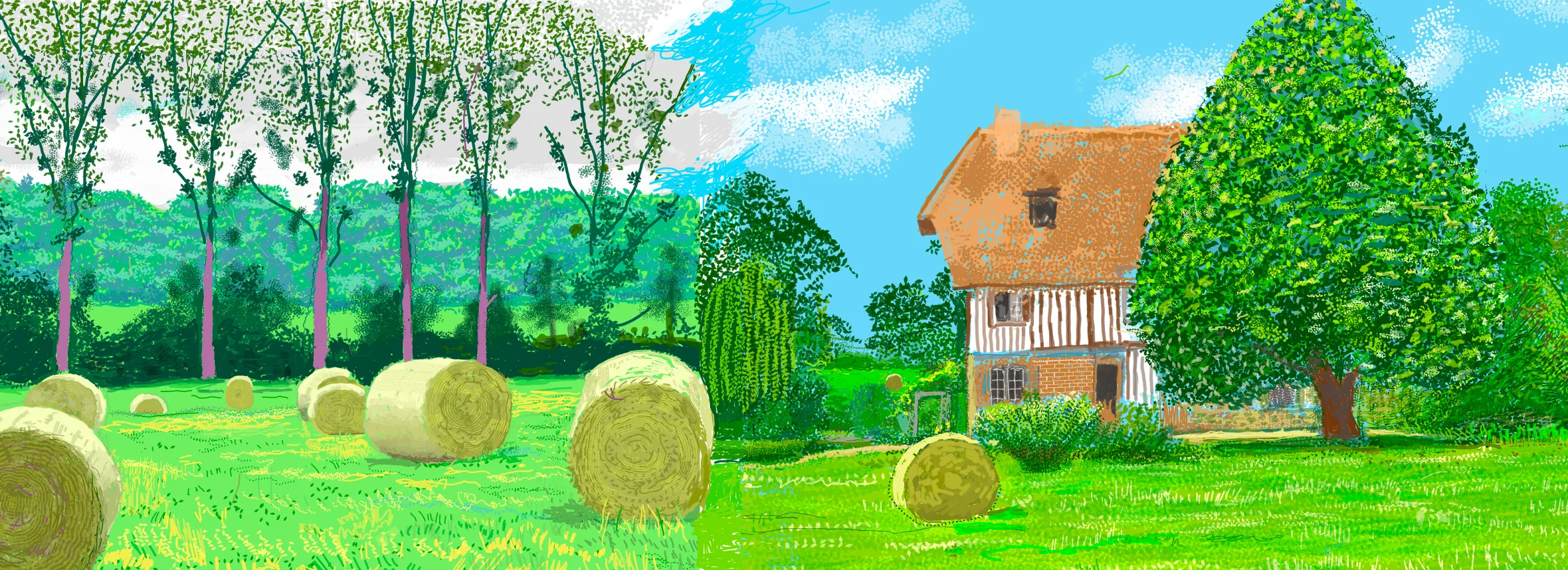 Hockney’s A Year in Normandie, 2020-2021 (detail) © David Hockney
The Bayeux Tapestry, made in the 11th century, probably in southern England, is made of coloured woollen embroidery on a linen background. It is coming to the British Museum in London from September 2026, and Hockney’s work is clearly meant to be in conversation with that great account of the Norman invasion. In January, in one of those robust public interventions he usually reserves for a defence of smoking, he said it was “madness” to risk damaging the tapestry on its journey to the museum.
Hockney’s work is about the same length (the Bayeux Tapestry is 70m long), but seems in many ways the anti-Bayeux. Although the natural world occurs frequently in the older work, it is really about war, power, authority and death; Hockney’s answer is about unchanging natural rhythms and the life force. He confirms to me that this is an intentional response: “There is no war or death in my picture.” In his oft-repeated war cry, “Remember, they can’t cancel the spring,” he can sound political in an anarchistic way, but this work is about as uninterested in power and politics as it is possible to be.
In the middle of the gallery, set apart from the frieze, is a series of paintings centred on reverse-perspective chequered tablecloths: five portraits and five still lifes. They include some of the most loving portraits Hockney has made in recent years and those playful references to abstract art, not only Rothko but Richter and Hockney himself, as alternative portrait subjects.
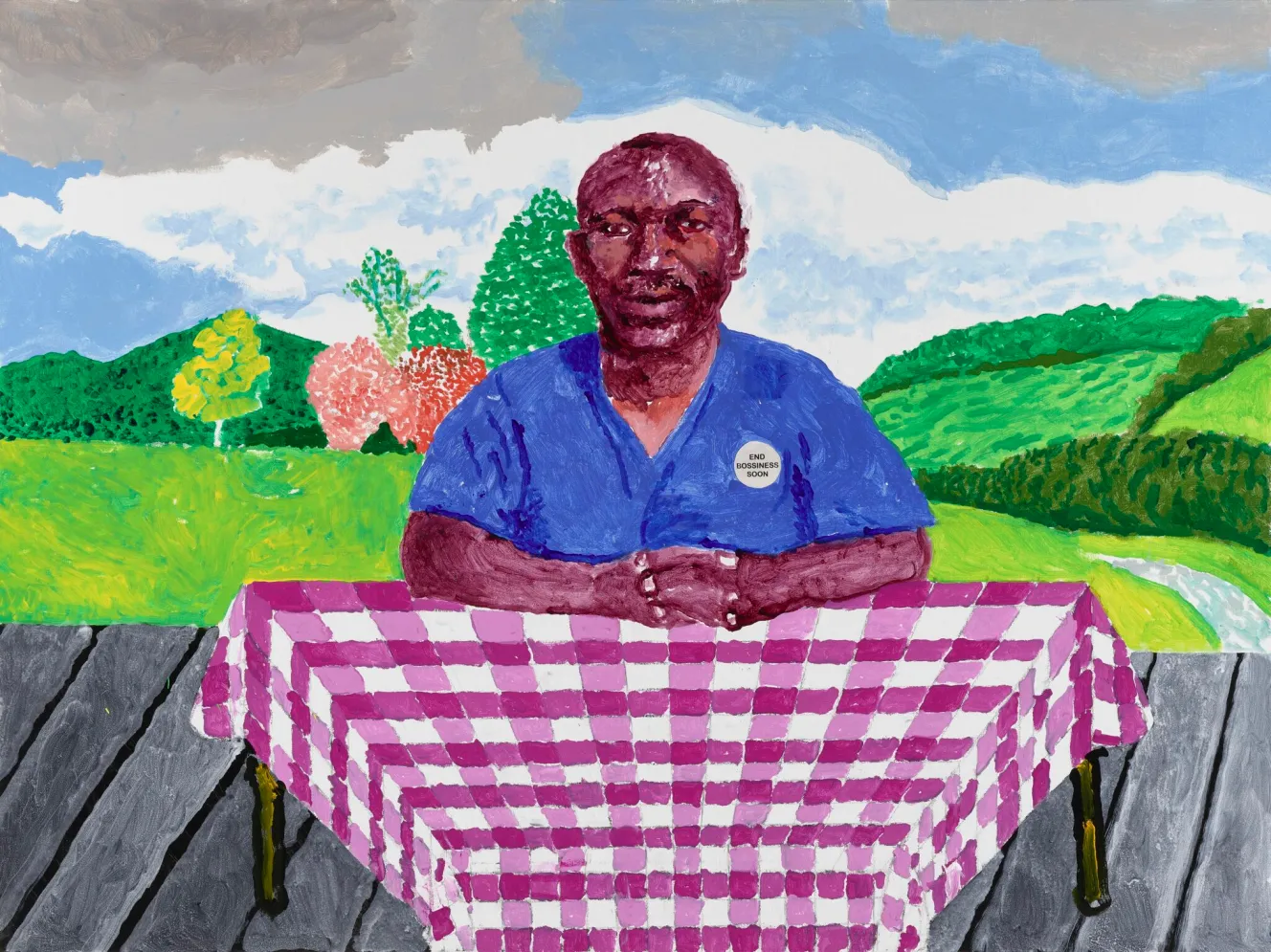 Thomas Mupfupi Resting on a Pink and White Checkered Tablecloth, 2025© David Hockney
In these we see his most recent form of brushwork, a kind of stippling or dotting that at first I found disconcerting but thought perhaps came from his iPad experiences — digital art teaching elderly fingers new ways of working. He agrees: “Yes it is, I think, because I put a colour down first and then I put more on it even when it is wet — the iPad of course is dry on dry. These marks are a bit different, I know.”
And here, surely, is what we should be celebrating: not just the ambition to make a show unlike any previous one but the newness Hockney searches for — that quiet, thrawn determination not to repeat old tricks.
After every recent big show, from the giant Royal Academy display of paintings and digital art from Bridlington to the Louis Vuitton retrospective in Paris last year and the Annely Juda exhibition in November, critics and admirers quietly shake their heads and say, this will be the last. It can’t go on.
Well, he may have been feeling a bit rotten recently, but inside he continues to blaze. He is well aware of the late-Picasso comparison and has been thinking about it since that lecture in 1984. As he says, Picasso kept up figurative painting when it wasn’t fashionable. Even at the time of Hockney’s lecture, “nobody wanted to hear about it then, because abstraction reigned”.
But artistic fashion, like the seasons, keeps turning. This won’t be the last we hear from him. He can go on. Thank God.
David Hockney: A Year in Normandie and Some Other Thoughts About Painting, Serpentine North Gallery, London, to Aug 23
Which exhibitions are you going to see this month? Let us know in the comments below