
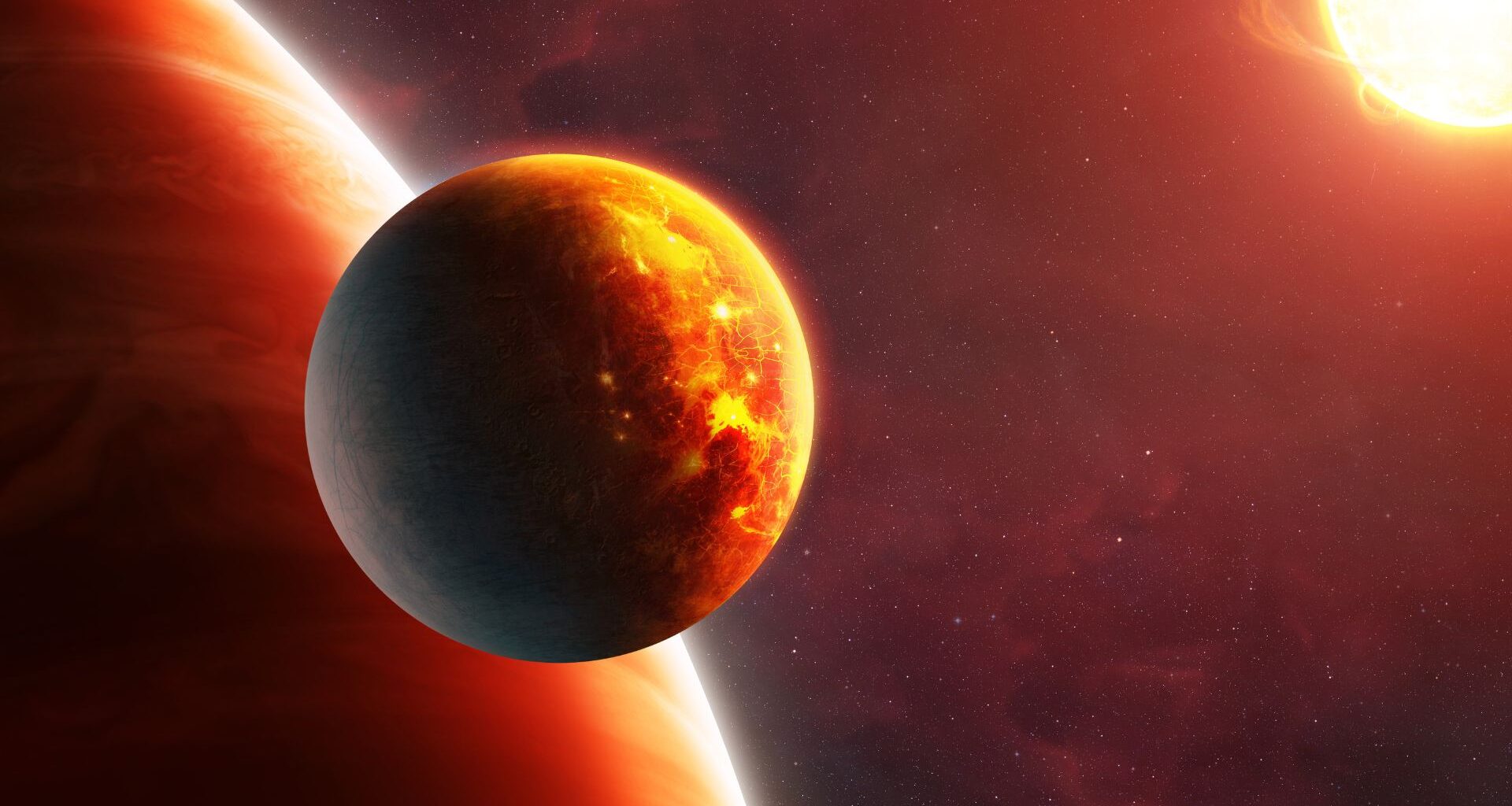
A new study led by researchers at the Max Planck Institute for Extraterrestrial Physics and Giulia Roccetti of the European Space Agency suggests rogue planets may host habitable moons.
The team found that thick hydrogen atmospheres can trap tidal heat, keeping surfaces warm enough for liquid water for up to 4.3 billion years.
Unlike CO₂-based models, these atmospheres avoid collapse. Combined with tidal-driven wet–dry cycles and ammonia-rich chemistry, such environments could support early life processes—even without any starlight.
“We find that such atmospheres can effectively trap heat via collision-induced absorption of H2, maintaining surface temperatures suitable for liquid water for time-scales of up to 4.3 Gyr, depending on the surface pressure, while not prone to condensation-induced collapse,” said researchers in the study abstract.
Rogue moon habitats
Astronomers have identified hundreds of exoplanets drifting through interstellar space, many likely ejected from their parent systems by past gravitational interactions.
While these rogue planets are expected to be cold and dark, their moons may follow a different path. During ejection, a moon’s orbit can become highly elongated, generating strong tidal forces as it is repeatedly stretched and compressed by its host planet. Similar to Europa and Enceladus, this process can produce significant internal heat, reports Phys.org.
If a moon’s atmosphere allows gases to condense, much of this heat would escape into space. However, in dense, hydrogen-dominated atmospheres, heat retention can increase. Under high pressure, hydrogen molecules absorb infrared radiation through collision-induced absorption, where temporary molecular complexes form during collisions.
These complexes enhance heat absorption, comparable to greenhouse gases like carbon dioxide and methane. As a result, internal heat could be trapped efficiently without atmospheric collapse. Researchers say such moons could maintain surface temperatures high enough for liquid water without requiring energy from a nearby star, although detecting and analysing such atmospheres remains challenging.
Hidden ocean worlds
The new study suggests that moons orbiting rogue exoplanets could sustain habitable conditions for billions of years—despite the absence of any nearby star. The research highlights the role of dense, hydrogen-rich atmospheres in trapping internal heat.
Using advanced simulations, the team modeled how a moon’s orbit and atmosphere evolve after its host planet is ejected into interstellar space. Their approach combined atmospheric temperature calculations with chemical processes such as condensation, alongside updated models of orbital evolution that account for declining tidal heating over time.
Rogue planets—many of which have already been detected drifting through space—are thought to have been expelled from their original systems through gravitational interactions. While these planets are expected to be extremely cold, their moons may experience intense tidal heating if their orbits become highly elongated. Similar processes are observed on Europa and Enceladus, where gravitational forces generate internal heat, reports Phys.org.
The study finds that thick hydrogen atmospheres, potentially up to 100 times Earth’s surface pressure, can efficiently trap this heat through collision-induced absorption. Under such conditions, temporary molecular interactions enhance infrared absorption, allowing heat to be retained far more effectively than in carbon dioxide–dominated atmospheres, which are prone to collapse.
As a result, some of these moons could maintain surface temperatures suitable for liquid water for up to 4.3 billion years. The presence of gases such as methane, ammonia, and water vapor may further stabilize these environments, significantly extending the potential window for habitability.
“Wet-dry cycling caused by the strong tides together with the alkalinity of dissolved NH3 could create favourable conditions for RNA polymerisation and thus support the emergence of life,” said the team in the research abstract.