
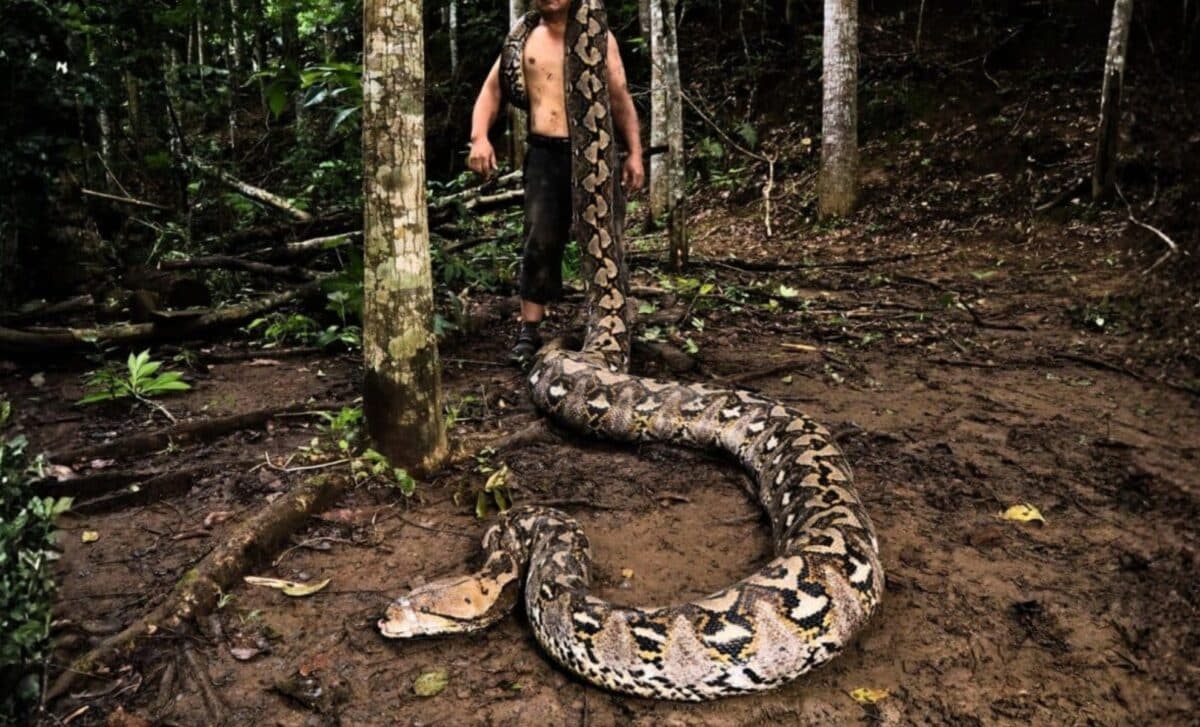
By the time word spread through the Maros region of South Sulawesi, the snake already had the kind of reputation that usually ends badly. She was enormous, female, and close enough to people to become a target. In Indonesia, pythons that large are often killed, sold, or vanish before anyone can do more than swap estimates about their size.
So when local conservationist Budi Purwanto moved to secure the animal, the urgency was not about fame. It was about keeping a rare snake alive long enough for someone to see what was really there. Photographer Radu Frentiu and wildlife guide Diaz Nugraha then traveled to Sulawesi after hearing rumors of an outsized python, knowing that if they waited, the chance to document her might disappear.
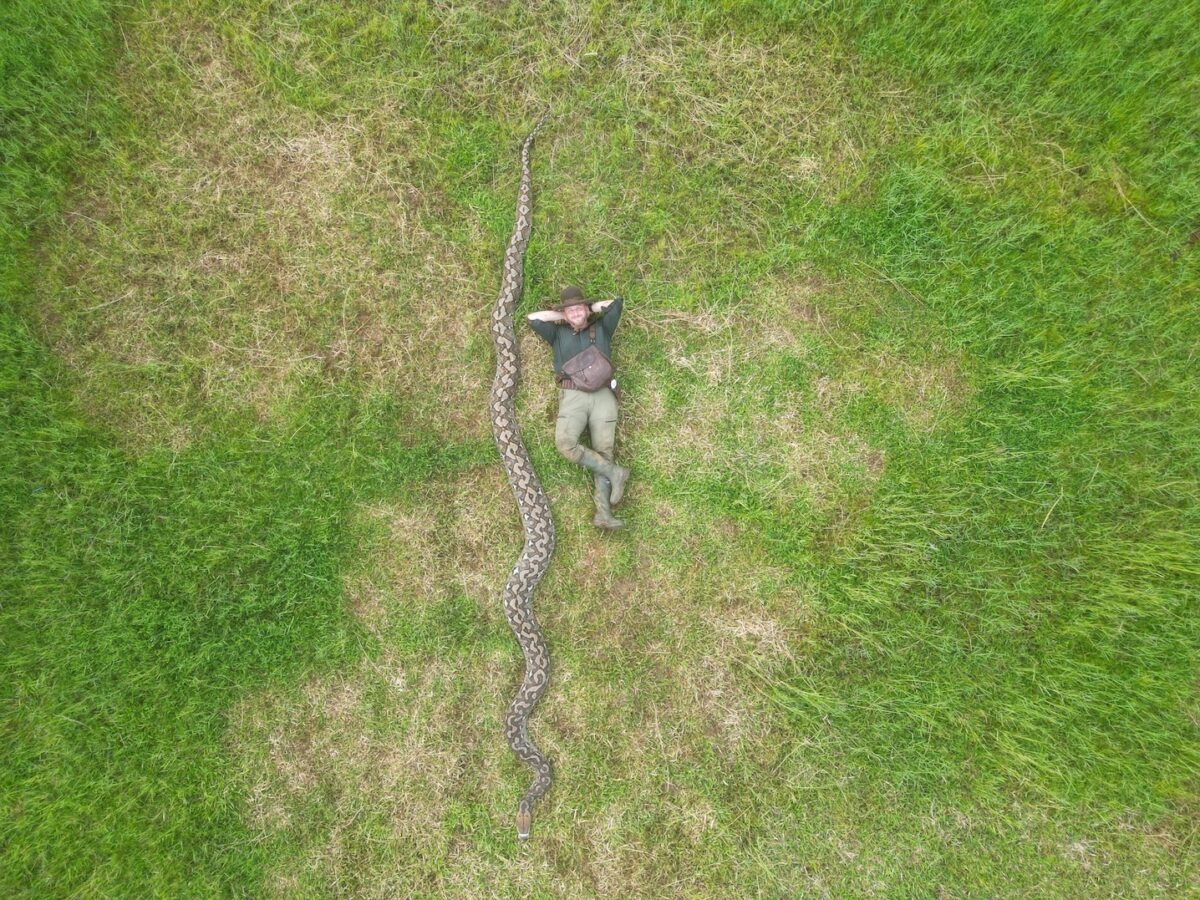 Photographer Radu Frentiu documented, weighed and measured the giant snake Ibu Baron. For this photo of himself with Ibu Baron, he used a drone for better perspective due to the snake’s enormous size. Credit: Radu Frentiu, Diaz Nugraha
What they found was Ibu Baron, or “The Baroness,” a female reticulated python that Guinness World Records later accepted as the longest wild snake ever formally measured. On January 18, 2026, using a surveyor’s tape and recording the process with photos and video, the team measured her at 7.22 meters, or 23 feet 8 inches, from head to tail tip. She also weighed 96.5 kilograms, about 213 pounds, despite not having recently eaten.
The Animal Was Real Long Before the Record Was
Reticulated pythons already hold the title of the world’s longest snake species, but that does not make record claims easy to prove. Reports of bigger snakes have circulated for decades, including accounts of animals said to be 10 meters long, yet many of those stories rest on secondhand descriptions or specimens that were never measured in a documented way. The difference in this case was not just size, but evidence.
That point matters because giant snakes tend to attract attention for the wrong reasons. Frentiu told National Geographic that such animals often disappear after they are found, either because they are treated as status symbols or because “something bad happens to them.” Ibu Baron’s survival long enough to be weighed, filmed, and measured is what pushed her out of rumor and into the record books.
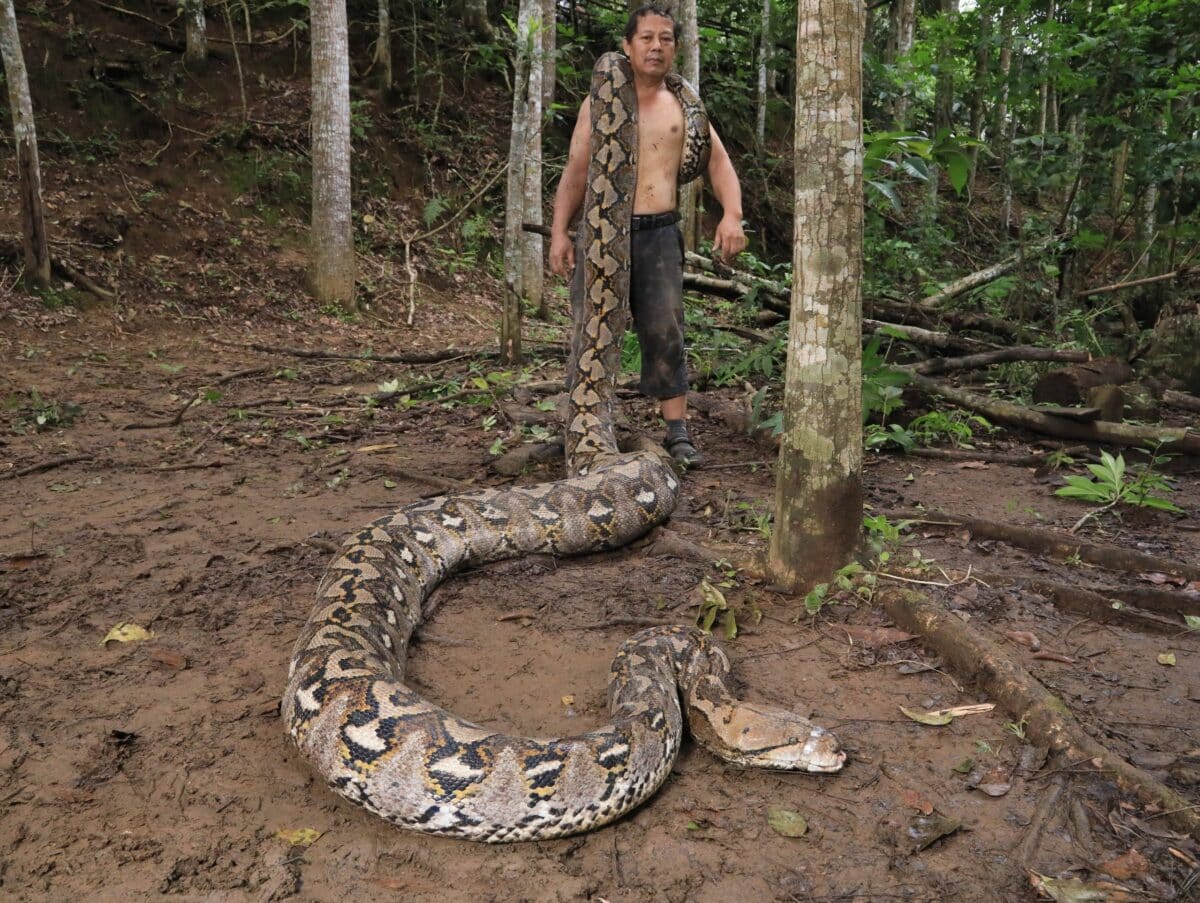 Snake rescuer Budi Purwanto runs a shelter for rescued pythons. He saved the record-breaking snake Ibu Baron, a name which means “The Baroness,” and is currently caring for her. Credit: Radu Frentiu, Diaz Nugraha
The measurement itself was deliberately conservative. The tape followed the snake’s natural curves while she was awake, not sedated and stretched. Guinness noted that under anesthesia, when a snake’s muscles fully relax, she could be at least 10 percent longer, putting her closer to 7.9 meters, or about 26 feet, though the organization said animals should only be anesthetized for safety or medical reasons, not to chase a record. National Geographic reported a similar estimate from Frentiu, who said sedation could add 10 to 15 percent.
Eight People, a Canvas Sack, and a Rice Scale
Part of what gives the story force is how physical the documentation was. Ibu Baron was weighed in a large canvas sack on scales normally used for bags of rice. At least eight people were needed to handle her safely for group photos after the measurement. Even in still images, the snake’s bulk is hard to miss.
Frentiu described the animal less as a long line than as concentrated force, saying each coil seemed to work like its own “powerhouse.” He also said the snake was large enough to swallow at least a calf, if not an adult cow, a way of translating the animal’s scale into something more concrete than a number on a tape. Guinness made the same point in its own way, noting that her measured length would nearly span the width of a standard FIFA goal.
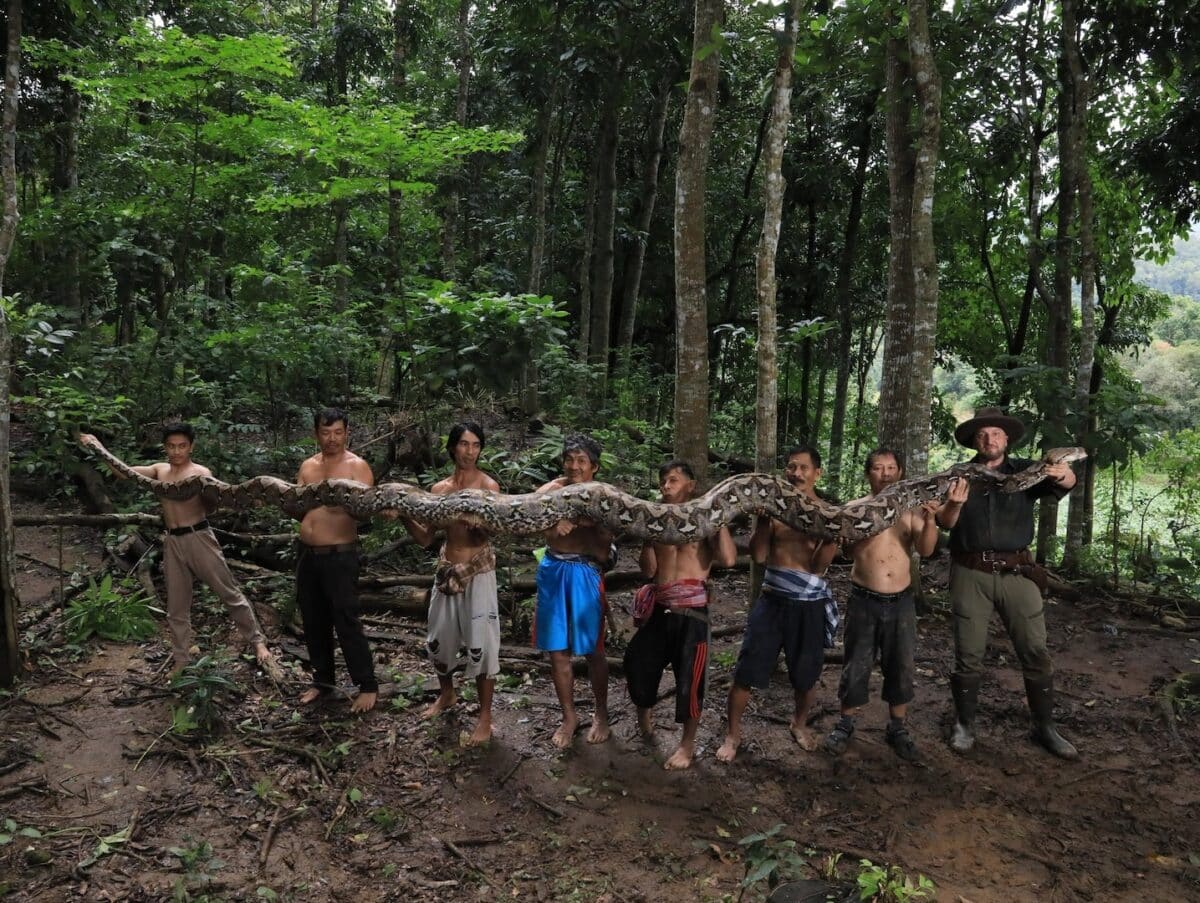 Radu Frentiu, Budi Purwanto and villagers from south Sulawesi, Indonesia, lift “The Baroness” for a group photo after her measurements were taken. At least eight people were needed to safely handle the snake at any one time. Credit: Radu Frentiu, Diaz Nugraha
Even so, the people involved were careful not to overclaim. Frentiu told National Geographic, “I do not believe in the slightest that this is the largest wild snake. I got lucky.” Nugraha told Guinness that snakes reaching 9 meters or more could still exist somewhere, possibly again in Indonesia. The claim here is narrower: not the biggest snake ever, but the longest wild one formally measured with evidence that holds up.
Why Snakes This Large End up near People
The story of Ibu Baron is also a story about shrinking room. Nugraha told Guinness that giant snake sightings are increasing because habitat is being reduced and the availability of natural prey is falling, likely in part because of poaching. National Geographic described the same pattern across Indonesia, where habitat loss and declining prey push large snakes closer to villages and farms.
That makes survival harder for both sides. Reticulated pythons are non-venomous, but their size and strength allow them to kill livestock and, in rare cases, people. Fear often kills the snakes first. They are also hunted for bushmeat and targeted by the illegal wildlife trade, which helps explain why a python large enough to draw widespread attention rarely remains in place long enough to be documented.
Purwanto’s intervention changed that sequence. Instead of letting the snake be killed or sold, he housed her in a shelter on his property with other rescued snakes. Frentiu, Nugraha, and Purwanto now hope the Guinness recognition gives local communities a reason to view such animals as worth protecting, whether for conservation, local identity, or wildlife tourism.