
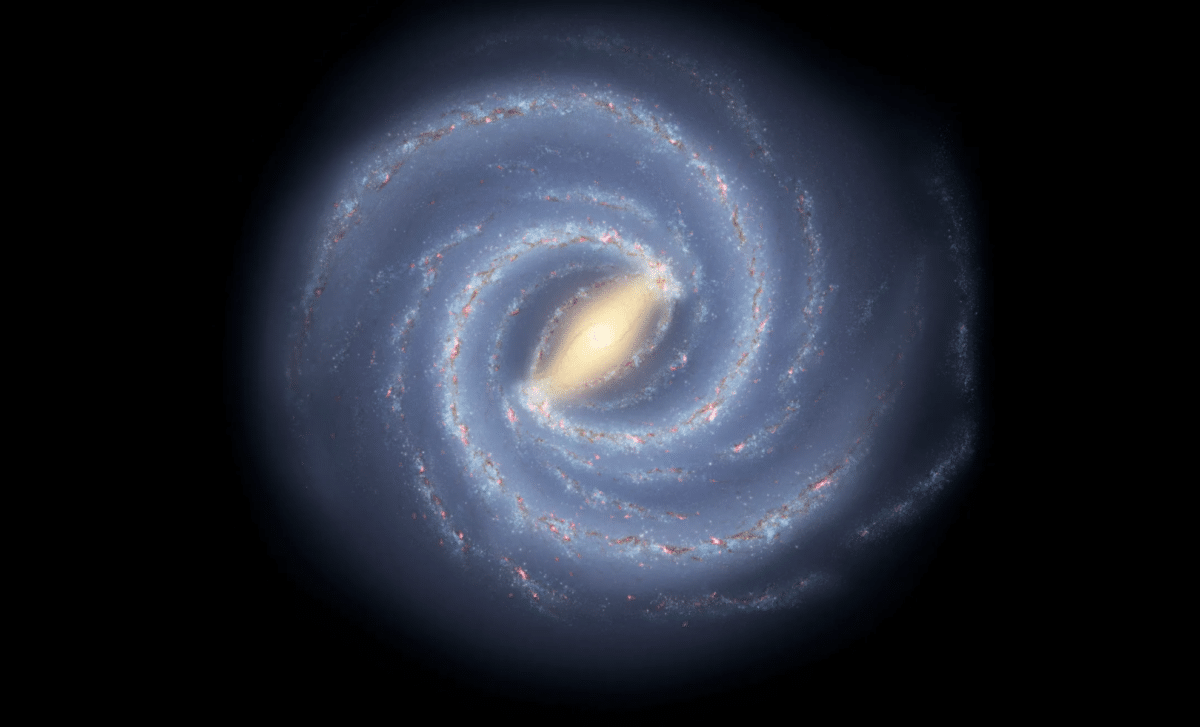
Amid the vast darkness of the Milky Way’s halo, a faint, enigmatic trail of stars has been spotted, one that could rewrite our understanding of the galaxy’s formation. C-19, a newly discovered stellar stream, stretches across the sky with a mysterious, ancient history. Its discovery, detailed in a recent study on arXiv, offers a rare glimpse into the remnants of a long-lost galaxy, providing new clues about the Milky Way’s early days and the unseen forces, like dark matter, that continue to shape its evolution.
The C-19 Discovery: A Glimpse Into Galactic History
For years, astronomers have speculated about the remnants of ancient galaxies and globular clusters lurking in the Milky Way’s outer regions. These remnants, called stellar streams, are created when dwarf galaxies or clusters are torn apart by the gravitational pull of the Milky Way, scattering stars along their orbital paths. The discovery of C-19 is a breakthrough in this area, revealing an extremely metal-poor stellar stream located 58,700 light-years from Earth.
Unlike typical stellar streams, C-19 is a rare and significant find due to its extraordinarily low metallicity, below -3.0 dex. This makes it the most metal-poor stellar population ever discovered, offering unique insights into the early stages of galaxy formation and the behavior of dark matter. At over 650 light-years in size and spanning an impressive arc of more than 100 degrees across the sky, C-19 is one of the largest stellar streams known to date.
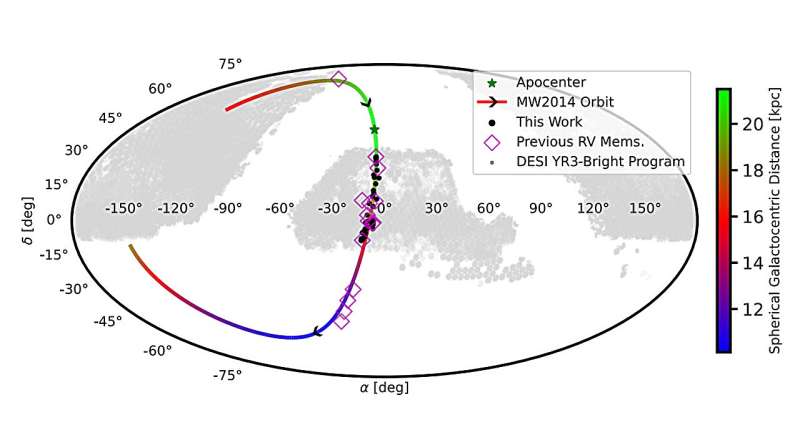 The black points represent the 47 (41 main sequence + red giant, 6 blue horizontal branch) C-19 member candidates identified in this study. Credit: arXiv (2026). DOI: 10.48550/arxiv.2603.11171
The stream’s mass, estimated to be between 40,000 and 50,000 solar masses, is a reminder that even seemingly small, distant objects can hold vast amounts of hidden cosmic history.
The Role of DESI: Advanced Technology Unveils Stellar Secrets
To uncover the full extent of C-19’s properties, the team of astronomers led by Nasser Mohammed from the University of Toronto employed the cutting-edge Dark Energy Spectroscopic Instrument (DESI) on the Mayall 4-meter telescope at Kitt Peak National Observatory. DESI, a next-generation spectrograph, provided invaluable data that allowed the team to analyze radial velocities and metallicities for more than 10 million stars, reaching deeper into the Milky Way’s stellar population than ever before.
“Using DESI, which provides radial velocities and metallicities for over 10 million stars reaching significantly fainter magnitudes than comparable surveys, we employ a mixture model approach to jointly characterize stream populations in proper motions, radial velocities, and metallicities against a Milky Way halo background,” the researchers explain.
This ability to look at millions of stars in detail is key to unraveling the mystery behind C-19’s origin and structure.
The data, published March 11 on the arXiv pre-print server, revealed that C-19 has a high velocity dispersion of 7.8 km/s, which is much larger than typical stellar streams associated with globular clusters. This suggests that C-19 is “kinematically hot,” meaning the stars within the stream are moving at high speeds relative to each other. The unusually high velocity dispersion and the existence of a “spur” feature, an offset group of stars deviating from the main stream, raise questions about the stream’s origin.
The Spur: A Clue to C-19’s Mysterious Past
One of the most fascinating aspects of C-19 is the discovery of a spur-like feature, roughly 1,000 light-years offset from the main stream. This structure, which spans approximately 3,000 light-years in length, consists of a group of stars that differ in velocity and position from the rest of the stream. The spur could be the key to understanding whether C-19 originated from a dwarf galaxy or a globular cluster.
The spur’s existence points to a more complex history than a simple tidal disruption. It suggests that C-19 may have experienced an event or interaction that caused it to evolve differently from other stellar streams. While the stream’s low metallicity strongly points to a globular cluster origin, the spur provides compelling evidence for a dwarf galaxy progenitor.
These findings indicate that C-19 is not just another piece of cosmic debris but potentially a remnant of an ancient galaxy, offering a glimpse into the early, chaotic stages of galaxy formation in the Milky Way.
Uncertain Origins: Could C-19 Be from a Dwarf Galaxy?
Despite the exciting revelations, the exact origin of C-19 remains uncertain. The stream’s low metallicity, combined with the spur feature, suggests a possible dual origin: a globular cluster or a dwarf galaxy. Dwarf galaxies, unlike globular clusters, tend to have higher velocity dispersions and can possess more complex structural features, such as the spur observed in C-19.
As the researchers continue to analyze the data, they will explore whether this feature could indicate a once-active galaxy that was disrupted by the Milky Way’s gravity, leaving behind a trail of stars like the C-19 stream. Understanding this will not only shed light on the history of the Milky Way but could also reveal more about the dark matter that resides in its halo.