

Over the past three years, artificial intelligence (AI) stocks spent most of the time doing one thing in particular: marching higher. The S&P 500, over that period, soared more than 78%. But in recent weeks, the stock market has been a rocky place, with the famous benchmark shifting from gains to losses. This is amid a wide range of concerns — such as uncertainty about the AI revenue opportunity in relation to today’s spending levels and worries about the geopolitical and economic environment.
Against this backdrop, investors haven’t been feeling confident. In fact, the market’s fear gauge just spiked to 24. History says this is what happens next for AI stocks…

Image source: Getty Images.
AI stocks have led market gains
Before we take a look at what history tells us, however, let’s talk a bit more about the current market situation. As mentioned, the S&P 500 was flying high in recent years, led by well-known AI stocks such as Nvidia, Palantir Technologies, and Meta Platforms.

Today’s Change
(-1.51%) $-100.01
Current Price
$6506.48
Key Data Points
Day’s Range
$6473.52 – $6594.66
52wk Range
$4835.04 – $7002.28
Volume
7B
Investors recognized the game-changing power of AI and aimed to bet on players that could benefit. These are companies that develop, sell, and/or use this technology. AI has the potential to improve everything from office organization to factory operations — and supercharge innovation too. These and other uses of the technology could lower costs, increase revenue, and significantly boost earnings over time.
Investors were eager to get in on winning players early to benefit from this story, and companies have been spending billions of dollars to support their AI businesses. For example, big tech companies have pledged nearly $700 billion in capital spending this year — a great deal of this investment will support building out AI infrastructure.
But as this spending unfolds, some investors worry about the future revenue opportunity. Though demand for AI is high, they still question whether spending levels are justified. Meanwhile, the ongoing war in Iran and uncertainty about the pace of interest rate cuts in the U.S. have also shaken the market.
A focus on volatility
As a result, “the fear index,” more formally known as the CBOE Volatility Index (VIX), recently spiked. The VIX, created by the Chicago Board Options Exchange, focuses on volatility. This index offers us a glimpse of volatility expectations over the coming 30 days, and it’s based on options on the S&P 500. When the VIX climbs, it suggests that investors expect volatility ahead; when it falls or remains low, it indicates expectations of a steady market environment.
Now, let’s consider what history has to say about what’s next for AI stocks. A look at the performance of the S&P 500 in relation to the VIX over the past decade shows the following:
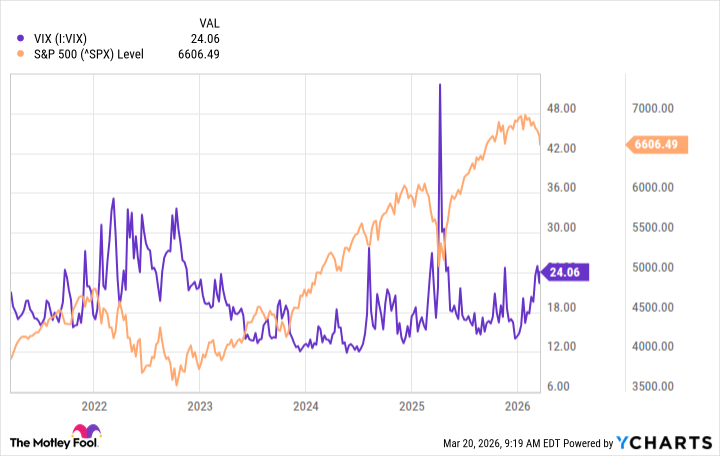
A peak in the VIX has resulted in or accompanied declines in the S&P 500, so history shows us that now, with this fresh spike in the VIX, AI stocks may continue to slip. Technology stocks are the most heavily weighted in the S&P 500, so its patterns can offer us a pretty decent picture of the future performance of AI stocks.
But before you decide to turn your back on AI stocks, it’s important to consider another key point revealed by the chart above. And that’s the fact that the S&P 500 has always gone on to rebound and advance after times of fear and uncertainty. So, even if AI stocks follow historical patterns and decline in the coming days or weeks, quality players are extremely likely to bounce back and go on to increase.
In fact, savvy investors will use any dip in AI stocks to get in on companies that have strong long-term outlooks — at times like these, we can snap up these solid stocks for great prices. So, instead of seeing this peak in the VIX as a signal to run away in fear, investors should look at it as a potential buying opportunity — and focus on the long-term, which still looks bright for quality AI stocks.