

Gavin Cooney
TO REACH THE 2026 World Cup, Ireland will have to overcome first Czechia, then either Denmark or North Macedonia, and finally the malign balance of history’s ledger, for Ireland have a fairly poor record in tournament play-offs.
Across 10 previous play-offs, Ireland have progressed just three times, and only once to a World Cup. And of those three successful play-offs, Ireland have never won both games, which they will have to do this time around.
The first play-off: Defeat to Spain on the road to the 1966 World Cup
Ireland’s maiden play-off would set the tone for some of the themes to haunt Irish football in the decades to come: on-field heartbreak and off-field shenanigans from the FAI. Ireland were drawn into a three-team group with Spain and Syria, only for the latter to withdraw in protest at the lack of African representation at the tournament, meaning Ireland’s qualification group became just a pair of games against a Spain team boasting Luis Suarez, the winner of the Ballon D’Or in 1960.
Ireland won 1-0 in Dublin but lost 4-1 away from home, but this was an era before Uefa introduced goal difference, and so progression would hinge on a play-offf between the teams at a neutral venue.
The nominated venue was Highbury, a major fillip for Ireland given the number of Irish fans available to pack the North London venue. The Spanish, however, wanted the game played in Paris, a city then flooded with Spanish exiles who had fled Franco’s regime. In a classical flourish of the FAI’s knowing the price of everything and the value of nothing, they struck a deal with the Spanish: they would play the game in Paris in return for 100% of the gate receipts.
Spain won 1-0, with Ireland admirably holding out until 11 minutes from the end. The players missed out on a World Cup across the Irish Sea, and the FAI on a payday far greater than their Faustian pact with the Spanish.
The late 1990s bring three defeats in a row
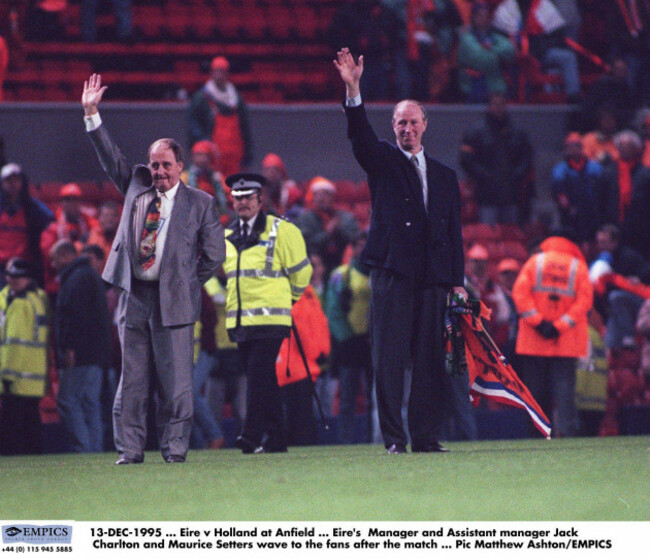
Jack waves goodbye at Anfield. Alamy Stock Photo
Alamy Stock Photo
As the Celtic Tiger was loping into view and limbering into action, the Irish football team remained stuck in a play-off quagmire. Having barged through the front door to Euro ’88, Italia 90, and USA ’94, Jack Charlton’s Ireland would need a play-off to reach Euro ’96 and give Jack a swansong in the land of his birth.
Alas, an Irish side without Roy Keane, Steve Staunton, and Niall Quinn were paired with a Dutch side backboned by the Ajax side that had won the European Cup six months earlier. A 2-0 loss at Anfield meant an emotional end for Charlton, who stood on the pitch and waved goodbye as Irish fans serenaded him with a rendition of You’ll Never Walk Alone.
Mick McCarthy succeeded Charlton and quickly racked up as many play-off defeats as Ireland had had in its entire history to that point. Having finished second in their group for 1998 World Cup qualifying, Ireland were sent to a two-legged play-off for the first time in their history, paired with Belgium. Roy Keane was absent again, and Denis Irwin’s first-leg goal was cancelled out by Luuc Nilis’ stunning strike, giving the Belgians an away goal to bring into the return leg. Belgium took the lead in the second leg before Ray Houghton equalised, only for the referee to incorrectly give Belgium a throw-in with 20 minutes remaining, which led to another Nilis goal and more Irish heartbreak.
Ireland should not have needed a play-off to qualify for Euro 2000, but the concession of a last-minute equaliser in their final group game away to Macedonia condemned them to the scenic route. Roy Keane was available for this play-off against Turkey, and his namesake Robbie gave Ireland a late but brief lead in the first leg at Lansdowne Road, cancelled out within minutes when Lee Carsley was penalised for a handball in the box. The second leg was an acrid, goalless draw off-broadway in Bursa that ended with Tony Cascarino scrapping on the pitch and Ireland exiting on away goals.
The 2002 World Cup: Breakthrough at last
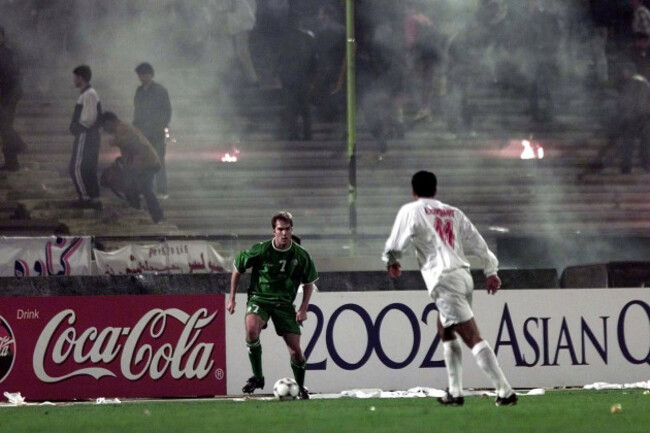
Iranian fans light fires on the terraces as Ireland finally make it through a play-off. Alamy Stock Photo
Alamy Stock Photo
Roy Keane hit his peak and helped Ireland through a brutally tough qualifying group, splitting Portugal and the Dutch to finish second and earn a play-off against a side from another confederation. It proved to be Iran, whom Ireland beat 2-0 in the first leg in Dublin.
Roy Keane did not travel to the second leg in Tehran – an issue that would, err, resurface, on the eve of the World Cup – as Ireland were pitched into a hostile, alien atmosphere in which Iranian fans turned from boisterous to threatening and some Irish players mistook the stadium PA’s call to prayer for the Iranian anthem. A 1-0 loss was enough to qualify Ireland through the play-offs for the very first time. But it seems every glory comes at a cost, as was unsubtly foreshadowed by the Iranian journalist who asked Mick McCarthy at the pre-game press conference: are you the Republic of Ireland, or the Republic of Roy Keane?
Larceny in Paris
Alamy Stock Photo
Alamy Stock Photo
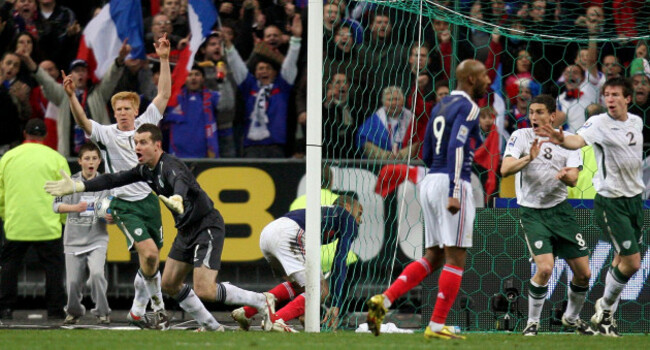
You won’t have to be reminded of the circumstances of one of our greatest nights of grievance. First Fifa changed the conditions of the play-off draw for the 2010 World Cup to keep the four highest-ranked sides apart, landing Ireland with France. Nicolas Anelka’s goal at Croke Park gave the French a one-goal lead to take back to the Stade de France, where Ireland greatly improved upon their first-leg performance. Robbie Keane put Ireland ahead on the night, which ultimately sent the game to extra-time. Then came Thierry Henry’s handball-and-assist for William Gallas, eliminating Ireland in one of the modern game’s most infamous injustices.
Amid the hysterical fall-out, one Liveline caller said the nation should boycott bakery chain Cuisine de France – an Irish company – and the FAI drew the laughter of Sepp Blatter and Fifa’s football family for requesting to be sent to South Africa anyway, as the 33rd team. In the end the FAI didn’t qualify but were given €5 million by Fifa, which provided an echo of the ’66 World Cup play-off all those years earlier: another play-off loss in Paris, but another payday for the FAI.
Back-to-back European Championships
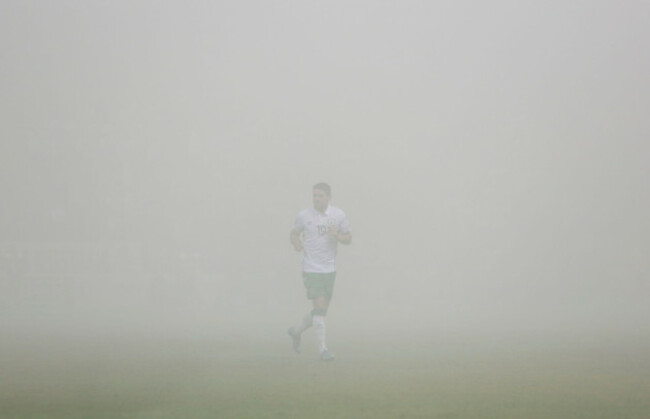
Robbie Brady is in there somewhere. Alamy Stock Photo
Alamy Stock Photo
Giovanni Trapattoni got some belated fortune in landing Estonia in a two-legged play-off to reach Euro 2012, and a 4-0 win away from home rendered the subsequent 1-1 draw in Dublin academic. The less said about what happened at the actual tournament the better.
Four years later, Martin O’Neill guided Ireland to Euro 2016 via a two-legged play-off win against Bosnia. Robbie Brady materialised through the thick Zenica fog to equalise in the first-leg, and Ireland were superb in the return game, with Jonathan Walters’ double sending Ireland to Uefa’s French jamboree. That campaign looked dead and buried after Ireland lost in Glasgow to Scotland and then narrowly avoided defeat at home to Poland, but an astonishing home win against Germany defibrilated the whole enterprise and carried Ireland to the play-offs. For Germany in 2015, see Portugal in 2025?
The 2018 World Cup: A Danish pasting
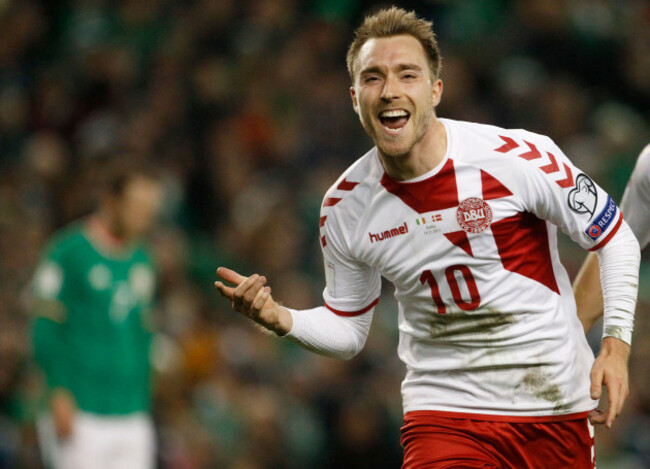
Christian Eriksen. Alamy Stock Photo
Alamy Stock Photo
If Ireland raced to the Euro 2016 play-offs, they ground their way to the equivalent for the 2018 World Cup. Having nabbed a 1-0 win away to an injury-depleted Wales, O’Neill’s side gave one of their most prodigious displays of anti-football in a goalless, incident-free first-leg draw in Copenhagen, after which the Danes loudly complained of Ireland’s approach.
Shane Duffy’s early goal to put Ireland ahead in the return leg appeared to vindicate O’Neill’s approach, but quick fire Danish goals put them ahead at half-time. Now forced to chase a goal, O’Neill withdrew his starting midfielders and left room for Christian Eriksen to run riot: he scored a hat-trick as Ireland fell to a 5-1 loss which greatly tarnished O’Neill’s legacy.
The Covid play-off in Slovakia
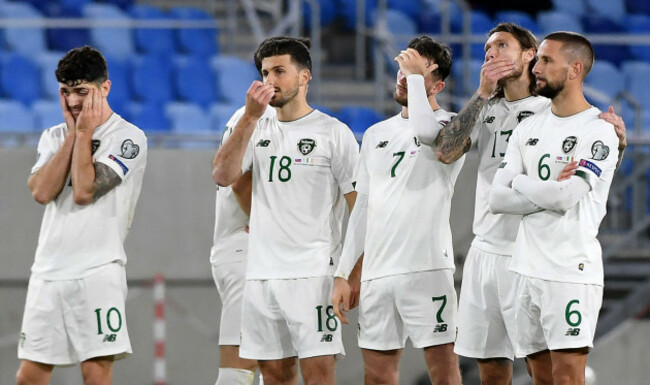
Defeat in Bratislava. Alamy Stock Photo
Alamy Stock Photo
Ireland’s play-off loss in Bratislava to miss out on a spot in Euro 2020 (+1) may be remembered as the most bizarre of all of Ireland’s defeats. First of all, Ireland less earned a play-off than they were gifted it: an early flaw in the new Nations League campaign meant that Ireland’s finishing bottom of their group with zero wins and one goal scored was enough to land in a play-off. Though Mick McCarthy took charge of the qualifying campaign, Stephen Kenny was promoted to the job by the time the play-off came around.
Played behind closed doors in Bratislava, Kenny lost Aaron Connolly and Adam Idah ahead of kick-off, as they were in breach of social distancing rules as they sat on the wrong seats on the plan over. They were deemed to be 10cm and 30cm too close to an FAI staffer who tested positive for Covid upon landing in Slovakia. In a cruel kicker, said test proved to be a false positive.
In a one-off semi-final to earn progression for a final against Northern Ireland, Conor Hourihane and Alan Browne missed a pair of sitters in a goalless draw that went the distance to penalties. Browne and Matt Doherty missed from the spot to condemn Ireland to defeat.