
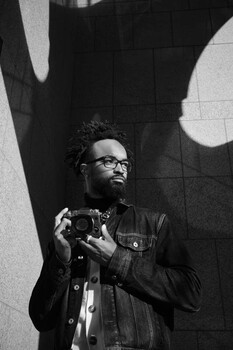
Doriyan Coleman is a Cleveland-based photographer, author, and educator whose work treats the everyday as something worthy of sustained attention. His street photography draws on themes of selfhood, community, and the quiet grandeur of the natural world, and the results feel less like documentation and more like visual verse.
Coleman’s trajectory has been unconventional. He entered photography through the commercial world in his early twenties, shooting modeling and fashion work with no formal instruction. After discovering the work of Gordon Parks, Dorothea Lange, Robert Frank, and Andre Kertesz, he pivoted entirely toward street and documentary photography, studying their images alongside those of master painters and treating them as long-distance mentors.
That self-directed education has led to a substantial body of work and an increasingly prominent presence in Cleveland’s arts community. His images are permanently exhibited at the MetroHealth Glick Center through ongoing acquisitions by LAND Studio and MetroHealth, and from fall 2022 through spring 2023, his photograph “Public Square” was displayed on the Cleveland Public Square Art Wall. In May 2025, selected images from his collection “Togetherness” were shown in Cleveland Play House’s inaugural Hall of Mirrors gallery exhibition.
In September 2025, University Circle, one of Cleveland’s (and arguably, the country’s) most prominent cultural districts, awarded Coleman its Artist in Residence position. That residency has included a yearlong solo exhibition of his street photography collection “Where We Call Home” at UCI’s Magnolia House, which opened in December 2025 and runs through November 2026.
Coleman is also an experienced photography educator. During the 2022-2023 school year, he served as an In-School Artist in Residence through the Ohio Arts Council’s TeachArtsOhio grant, designing and teaching photography curricula for Urban Community School. He continued instructing programs for UCS and Cuyahoga Community College through spring 2024, and he is leading two new photography programs for University Circle in spring and summer 2026 as part of his current residency.
He frequently collaborates with Fujifilm on fine art and digital media projects, publishes the newsletter Camera Flow, and runs a YouTube channel with over 7,200 subscribers and 650,000 views exploring photography theory, history, and gear. On March 13, 2026, he self-published his first street photography book, also titled “Where We Call Home,” featuring 60 images. The book launched at a sold-out solo exhibition at Magnolia House.
I sat down with Doriyan to discuss how he finds meaning on the street, what his students have taught him, his relationship with Fujifilm, and what comes next.
Finding Poetry in the Everyday
Your work often treats everyday life as something lyrical rather than mundane. What does “poetry” mean to you in the context of street photography?
Poetic imagery, to me, opens the imagination towards meaning, stories, emotion, and consideration beyond the surface level. When reading writers like Emily Dickinson or William Blake, there are allusions to higher states of consciousness, often inspired by everyday occurrences. Our challenge is two-fold: street photography is spontaneous, and modern life has no shortage of distractions that deter us from these meditations. At its best, street photography is more than “just pictures.” Great images, to me, open the heart and mind to those deeper ideas.
How has your personal vision evolved since you first picked up a camera, and what beliefs about photography have you had to unlearn along the way?
My first foray into photography was in my early 20s via the commercial realm. Modeling, fashion photography, etc. Never took any photo classes or had any teachers. I eventually came across folks like Gordon Parks, Dorothea Lange, Robert Frank, and Andre Kertesz, and to say I was spellbound would be an understatement.
Their imagery has a perfect fusion of artistic expression and historical significance, and that became my motivation. I studied their works, as well as those of many master painters, and have since taken them all on as my mentors from a distance. Somewhere around my first and second years of photography, it clicked that, with dedicated effort, I could walk out my door and make beautiful, insightful, and visually impactful photographs of my own.
An idea I had to unlearn is that you always know, out of the gate, whether an image is strong or not. Early on, I would photograph all day, immediately review images once I got home, and delete away. These days, unless an image is egregiously off, I’ll give it at least a few weeks. Some of my strongest, audience-favorite images are pictures that I was initially unsure about and/or almost deleted forever. Sometimes, you have to grow a bit before you see the power of an image.
A strong sense of empathy comes through in your images. How do you approach photographing strangers in a way that feels respectful rather than extractive?
My guiding intent is to photograph the world in a way that dignifies the human experience and candidly catalogues our time. Sometimes, that’s staying in the scene a few extra minutes to make sure you got it “right.” Controlling my spacing and knowing when (and when not) to be close to folks. It’s also little things like waiting for someone to stand up straighter or for a group of folks to arrange themselves a certain way.
At the same time, I don’t embellish, because our lives aren’t perfect. Everybody in my images isn’t always smiling, because life isn’t always smiles. All of your favorite books and movies aren’t sunshine and love songs, and photography can’t always be that either.
I naturally gravitate towards themes such as friendship, individuality, community, discipline, and the general splendor of nature. All of my favorite artists and writers have captured them so well, so I’m sure there’s a subconscious element as well.
In a more literal sense, I keep welcoming body language, my camera out, etc. I’m somewhat tall, so being “stealthy” has always been out of the question for me. Smiling never hurts, either. That said, I’ve lost count of how many times someone pleasantly greeted me on the street, and that moment turned into a spontaneous image.
When you’re on the street, how do you recognize a moment worth committing to, and what tells you it’s time to press the shutter?
Man, they’re so fleeting that it’s tough to recognize themes every single time. It’s frequently a fusion of all of the intangibles: light, gesture, environment, and some expression of character, substantial or otherwise. It’s hard to articulate, but it’s somewhat of an instinct.
The Role of Gear
What role does gear actually play in your work, and how do you decide what’s essential versus what might get in the way?
Can’t negate the importance of gear. Lens-wise, I’m a 28mm-40mm guy. That range of focal lengths helps me photograph life and context in ways that feel natural. From 2018-2023, I was 99% Fujifilm APS-C. Edited on everything from a busted iPhone XS to a cracked iPhone 12, on to a painfully under-spec’d laptop, and finally, something capable!
These days, I’m using digital medium format. My current exhibition features images made with the Fujifilm GFX50S II and GFX100S II, and the archival prints are simply jaw-dropping. I usually print anywhere from 11×14 to 24×36, so the resolution is quite nice.
You’re closely associated with Fujifilm cameras. What aspects of that system align with how you see and work?
Everybody knows that Fujifilm cameras are compact, powerful, and stylish. What’s kept me investing in them as my choice of equipment is their commitment to the art of photography and their willingness to evolve. Also, everybody I’ve ever spoken to from Fuji has been absolutely delightful.
They’ve sent me loaners for everything from YouTube content to news assignments, and on to my personal and fine art projects. The Instax division has sent me film to support the classes I teach, and they’re currently providing multiple cameras for my year-long artist residency. I wish you could’ve seen the look on my students’ faces when I told them Fujifilm loves what they’re doing. They’ve never asked for anything in return, either. Some truly kind, gracious people work there.
Teaching and Learning
Teaching and community education are a major part of your practice. How has working with students influenced the way you photograph?
I tell you, these kids see the beauty in everything. The number of times they’d run up to me with prints of things even I didn’t notice. They inspired me to become even more observant in my day-to-day craft and to be even sharper in my knowledge base and communication. For some of them, I was their first introduction to the “art” of photography, and that’s a huge responsibility.
In some ways, too, they’ve inspired me to keep on going. I always had my middle schoolers write reflection papers at the end of the trimester, and some of them wrote things like “I feel like I’ve found my calling in life” and “Mr. Doriyan was so kind.” In many ways, if I don’t focus on being the best artist I can be, the best communicator, etc., I’ll slowly run out of things to teach future students, and in that timeline, we’re all worse off for it.
You’ve taught photography to middle school students and young photographers. What have they taught you in return?
In 2023, I had a middle schooler who was the biggest Aphex Twin fan you’ll ever meet. Loved The Backrooms, too, and it showed through his “liminal” photos around the building.
We always had photo reviews towards the end of class, and I’d have the kids explain their methodology behind capturing the theme of the day (leading lines, contrast, shapes, etc.). I made it a point to be positive and constructive because I didn’t want to be responsible for creating the next Syndrome, terrorizing the city of Cleveland, and whatnot.
One day, after one of these reviews, another student asked, “Mr. Doriyan, how many pictures do you think you’ve taken in your life?”
“Thousands,” I replied. “What’s crazy is that I probably only have a solid 200 that I’m truly proud of.” It was 30% a joke, 70% self-deprecation, as not a critic in the world can compare to my inner dialogue.
After I said that, my Selected Ambient Works-loving little homie quietly said to himself, but loudly enough for me to hear, “Dang, I’m proud of all the pictures I’ve taken so far.”
Hit me like a truck. Thought about it for days. Helped me realize I am way too hard on myself. Also, if I don’t talk to my inner artist more lovingly, I’ll become like Prince Zuko and create from the wrong energies. I realized I can evaluate my images without calling them “trash” or “terrible.” Also, I can appreciate my earlier work without harsh comparisons to myself now, or anyone else. This young kid genuinely helped me see my work with more caring eyes.
When introducing visual literacy to beginners, what do you think matters more early on: technical competence or learning how to see?
Learning how to see, 100%. During the first few classes, I teach them enough about the buttons and dials to be swift. Of course, we get into more technical aspects as time goes on, but if you can “see,” that translates across cameras, mediums, etc.
Particularly with my younger kids, before we touch on fundamentals, we learn about different genres of photography, significant artists from all backgrounds, past technologies (daguerreotype, autochrome, etc.), and what needs they were born to fulfill. These kids were born in the late 2000s/early 2010s, so we do this to build an appreciation for the craft and to understand its context and history.
With all of my students, middle or high school, the first photo exercise we always did was splitting into groups of three and traveling around the campus to photograph items (or people) that began with each letter of the alphabet. “C” for chair, “D” for Mr. Doriyan, “L” for locker, and so on. Since they’re in groups of three and Instax has ten pictures per pack, you literally have to work together, and some letters are much harder than others. Only a handful of groups ever got all 26! However, they almost always became friends afterwards.
Community and Responsibility
Your solo exhibition, “Where We Call Home,” explored ideas of place and belonging. How did working toward a gallery show change your relationship with those themes?
It made me further consider those ideas of place, belonging, and selfhood, but with coherence and across time. When you think of street photography cities, New York and Chicago easily come to mind, then it’s pretty much “everywhere else.” Cleveland has some remarkable street/documentary photographers, like Allen E. Cole, but not a laundry list of names like the former cities.
I initially understood my collection as candid, visual poetry that articulates a variety of humanist themes. When I used to go on my photo walks, I didn’t always conceptualize it as “history-making” on a moment-to-moment basis. Over the years, as I’ve developed a deeper understanding of my craft and spoken with community members, organizations, and the fine folks at University Circle, I’ve realized that it’s also a historical record of Cleveland.
I’ve already come across certain spaces in this collection that are no longer around. Shoot, I won’t always be around. The archival element of this collection goes beyond the paper used for the prints; it also exists in the universal themes it expresses, as well as in its relation to my city and our people.
While the exhibition has around 20 images, my first photo book of the same name, “Where We Call Home,” has 60 images that explore those themes in their entirety. I’ve been working on this book/idea for the better part of three years, and it’s truly special to me.
As an Artist in Residence working directly within a community, how do you balance personal artistic goals with public responsibility?
They’re often intertwined. If I’m to be the best photographer I can be, who makes images of cities and places that resonate, I have to be out in the community at hand for extended periods of time. The 20-something images in my exhibition and the 60 in my book couldn’t have happened in one day. You have no choice but to be out and about.
If I’m to become the best teacher I can be, I must individually become more wise, an even more effective communicator, and able to meet a wide range of people where they’re at, so I take them where their potential resides.
My photography experiences directly inform my classes and workshops. As we explored a few questions earlier, some of my experiences with students, regardless of age, have also informed my photography. While I certainly have hermit tendencies and spend a lot of time in solitude, my personal approach to street photography cannot fully exist in a silo.
You’ve written about photography’s relevance in the age of artificial intelligence. What do you see as the ethical responsibility of photographers right now?
Street photography is a powerful fusion of artistic expression and historical record. The moment you remove the historical aspect of real-life imagery, a foundational peg of the craft is gone.
I’m not sure if this qualifies as ethical, but I tell anybody who will listen to be the songbird of the spaces they frequent and to make images that speak to the human element. You already see fashion houses like Gucci making AI-generated campaigns, and who knows how many marketing studios are doing the same. Something that’s absolutely within our control as street photographers, documentary photographers, and photojournalists is telling stories that resonate with us through an uncompromising commitment to humanist narratives.
When you’re shooting, what tends to pull you into an image first: emotion, composition, gesture, or something less tangible?
“Something less tangible.” Composition is essential, as it helps make images legible. Still, I’ve learned over the years to trust the invisible urge that steers me towards a moment and to allow clarity to manifest during the review process.
Documenting real communities comes with weight. How do you think about responsibility when your work represents other people’s lives?
You hear the phrase “art imitates life” often, but I’m also a firm believer that life imitates art. Studies show that joyful, harmonious, humanizing art helps patients in hospitals heal faster. Local organizations acquired multiple images of mine into the Metro Health Glick Center for similar reasons. Vermeer’s “Milkmaid” does something different to your soul than Duchamp’s “Fountain.”
My view of this responsibility is that we live on a shared earth. You can photograph me (as many street photographers have), and I can photograph you. Those resulting photographs, as well as the music, movies, paintings, books, and social media we experience, absolutely affect us. Like I said earlier, life isn’t always sunshine and daisies. However, I do think there is a way to photograph the world in a way that is life-enhancing and resonant, transcending skin color and culture.
Looking Ahead
Looking ahead, what directions are you most interested in exploring next, either creatively or conceptually?
Books! My first photo book, “Where We Call Home,” released on March 13, 2026, the same day as my sold-out solo exhibition. It feels like the culmination of everything I’ve ever read, learned, and resonated with artistically.
These 60 images, in many ways, punctuate what I feel is the first era of my artistry. There’s an image from my second month of street photography, and some as recent as the end of 2025. I’m ecstatic that many of these will get to live in the physical world for their first time. I self-published it; I designed it top to bottom, and it’s really special to me. There are only 100 copies of this first edition, and it would be amazing if they all found a new home.
Outside of that, I’m teaching two new photography programs for University Circle this spring and summer, and I’m so excited to see some new faces and, of course, take some pictures!
To see more of Doriyan Coleman’s work, visit his website, subscribe to his newsletter Camera Flow, or follow him on Instagram and YouTube. His first photo book, “Where We Call Home,” is a limited first edition of 100 copies and is available through his website. Coleman shoots on the Fujifilm GFX50S II and Fujifilm GFX100S II.
All images used with permission of Doriyan Coleman and Dorrian Hawkins.