
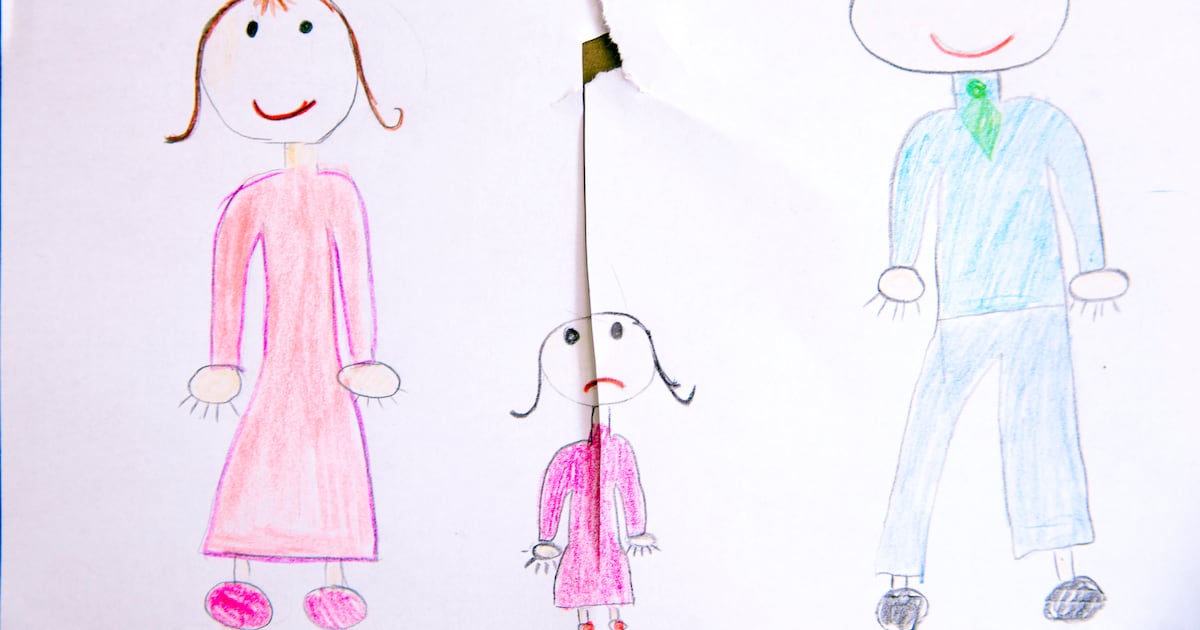
Acrimonious parental separation negatively affects about one in 10 children in the State, according to a new report published today by Barnardos Ireland.
The children’s charity commissioned a nationally representative survey of parents that found almost one in five (19 per cent) have separated from their children’s other parent. More than half of these experienced significant conflict when separating, while a third reported that communication had become either extremely difficult or impossible.
The survey conducted by Amárach Research among almost 650 parents shows that of those who had separated:
One third (35 per cent) said it affected their ability to provide practical care. About half (49 per cent) said it affected their child’s emotional wellbeing, anxiety and behaviour.Forty per cent said it negatively impacted on children’s routines and stability. Nearly half (48 per cent) said it affected the child’s relationship with them or their other parent.
The report, entitled, Acrimonious Separation: The Impact on Children, warns that youngsters caught up in parental conflict are at risk of trauma and having poorer health, wellbeing and developmental outcomes.
“The longer that a child is exposed to it, the greater the likelihood that it will cause them harm, because childhood lasts a lifetime,” says Suzanne Connolly, Barnardos chief executive. The charity is calling on the Government to increase support for families struggling with separation. More funding is needed “to help parents de-escalate conflict earlier, develop coping mechanisms and keep focused on children’s best interests”, it states.
The report commends the Department of Justice and the Courts Services for significant policy improvements around parental separation. But it says more work needs to be done to reduce the number of families going to court and to prevent parents’ conflicts becoming entrenched and prolonged within the home, before and after separation.
It is not the act of separation but how it is handled that can have a “profound” impact on children, lasting into adult life, says Deirdre Cahir, who manages Barnardos family support services across Co Offaly and Co Laois. “It impacts every aspect of their life, from school to not being able to sleep, to, if there’s two houses, the going between two homes.”
However, the “detrimental norm” amid the housing shortage is that separated parents remain under the same roof, she says, adding that demand for services around separation has noticeably increased since the Covid-19 pandemic.
“By the time they get to us, it can be extremely acrimonious and parents are so entrenched in anger and emotion that the children are nearly sidelined at that stage.”
 Suzanne Connolly is the chief executive of Barnardos
People separate all the time, “but there are very few that I’ve seen have done it graciously”, says Cahir.
As soon as parents realise their relationship has broken down, they should seek support for managing the separation. This would help focus their minds, she suggests, on facts and questions such as: “We don’t like each other any more; we’re separated. How do we manage our children, who we both love? How do we put our emotions towards each other to the side to focus on our children?”
Barnardos has developed a specialised entrenched inter-parental conflict parenting programme, to add to a separated and parenting course that has been running for many years. The charity encourages both parents to do it, initially meeting with the same project worker, but at different times, and then completing the programme within separate peer support groups.
Staff often ask parents to bring a photograph of their children to sessions, as a visual reminder of who is at the centre of their behaviour and planning for the future. The programme includes a look at how they are parenting post-separation, the impact of conflict on children and how to spare them from it, and self-care that will enable somebody to be the best parent they can be in the circumstances.
“We all have strengths as parents, but we all have areas that we need to work on as well,” says Cahir.
[ ‘My wife and I are separating. What can we do to help our young children cope?’Opens in new window ]
Another crucial topic is communication: “I could tell you horror stories of people living in the same home. They’ve had to use a notebook that’s left on a [kitchen] island to communicate. Children have access to this.”
Children can also be used as messengers. Barnardos reports a recent example of a girl who had been told by her mother to tell staff that her father wasn’t doing certain things. The service is developing a programme for children to support them in having their voice heard.
“When we’re talking about the impact on a child, we really can’t overestimate that. What we think as an adult is innately different to what a child is thinking.”
In these situations, “they’re big emotions when you’re an adult, they’re even bigger when you’re a child”.
Children often think it is their fault. Uncertainty and the unknown is, says Cahir, “a very unsafe place for a small person to live in, in their head”. Parental calmness, reassurance and consistency are needed.
Power and control, as well as finances, are the usual flashpoints. People’s feelings are hurt, something is ending and they don’t want to come out on the worst side of it, Cahir says. “We had one couple who were shift working, trying not to be in the same house at the same time. But the fallout was that when they crossed each other, the arguments were significant even in those moments. The children were in a constant state of fear and stress as to what was going to happen next.”
!['[Our children] were seeing sides of us that we had hidden behind the bedroom door'](https://www.newsbeep.com/ie/wp-content/uploads/2026/03/L46YZ3V6QRDLZPB7UHQRCMSSUA.jpg) ‘[Our children] were seeing sides of us that we had hidden behind the bedroom door’
‘[Our children] were seeing sides of us that we had hidden behind the bedroom door’
She has heard of scenarios where children arrive at one parent’s house with clothes to be told they can’t wear them there because the other parent bought them. “It just gets unbelievably ridiculous – but heart-wrenching and heartbreaking for a child to try and negotiate something like that.”
Parental separation can happen in any family, and Barnardos, which operates across 56 locations in the State, makes its services available to the whole community. But there is no denying that poverty compounds the challenges for fractured families. Cahir recalls how “we had a little guy at one stage who was telling his mum he wasn’t hungry, because he felt she didn’t have money for food”.
‘I feared people seeing inside our snow globe of doom’
Niamh and her husband continued to live in the same house with their three children when they separated three years ago.
It was a very volatile time and she has huge regrets about not looking for support then for her children who were exposed to so much anger. Their eldest son, a teenager, had to intervene on occasions.
“They were seeing sides of us that we had hidden behind the bedroom door,” says Niamh. She was hugely concerned about the impact of the ongoing conflict on the children but, with none of her own family living near their Co Laois home, she had no one to talk to, as she tried to keep up the pretence that all was well.
“I had so much fear of people seeing inside our snow globe of doom. I was afraid of judgment.”
[ ‘We will be going through divorce very soon and have not told our children’Opens in new window ]
She cannot recall how she heard about Barnardos but, out of desperation, rang its crisis line. She was seen within about a week and later enrolled on the inter-parental conflict programme.
“I found it invaluable in building my confidence. It helped me recognise how well I was doing in the circumstances and to lean into the things that were working well.” She also learnt to make peace with what was outside her control. By that stage her husband had had to leave the home, after a neighbour reported an altercation between him and Niamh and their daughter outside the house.
She and her ex went through the family court system. Although Barnardos, Tusla and the family courts all talk about doing what’s best for children, she criticises the lack of co-operation between the three.
“Nobody joins the dots and sees the bigger picture.” She felt the court system was “all about finance and control”.
It pains her now to watch her children struggle with the rigidity of their father taking them every second weekend, with no allowances for what might be going on in their lives. She communicates with her ex-husband through the court-approved My Family Wizard app.
Their youngest child has had play therapy and the middle child is on the waiting list. She organised counselling for their eldest child, “to get him to a place where he wasn’t so angry”.
In hindsight she sees how the family needed these services at the time of the separation, “to allow children to have the opportunity to feel solid”.
“I am not going to say there is a happy ending to this,” she adds. Her advice to other parents weighing up their relationship is, “if it can work, please try”.
‘I couldn’t tell my son why I took him out of the house’
John and his wife remained living in the same house for about six months after they separated. He was working nights and they managed to share the parenting of their two children, a teenage girl and six-year-old boy, before John moved into an apartment close by.
Then their son began to act out: “Running into people and headbutting them, in the chest”, says his father. The couple tried to manage him themselves, but then a doctor recommended family support and they went on a waiting list.
It was at least a year after separation before John and his ex got on parenting programmes, within about a month of each other. Their son had also started play therapy. By then he had stopped acting out so physically, although he was still targeting his father, and the couple were going through the courts.
“There was an incident and I had to go and take my son from the house,” says John, who applied, ultimately successfully, for full custody of the children. There was an interim agreement between the couple and Tusla that she would see them on Saturdays.
[ ‘I am a separated dad and my 15-year-old daughter won’t talk to me’Opens in new window ]
“From the start, I think she was more consumed with what was going on with herself,” he says. “I didn’t want to impinge on her access to my son as long as she was okay.” She could drop in to the apartment to see him during the week.
“It was going through the courts for a year or a year and a half. At that point we were in a bit of a stressful situation in that myself, my son and my daughter were living in the one-bed apartment that I had intended to move into as a stopgap.” They stayed there for two years.
“I was paying the mortgage [on the family home] and the rent so it wasn’t an option to upsize on the rent.” He is very grateful that his daughter, who lived there part of the time, was able to fit college classes around his shifts and look after her brother when he was working.
John found the Barnardos course very helpful but believes separating couples need support faster and suggests online resources should be made available if there is a delay. He felt some of the content was all very well “in a perfect world”, but the real-life experience of fellow participants “balanced that out”.
John had been trying to figure out what to say to his son about being out of the family home. He knew he could not keep fobbing him off.
“I didn’t want to have to tell him exactly why he had to be taken from the house – and why he wasn’t going back.” There are only so many times you can say “she has gone on holidays” or try to change the subject.
On the course he was advised how to explain things in an age-appropriate way. But while he was in and out of court trying to finalise arrangements, he had to tell his son that he simply did not know how long it would be before they could go home.
“There was no way for me, as a man, to get a barring order on her, to get her to move out of the house.” After John was granted full custody, there was court agreement the boy would go to his mother for eight hours on a Saturday. “We stuck rigidly to that for a while. But then, as life comes in the way, we were able to just be flexible and move things around as needed.”
One recommendation John took away from another parent, who was not on talking terms with their ex, was an app for easy calendar sharing, called TimeTree. “I use it religiously now,” he says. Football training, being away for work and other information relevant to co-parenting can be logged. “You can arrange things without having to directly talk about them.”
John and the two children moved back into the family home in Co Westmeath earlier this year, after he bought his ex-wife out as part of the divorce agreement. Having taken redundancy some time ago to be a stay-at-home father, he is now looking for a job.
Names of parents have been changed to protect their families’ privacy