
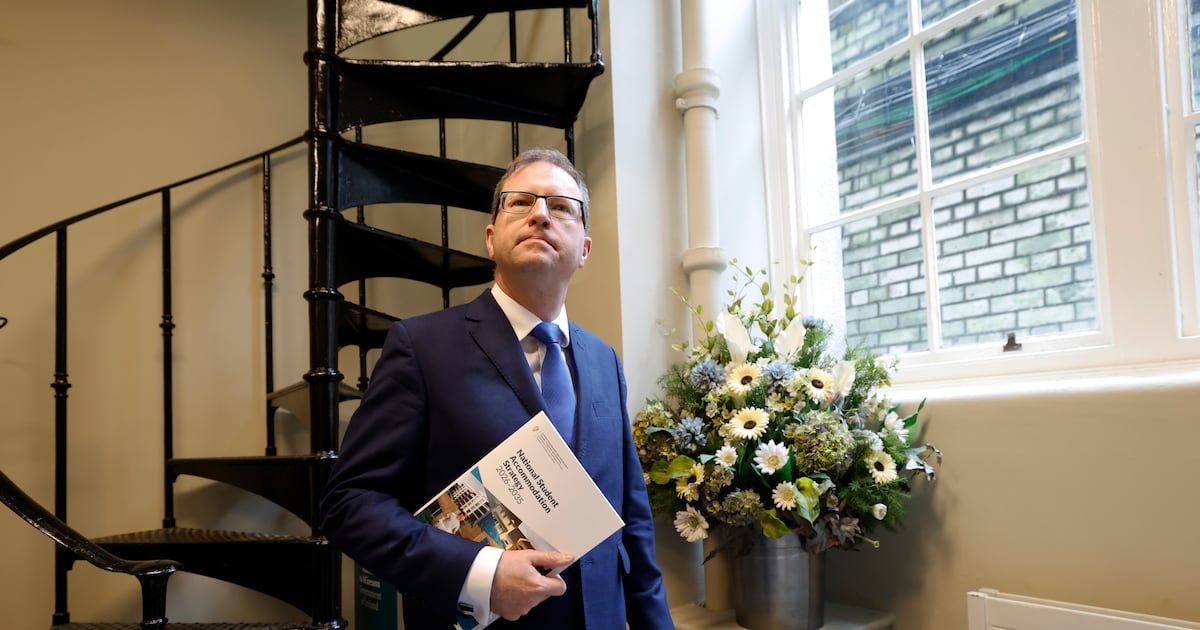
The State aims to address the student accommodation crisis by delivering 42,000 new beds over the next nine years by incentivising private development in on-campus units.
The National Student Accommodation Strategy for 2026-2035, published on Tuesday, lays out a plan to address the viability obstacles slowing down the pace of construction of purpose-built student accommodation.
The lack of accommodation is the single biggest barrier to students in Ireland accessing and completing higher education, according to Amlé, the union of students in Ireland.
Many students have told The Irish Times stories of long commutes, an impossible rental market and couch surfing.
Thousands of on-campus student beds across Dublin remain unbuilt, despite having been granted planning permission, because of rising construction costs and a gap in Government funding.
The key State strategy to tackle the crisis has been delayed by more than two years, having been originally announced in January 2024.
However, there will be no new beds ready for September 2026 under the new strategy, Minister for Further and Higher Education James Lawless told The Irish Times following its announcement, as this is a “long-term plan. It is a complex plan. It’s not going to deliver overnight.”
The Minister hopes a number of beds will be under construction by the following academic year in September 2027.
Under the plan, higher education institutes will be able to make their lands available for private development through a licence system.
The colleges will enter into what is being termed a nomination agreement with private developers. Under these agreements, the land will remain in public ownership, but private developers will be able to build on it.
This will reduce land-acquisition costs for the developer and guarantee access to student beds for the college.
The State will provide site-servicing work – such as utilities, road access and infrastructure – to make campus lands development‑ready. No figure has been provided for this work, other than that it is a “multimillion euro” sum.
Some 10,000 of the 42,000 new beds will come from the rent-a-room scheme, which allows householders to take in €14,000 a year in tax-free rental income when renting a room in their home.
The Department of Further and Higher Education is planning a communications campaign to increase the uptake of the scheme, and will carry out research on its participation.
Also under the strategy, VAT rates for student accommodation sales will be reduced from 13.5 per cent to 9 per cent.
Landlords will also be able to reset rents between tenancies, but students will be given a three-year rent protection window.
The plan also outlines the existing State supports that students can access, amounting to €176 million, through Susi (Student Universal Support Ireland) grants, bursaries, hardship funds and accommodation assistance.
It references the rent tax credit worth up to €1,000 a year for single renters or €2,000 for jointly assessed couples.
The strategy will be overseen by an interdepartmental group to ensure co-ordinated delivery across Government.
Every higher education institute will be asked to create its own student accommodation strategy.
Lawless said the plan was delayed in order to align with the Government’s new housing plan, announced in November, and new rent regulations which came into force in March.
“Largely the work on the strategy was complete late last year, but we were sequencing it behind the housing strategy, because ultimately, it should complement the housing strategy, it shouldn’t be in competition with it,” Lawless said.
Asked what new State investment was being put forward in the plan, the Minister said Government money was being put into “activation measures” such as site servicing, and the public land banks on and near campus which would be made available for building.
“The State is not proposing to build every single bed itself – what the State is doing is providing sites to the private sector under a very definite form of legal agreement,” Lawless said.
On the issue of affordability, there were no specific protections to cap rents, but “the more supply we can increase into the system, the more levelling of market rents should follow”, the Minister said.