
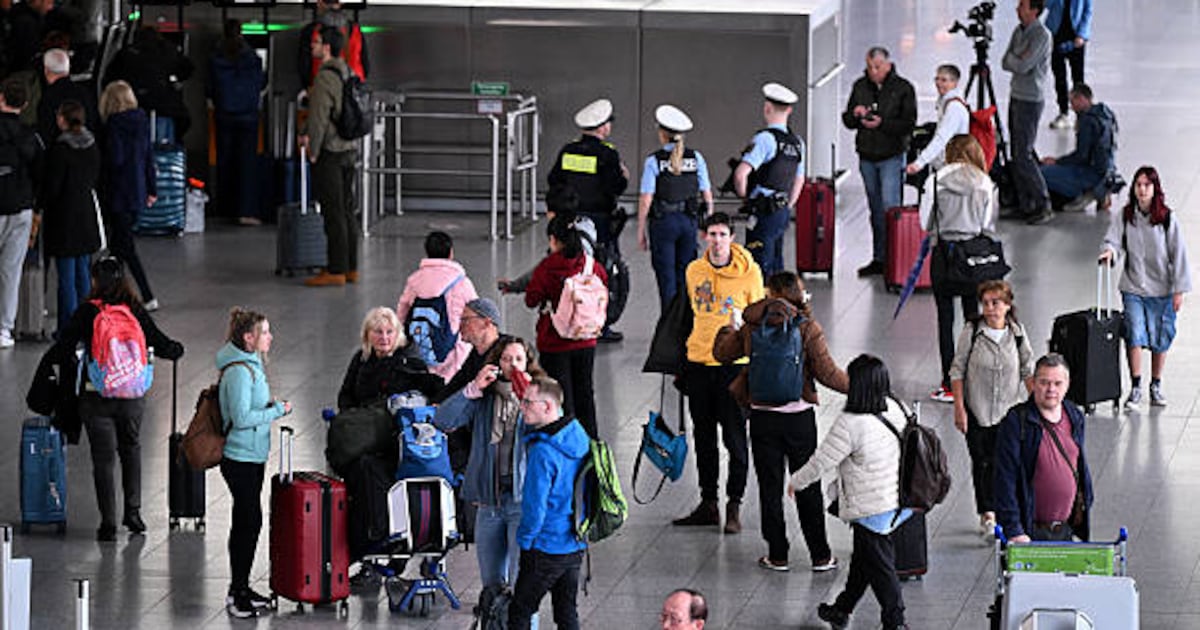
Passenger data from people flying in and out of Ireland and to countries within the European Union will be collected by the Government under a new proposal agreed on Tuesday.
Minister for Justice Jim O’Callaghan is bringing forward amendments which will extend the Passenger Name Record (PNR) system to include EU flights on the basis of risk.
According to the Department of Justice, the data is used “to detect suspicious travel patterns and identify criminals and terrorists”.
PNR data is the information a person shares with an airline when they book a flight. In cases where Ireland faces a “genuine and present or foreseeable terrorist threat”, flight data from all EU flights will be collected.
Since 2016, an EU directive has allowed member states to set up their own PNR units, and to allow police forces such as An Garda Síochána to apply to access data on a case-by-case basis. Since 2018, Irish law has required airlines to share PNR data with the Government on flights flying in and out of Ireland to and from countries outside the EU.
Under the new amendments, the PNR data collection scheme will be expanded. At the same time, the Irish Government is also being forced to limit some of its PNR data collection.
It follows a 2022 European Court of Justice case on the legality of collecting PNR data, which effectively narrows the scope under which Governments can collect the data and places a limit on how long it can be held. The amendments, which were approved by Cabinet on Tuesday, will bring Ireland in line with the effect of the judgment.
Meanwhile, senior officials at the Department of the Attorney General will now meet every time there is a court judgment likely to have an effect on infrastructure delivery.
Minister for Public Expenditure Jack Chambers has set up a new “mandatory and rapid” reporting system, which means officials will have to quickly assess and respond to any court decisions that could slow down or halt important projects. The measure is part of a broader plan to accelerate the pace of infrastructure delivery.
Ministers also heard there was a 63 per cent jump in the number of people waiting on hospital trolleys over St Patrick’s weekend when compared to the same period in 2025.
[ EU deadlocked over proposed new law on passenger data recordsOpens in new window ]
Minister for Health Jennifer Carroll MacNeill told colleagues there had been a “sharp deterioration” in 8am trolley numbers over the recent bank holiday. On the morning of March 18th, the day after St Patrick’s Day, there were 327 people waiting on trolleys in Irish hospitals at that time, , an increase of 97 from the 230 people waiting on trolleys on the same date in 2025.
In general, there was a 6 per cent increase in hospital attendances over the St Patrick’s weekend. Some regions experienced over a 27 per cent increase in attendances from those aged over 75. A four-day, rather than three-day, bank holiday weekend was partially blamed, with St Patrick’s Day falling on a Tuesday, as was an “increased prevalence” of norovirus.
Separately, the Government is now trying to contact more than 350 Irish citizens in southeast Asia who are not immediately affected by the war in Iran, but who may be stranded.
Minister for Foreign Affairs Helen McEntee told Cabinet that 100 people have been directly assisted. The consular effort to help Irish citizens in the Gulf since the US-Israel war on Iran started has been the most significant consular crisis since Covid-19.
More than 2,500 people have received help since the conflict began, which is about the same number as an entire consular caseload in an ordinary year. More than 19,000 Irish people have registered their presence in the Gulf with the Government. The Department of Foreign Affairs believes that most citizens who were in the Gulf region temporarily, either on holiday or in transit, have “likely” been able to return to Ireland.