
My brother planted daffodils in his back garden in Limerick a couple of autumns back. Our mother would do the same each year after the heat of summer had ebbed away and before the first frost came gnawing. She’d send us both out with a trowel to burrow deep holes in the flower beds.
She’s been gone a decade now, and it’s my brother who goes out into his own back garden, secreting daffodil bulbs beneath the grass in a designated patch of lawn, a few feet away from the swing set my little niece and nephew use when the weather warms up. He sent me pictures as he planted the bulbs, making what felt at the time like impossible promises about how the flowers would appear when spring came around.
Each spring, their bonneted, truncated heads burst through the grass above and the strip of lawn they live in is left wild and unmowed until their parade ends. There’s a gap left in the middle so the children can run through it, tipping their big heads forward on little legs to place their noses into the butter yellow funnels and sniff theatrically. When the swaying lemon wave disintegrates into a mushy droop, the whole patch is mowed over and the air smells of impending summer.
Yesterday, as I gazed out the window across the leafiness of early autumn in Canberra, spying yellow creep on the tips of the trees, my phone lit up with a photo from home. My brother’s daffodils strained determinedly against the grey cast of the morning. In the background, bald trees were furred with the beginnings of buds.
With the turn of each season, I wait for the shock of it all being backwards to recede. I wait for the hum of spring at home to feel concordant with the cooling and crisping of autumn here in the Australian capital. I tell my eyes not to search out daffodils just because we’ve made it to March or April. September is their season down here. Yet seasonal predictability seems to live in you somewhere. The body expects spring despite the fact that we’ve just had summer. It looks for daffodils where they can’t possibly be.
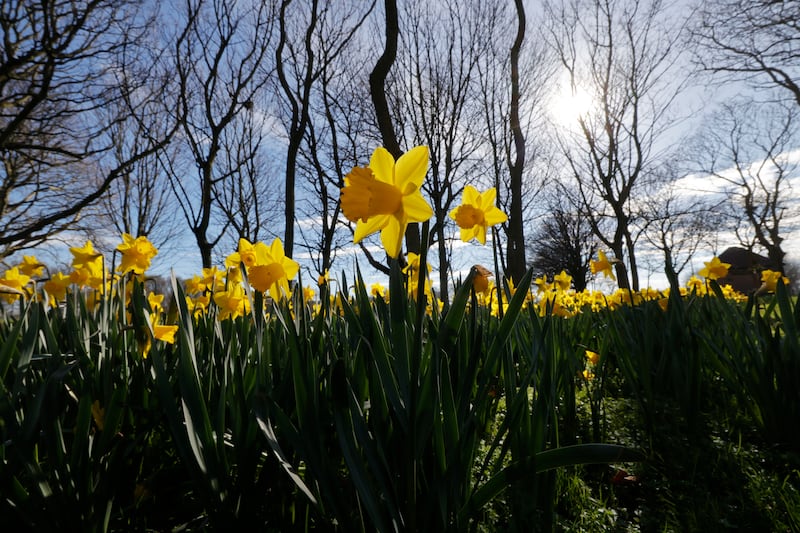 September is daffodils’ season in Australia. Yet seasonal predictability seems to live in you somewhere. The body expects spring despite the fact that we’ve just had summer. Photograph: Alan Betson
It isn’t just the rhythm of Australian nature that is shockingly other for someone who grew up in Ireland. Its size, its cadence and its capriciousness will all unnerve you. This is my third autumn here and yet the natural world still seems too vast and strange to predict. At home we have storms, floods, ice. We can have months of rain, wind that will pull trees down on us and waves that bite chunks from the land they rush at. We have bats and hornets and rodents that move in when the winter gets too cold. Nature imposes its will on us and we work around it.
The other day, I halted suddenly at the door of my building because there was an alien perched on it. Just standing there. A large, sticky insect the beige-grey colour of driftwood with two opaque, livid green orbs for eyes.
Horrified, fascinated and unsettled, I sent a picture to my friend Daniel in Dublin. He is, among other things, one of those guys who finds bugs very interesting and knows a lot about them. I respect this interest but do not share it. It didn’t take him long to get back informing me that the guy with all the legs on the door was a purple-winged mantis. They can fly, live up to a year and are usually three to four inches in length, though I would conservatively guess this one was around nine feet long. They eat other insects, he told me.
Google enlightened me further – they’ve been known to eat small frogs or lizards. There was this mantis on the door – this frog-swallowing, twig-mimicking exoskeletal alien. This marvel of nature. This horror. This surprise.
A few nights later himself and I sat at the dinner table discussing the day when the apartment began to move around us. This is unusual. We live high up in a tall building and the sensation was unlike anything I’d experienced.
My houseplants waved merrily in their pots like my brother’s breeze-brushed lawn daffodils, and the floor rumbled up through my chair, sending warning shocks into my feet. “Is the building falling down?” I thought briefly, before the movement stopped and the plants stilled. We waited with chests full of unexhaled air to see if it would start again. Modern apartment buildings are rarely very well built. I wondered if some cowboy’s cost-cutting measures would have everyone in the building plummeting to the street. Nothing more happened. We stared at one another.
“Was that an earthquake, do you think?” my husband asked, but in the tone of someone who just saw a horse with a horn tied to its head asking, “Was that a unicorn, do you think?” In Ireland, buildings have the decency to stay where we put them under most circumstances. They are not known to wiggle suddenly about as though they’re shaking out one weary leg. We have no precedent for moving apartments.
It was a unicorn. Or rather, it was an earthquake. A very, very small one, the epicentre of which was well over 100km from our livingroom. Almost embarrassingly small, really. It was the kind of earthquake you’d be taunted for even calling one and yet Google confirmed it. Later, so too did the local paper, whose stories about earthquakes and crime and a local avian scoundrel who was caught on camera stealing people’s parcels from their front porches keep me informed of local happenings.
“Did you know that could happen here? An earthquake?” my husband asked politely, returning confusedly to his dinner. “I did not,” I replied, thinking about the mantis on the door and the daffodils in Limerick and the eastern brown snake I saw easing its ropy heft into some dry looking grass by a quiet path I was walking down. “We’ll add it to the list.”