
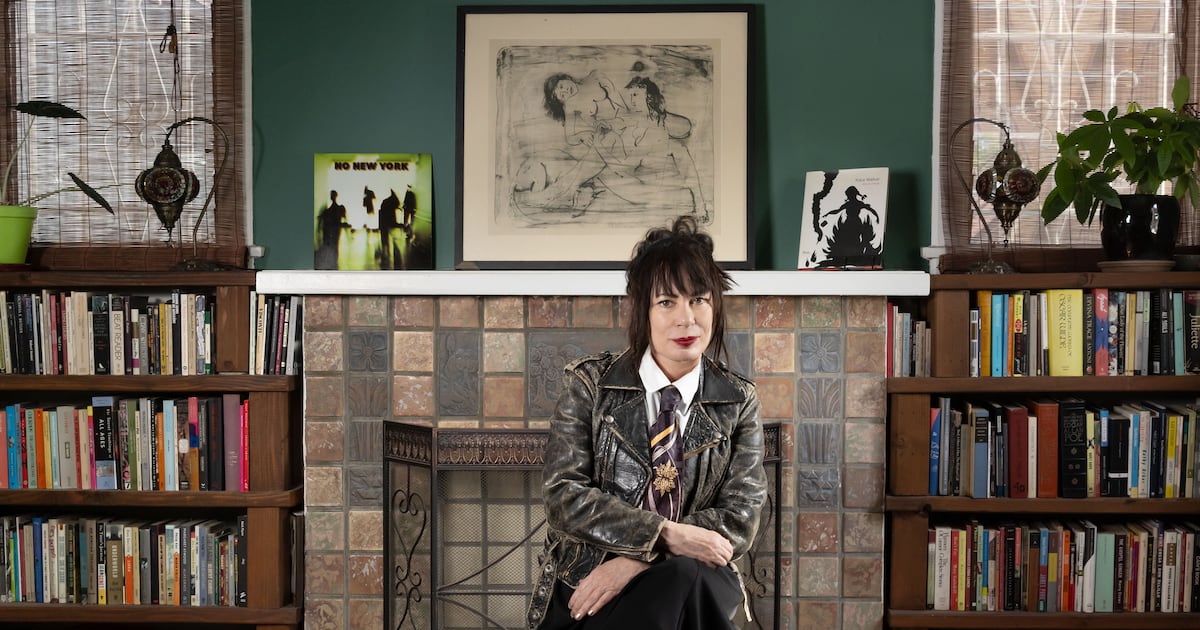
When Adele Bertei alighted from the Cleveland bus at Port Authority in July 1977, New York City was in a bad way. Bankruptcy, blackouts, arson, muggers, and pervs hanging around peepshows and midnight movie theatres. But this urban wasteland also spawned beautiful cultural mutations, proto-punks like Suicide, Patti Smith, Television, Blondie, the Ramones, Richard Hell and Talking Heads.
Bertei arrived on the scene as a shorn-headed veteran of Ohio juvie institutions. She’d visited the city briefly before, under the wing of her friend and mentor Peter Laughner (Rocket from the Tombs, Pere Ubu) and his buddy Lester Bangs, the legendary rock writer. Then Laughner died and Bangs fell into decline. The 22-year-old was on her own.
She found her freak family among the burgeoning no-wave movement that included James Chance and Lydia Lunch, bands like Mars and DNA and Teenage Jesus and the Jerks. She joined The Contortions, worked with Brian Eno documenting the scene on vinyl, embedded with the Super 8 guérillères film-makers, basically a queercore feminist artists’ colony.
Her friends included the photographer Nan Goldin, the Born in Flames director Lizzie Borden and the expat Irish film-maker Vivienne Dick. Before Aids and heroin decimated downtown, the scene was almost egalitarian, if not utopian, with writers and artists like Kathy Acker, William S Burroughs’s bunker coterie, Jean-Michel Basquiat and the Wild Style/Fun gallery crew.
Bertei’s new book, No New York: A Memoir of No Wave and the Women Who Shaped the Scene, is an inspiring and electrifying account of those days in the downtown demi-monde. What does she hope a younger generation might take from it?
“I think the human connection,” she says, on a video call from California. “We didn’t have the internet, social media, any of this technological distancing. It was economic as well: we could live very cheaply. But being in communion with each other in the clubs, in the streets, cross-collaborating across different genres, was so ecstatically freeing and creative.
“I think it was Descartes who said there’s animal spirits in the blood, and I don’t feel we can have that in a technological society where we’re living through screens. We need to be with each other.
“If there’s some way that can be communicated to young people at a time where we’re being completely commodified, and where transhumanism is being pushed on us – where they’re trying to erase our humanity, basically – there’s got to be a way that young people can seize it back.
I do think about people a lot that are gone and what they had to teach
— Adele Bertei
“And I think part of that is by divesting all this technological insanity that’s going on, at least be able to harness it for ourselves instead of being controlled by it.”
How did she transport herself back to the 1970s in order to write the book?
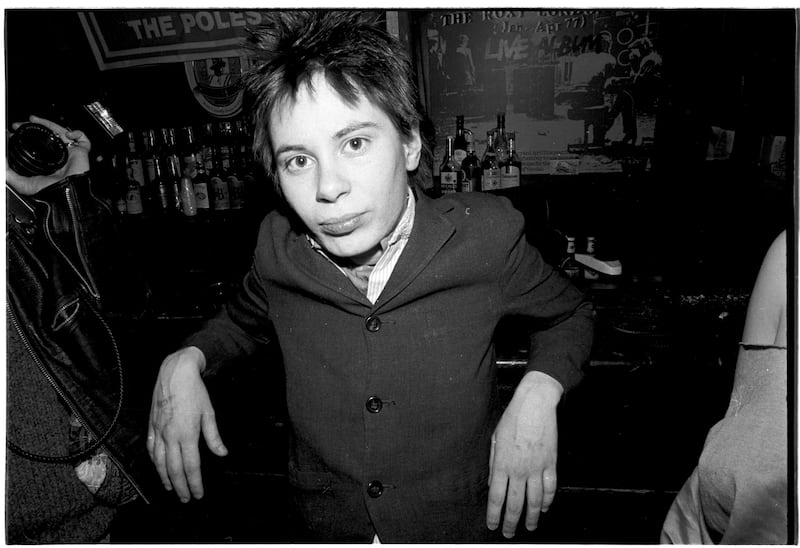 Adele Bertei at CBGB, the New York music club. Photograph: Julia Gorton
“Music’s always a memory cue for me, and photographs would trigger certain memories as well. I have an altar. I do think about people a lot that are gone and what they had to teach. And how much longer we’re going to be on this earth is hard to say, as we’re looking at existential obliteration, the messages we’re getting towards women and girls, that these men in power are saying, ‘We’re going to kill you. We’re going to rape you. We’re going to control you. There’s absolutely nothing you can do about it.’
“It’s a kind of psychological warfare. I didn’t feel that back in the 1970s or 1980s; I felt an equilibrium. There was oppression against women, but in our art scene we were very equal; the men respected us in a lot of ways. I think they were more inspired to take artistic risks because we were doing it.
“But right now it’s almost as if the patriarchy is this huge toxic boil and it’s exploding, and we really need our male allies to come to the fore here and help us out, because it’s a f**king mess.”
The strange thing is that Bertei’s book crackles with a constant play between the dystopian and the utopian; the no-wave scene was simultaneously stimulating and scary.
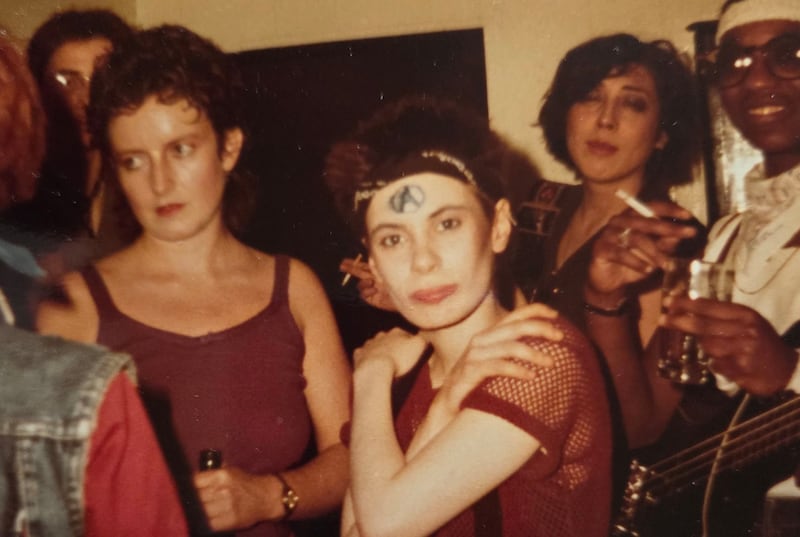 The Bloods: Adele Bertei in the band she formed with the guitarist Kathy Rey
“It definitely was. New York City was bankrupt completely. It felt like we were on the heels of Patti Smith. She was this androgynous force, this revolutionary poet that came out spitting. And for women all over the country, all over Europe, Japan, everybody flocked to New York – men as well – because there was a moment that felt like something was cracking open.
“Here we had this city that looked like Dresden after the war, and we were able to walk in there and do with it what we would, so we created art on the walls, in the studios, in the lofts. We took over buildings. We collaborated. We made work with pennies. You made Super 8 movies with any amount of money you could scrape up, going into the junkyard of New York City and building this kind of brutalist, defiant society of art makers.
“That had never really existed before in the way that women were involved. If you look at the surrealists in Paris, the Beats, it was all primarily men, and the women were just kind of shadow figures. That was not the case here. The women were equal progenitors.”
That legacy continued into the 1990s, when rock bands were frequently co-ed: the Pixies, Sonic Youth, Smashing Pumpkins, the Breeders, Hole, Garbage. That ended with the pornification of hip-hop and pop, assembly-line boy and girl groups, a return to 1950s teen-idol conservative values.
“And that was social engineering. I don’t know what it was like in Ireland, but in America, in the early days of the 1990s on the radio, you had really revolutionary women’s voices like Dolores O’Riordan, Alanis Morissette, Shirley Manson, Courtney Love, Tracy Chapman, Tori Amos.
“And then Bill Clinton did something called the Telecommunications Act of 1996, and it consolidated all the radio stations around the country. And guess what happened: women’s voices disappeared from the radio. Strong women’s voices like Queen Latifah, gone.
It’s been engineered in a way that sexuality is the most important thing … are you sexually free or are you exploiting yourself?
— Adele Bertei
“And this is a consistent misogyny that’s been happening, systematically, and it’s hitting its worst peak right now. We’re living through it. But I’d like to know, are there more co-ed bands happening in Ireland?”
There are, on a grassroots level. In my hometown of Wexford we’ve had young bands like The Ovarlords and The Mabels. But radio will never play them. They won’t be invited on to TV shows. Even on a global level, Nine Inch Nails and Deftones sell out arenas and stadiums, but they’re almost completely blanked from the mainstream media.
[ Deftones: ‘I definitely think we’ve followed the Madonna model’Opens in new window ]
“Same with certain rap women. It’s been engineered in a way that sexuality is the most important thing, and that’s a mixed message, because are you sexually free or are you exploiting yourself? Which the patriarchy loves.”
But style is seditious. In 1970s downtown pageantry, no one had any money so they sewed their own. Clothing was handmade, home-made, distressed or repurposed. Idiosyncratic exhibitionism was in. Retro-irony, androgyny, fetishwear. No logos, no off-the-rack tat, no fast fashion.
“Everybody was playing to their innermost fascinations, whether it be French new wave or Buster Keaton, or women being incredibly feminine, like Jeanne Moreau. We were anti-commodification, anti-label.
“I always think of the Au Pairs’ Stepping Out of Line. Do you remember that song? It’s all about the fact that the more we brand ourselves into these tiny little compartments, sexually or politically or racially or ethnic or whatever, it gives the powers that be, the corporatocracy, the ability to know exactly how to sell to us, to brainwash us.
“These are the things that divide us as a people and prevent us from creatively having a revolution.”
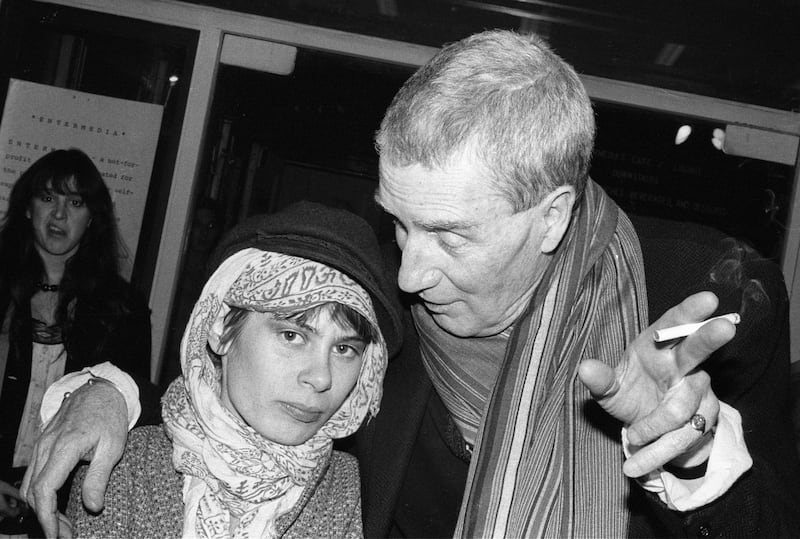 Adele Bertei with the painter, poet and writer Brion Gysin
And for many young Gen X men, artists like Patti Smith or Chrissie Hynde were as sartorially influential as Keith Richards or Jim Morrison, co-opting a male-rock-star paradigm, feminising it, making it more poetic.
“Antonin Artaud kind of predicted electric instruments in his Theatre of Cruelty essay. He didn’t say they belonged to women or men. The same with Arthur Rimbaud. We were paying a lot of attention to these people in no wave, people who said that when women finally break through their conditioning they’re going to create marvellous things.
“These were our credos. We all grew up with rock’n’roll – we loved it – but it was kind of positioned as a male paradigm that we couldn’t break. And then these brave women like Patti Smith and Chrissie Hynde said, ‘F**k that, we’re going to do it our way, use it to say what we want to say,’ which was revolutionary for its time. And people followed.”
No New York: A Memoir of No Wave and the Women Who Shaped the Scene is published by Faber & Faber on Thursday, March 26th. Adele Bertei will be in conversation with Peter Murphy at Books Upstairs, Dublin 2, on Tuesday, April 21st, at 6.30pm