
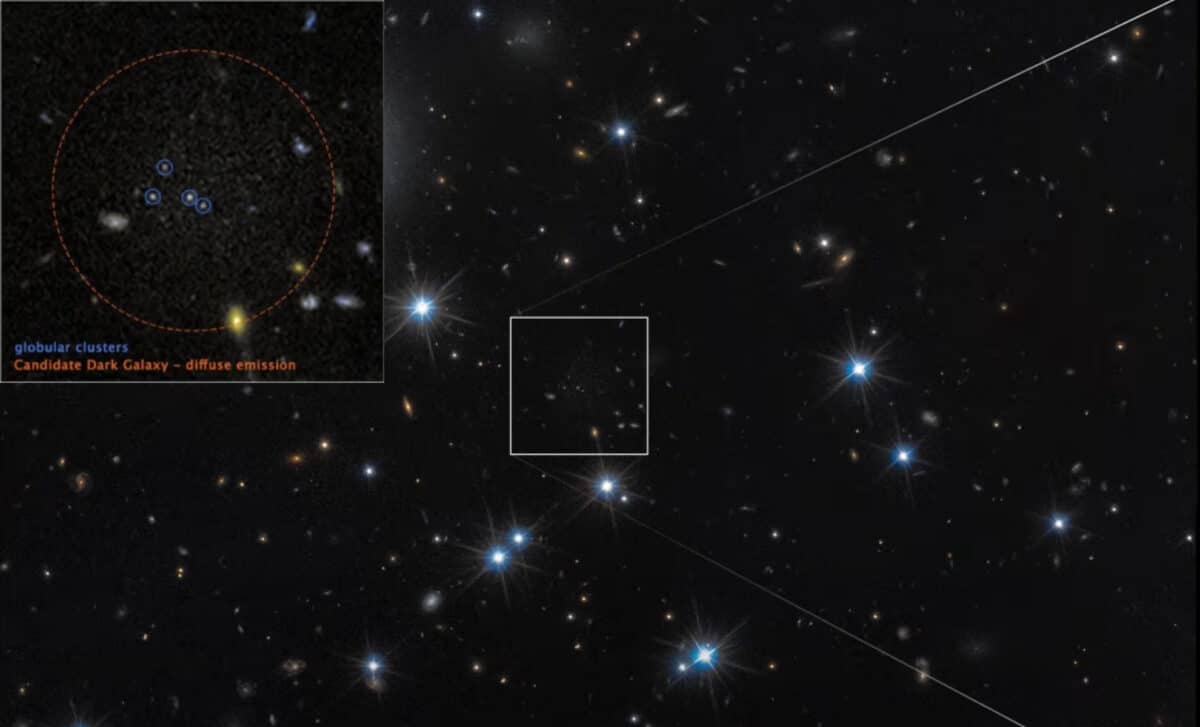
Dark matter is no stranger to the cosmos. It outweighs ordinary matter, the kind that forms stars, planets, and everything tangible, by five to one across the universe. Yet even within that dark-matter-saturated backdrop, CDG-2 stands in a category of its own. A study published in The Astrophysical Journal Letters describes it as a compelling candidate for so-called “dark galaxies,” a class of objects astronomers have been hunting for decades, theorized to contain vanishingly few stars, if any at all.
The galaxy belongs to a broader family of objects known as low surface brightness galaxies. But according to study lead author Dayi Li, an astrophysicist at the University of Toronto, CDG-2 pushes that category to its limits. “To be technically correct, CDG-2 is an almost-dark galaxy,” he told CNN, adding that “the importance of CDG-2 is that it nudges us much closer to getting to that truly dark regime, while previously we did not think a galaxy this faint could exist.”
Hunting the Invisible With Three Telescopes
Finding something made almost entirely of undetectable material requires some ingenuity. Rather than searching for the galaxy directly, the research team looked for globular clusters, tightly packed, spherical groupings of old stars that Li describes as “basically the relics of the first generation of star formation.” In an essentially empty realm, dark matter is what helps keep these clusters gravitationally bound, making them useful markers in an otherwise lightless stretch of space.
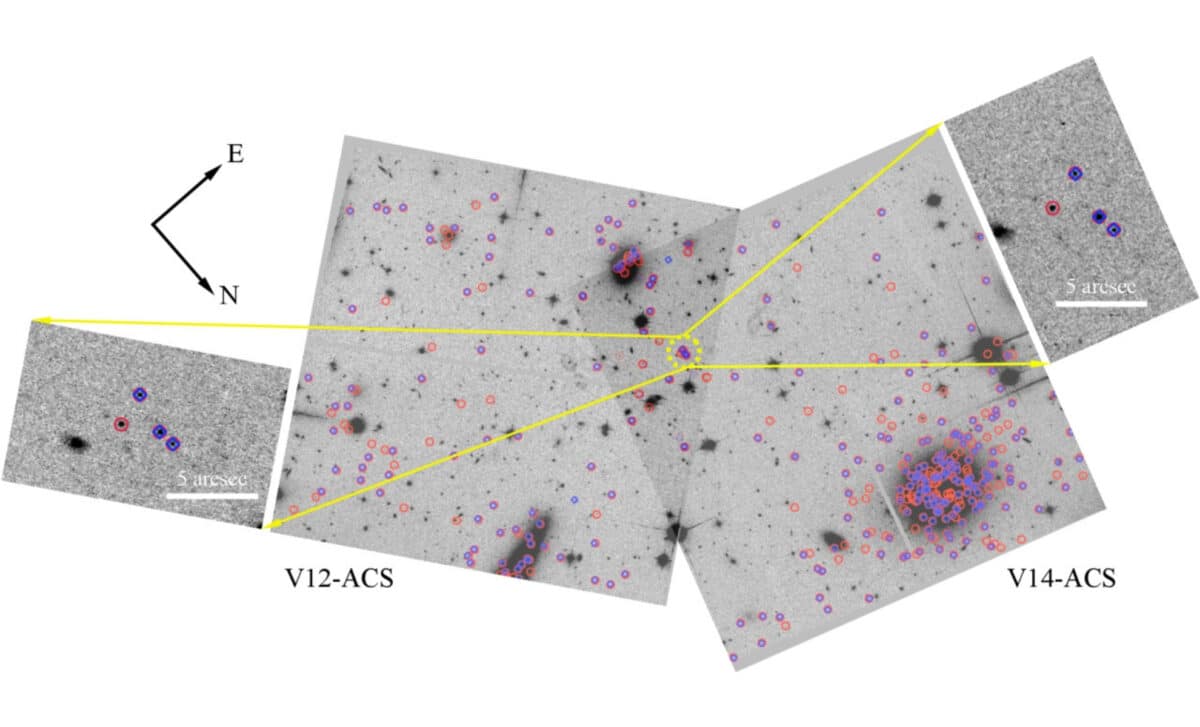 Spatial distributions of GC candidates in the F814W images V12-ACS (left) and V14-ACS (right) – © The Astrophysical Journal Letters
To track them down, the astronomers combined the capabilities of three observatories: the Hubble Space Telescope, the European Space Agency’s Euclid telescope, and the Subaru Telescope in Hawaii. The search led them to the Perseus Cluster, a dense grouping of thousands of galaxies suspended in a cloud of superheated gas, described by the study as one of the biggest and brightest objects in the known universe. There, they pinpointed four globular clusters sitting in what appeared to be an empty stretch, until a faint halo of glowing matter surrounding them confirmed that a galaxy was, in fact, present.
Starved Before It Could Grow
The Perseus Cluster, for all its scale, turns out to be an unforgiving environment for young galaxies. According to the research published in The Astrophysical Journal Letters, CDG-2 likely lost its ability to form stars because older, neighboring galaxies stripped away the material it needed to develop. It was, in essence, starved of its building blocks before it ever had the chance to grow.
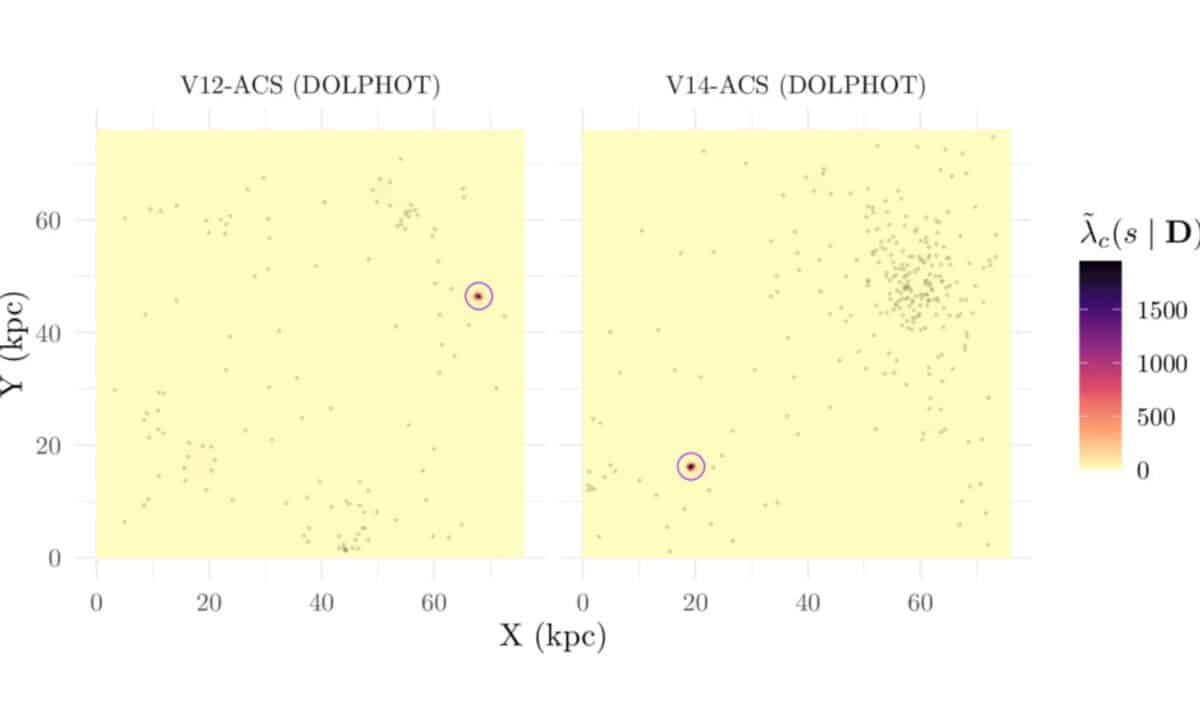 Scaled posterior probability (posterior/prior probability) of the potential locations of UDGs/dark galaxies in the images V12-ACS (left) and V14-ACS (right) obtained using the detection method in D. Li et al. (2025a) based on the DOLPHOT GC data (W. E. Harris et al. 2020) – © The Astrophysical Journal Letters
“The material that this galaxy needed to continue to form stars was no longer there, so it was left with basically just a dark matter halo and the four globular clusters,” Li told CNN. What remains is a skeletal structure, a dark matter halo anchoring four globular clusters, with almost nothing else to show for what might have been a fully developed galaxy under different circumstances.
A Pristine Lab for Dark Matter Physics
The scientific value of CDG-2 extends well beyond its strangeness. In typical galaxies like the Milky Way, dark matter is deeply intertwined with stars, gas, and all the complexity that active star formation brings, making it difficult to study on its own terms. CDG-2, stripped down to almost nothing, offers a rare workaround.
According to Neal Dalal, a researcher at the Perimeter Institute for Theoretical Physics in Waterloo, dark or nearly dark galaxies could provide a “cleaner probe of dark matter physics.” In ordinary galaxies, he explained to CNN, “stars and gas can have a significant impact on the distribution of dark matter, making it difficult to disentangle the effects of ordinary matter from the effects of dark matter.”
A galaxy where ordinary matter is nearly absent sidesteps that problem almost entirely, making CDG-2, paradoxically, one of the most useful objects astronomers have come across in quite some time.