
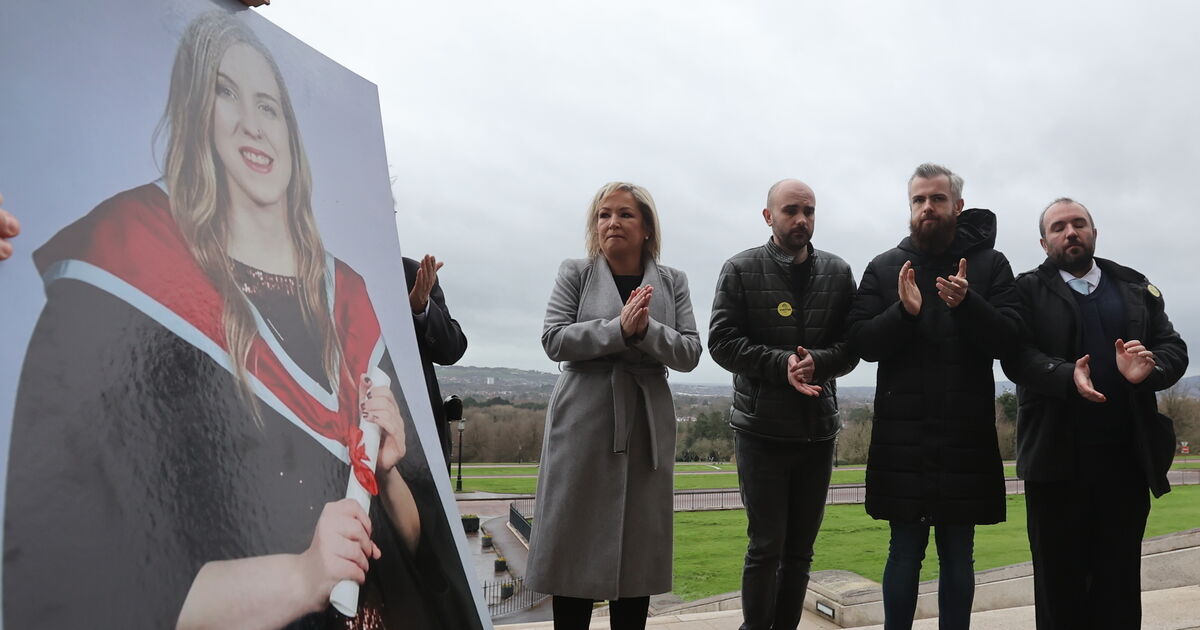
“Violence against women and girls is the shame of our society and we must do everything possible to end it,” were the words of Declan McNally as he paid tribute to his sister Natalie, who was three months pregnant when she was murdered in 2022.
This week in Belfast, her partner, Stephen McCullough, was found guilty of her murder. In the same week, a male suspect has been arrested and charged with the murder of 23-year-old Ellie Flanagan in Enniskillen, and police have launched a murder investigation into the killing of Amy Doherty, a young mother in Derry, murdered over the weekend.
Northern Ireland is the most dangerous place in the UK and Ireland to be a woman, and the second-most dangerous region for women in all of Europe, with femicide levels outranked only by Finland. Women account for 90% of sexual offence victims and 67% of domestic abuse victims, according to data from the Police Service Northern Ireland (PSNI).
Thirty-three women and young girls have suffered violent deaths since 2020. Each one of these violent crimes devastates an entire family in unimaginable ways, and leaves an indelible mark, not only on local communities, but on our collective humanity.
We in wider society cannot allow the lives of each of these women to be mere statistics. Politicians have issued statements, reaffirmed their commitments to ending this cycle of violence, and pointed to government efforts to effect change — but they can do more.
The total number of domestic abuse crimes recorded in 2024 and 2025 was 91% higher than it was 20 years prior. Whilst this spike may be partially influenced by an increase in victim reporting and police recording practices, the figures speak to a more pervasive issue; the Good Friday Agreement promised the people of Northern Ireland a future free from violence, but the violence has not gone away, it’s concealed behind closed doors.
Research from Ulster University suggests 98% of women in Northern Ireland have experienced at least one form of violence or abuse in their lifetime, with 50% enduring maltreatment before the age of 11, and seven out of 10 experiencing some form of violence or abuse within the last 12 months.
After the 1998 Good Friday Agreement, peace was primarily defined as the absence of sectarian war between men. Violence against women was largely relegated to a private or social issue rather than a political priority.
It wasn’t until September 2024 before the Northern Ireland Executive finally launched its first comprehensive Strategic Framework to End Violence Against Women and Girls. By international standards, we continue to lag far behind our post-conflict counterparts, with lethal consequences.
The systemic levels of violence against women and girls in Northern Ireland is not unique; across the island of Ireland, women are at greater risk of harm.
Despite being two different jurisdictions, societies north and south have been shaped by religious institutions that emphasised the sanctity of a conservative perception of the family unit, often at the expense of the individual safety of women.
For decades, a culture of silence has protected perpetrators and isolated women in dangerous circumstances, often in their own homes.
This isolation can be further compounded for women in rural areas where tight-knit communities can create added layers of fear and shame.
The context in Northern Ireland differs, and is more extreme, due to the high levels of violence endured throughout the Troubles, and the complete absence of effective transitional justice mechanisms.
The threat posed by paramilitary organisations who enforce a form of “community policing” continues to persist in some of the most disadvantaged areas.
A 2022 report from Cooperation Ireland focused on a gendered analysis of paramilitary coercive control concluded that violence and coercive control against women is an organised strategy used by paramilitaries on an international scale.
This control is compounded by a culture of silence and high levels of poverty — both of which, paramilitaries thrive on. Northern Ireland does not have an anti-poverty strategy.
Instead of ridding ourselves of the scourge of paramilitaries from society, we watch TV advertisements, akin to safe driving ads, warning of the coercive control weaponised by paramilitaries; the presence of these dangerous, illegal organisations has become normalised.
The first minister and deputy first minister both provided statements condemning violence against women and girls following the conviction of McCullough. That they chose to deliver their messages separately suggests a return to the trenches ahead of next year’s Assembly election, when the people they’re meant to represent desperately need a joined-up approach.
The stop-start nature of the Northern Ireland Assembly has limited real progress, while the mandatory power-sharing agreement restricts any single party from advancing a progressive agenda.
Women were only mentioned twice in the Good Friday Agreement, and neither references highlighted their vulnerability and the need to tackle systemic violence.
By contrast, Colombia treated violence against women and girls as a barrier to peace; during the Havana peace talks a specific gender sub-committee body was formed to review every line of the peace treaty.
A transitional justice court was established with a specific jurisdiction for crimes against women during the conflict. The law specifically recognises that economic independence is the most effective long-term shield against domestic violence.
In Rwanda, where sexual violence was used as a weapon of war during the 1994 genocide, the government determined that the best way to combat violence against women and girls was to increase women’s representation at the highest levels of government, manifested in-part with a 30% gender quota across all decision-making bodies.
Today, 63% of parliamentarians in Rwanda are women — far beyond Ireland, North and South — although there are concerns the regime is not democratic and parliamentarians have limited power.
For victims and survivors, the government created the Isange Model; a one-stop access point located within hospitals that provides immediate treatment, forensic evidence collection, counselling, emergency housing and a police officer on-site to record statements.
By contrast, victims across this island face a bureaucratic labyrinth of services that behaves more like a physical and emotional barrier to healthcare and justice.
Liberia’s dedicated sexual crimes court was created to solve the problem of cases languishing in a slow, general court system. What is to prevent Northern Ireland or Ireland from establishing a specialized domestic and sexual violence court?
In Timor-Leste, the Nabilan program, run by the government, works with the Catholic Church and traditional leaders to challenge the preconception that maintaining family honour requires concealing domestic abuse as a secret.
In Sierra Leone, success in tackling violence against women came from creating a chain of referral centres that connect isolated rural women to urban legal services.
Northern Ireland is currently in the middle of its First Delivery Plan (2024-2026). The focus right now is on “The Power to Change” campaign, which targets the attitudes of men and boys — a direct lesson learned from the Timor-Leste and Sierra Leone models of social change.
The problem is that Northern Ireland is attempting to adopt the theory of other successful post-conflict transitions without the infrastructure needed to turn theory into action.
Women make up over 50% of the population, and are being failed systemically. We can’t keep ignoring the legacy of Northern Ireland’s conflict, nor the legacy of Ireland’s patriarchal past.
Strategies are of little use without the infrastructure to support them. Northern Ireland’s peace process is praised as a global example, but it stands as an outlier in its failure to protect women.