
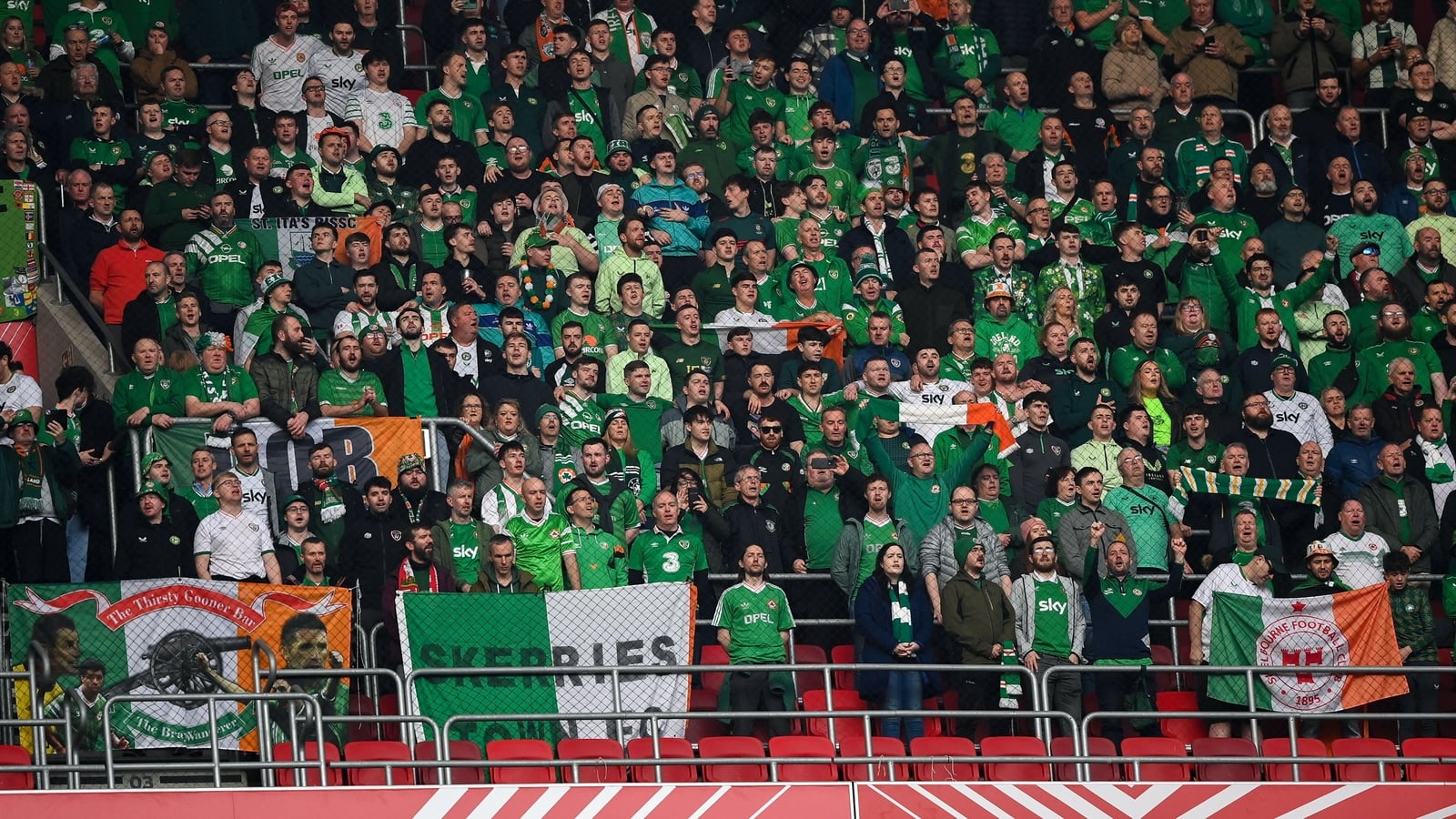
A few days after the miracle of Budapest, Wayne Rooney tentatively advanced the idea that Ireland might have over-celebrated following their dramatic late winner against Hungary.
“I thought they’d actually qualified,” Rooney joked on The Overlap.
It was a mark of how out of tune this sentiment was with the Irish football public at the time that Roy Keane – a man who ordinarily might be expected to loudly agree with such a proposition – pushed back on the idea.
In the midst of the general euphoria after Hungary, there were some occasional, brief twinges of annoyance that Ireland somehow weren’t in the World Cup, still.
People wondered how it was that every contentious enlargement of the tournament – save for the initial one bringing it from 16 to 24 teams, to be fair – seems to make it no easier for the unfashionable middle-ranked UEFA nation to earn an invite.
It’s easy, if you’re not careful, to turn into a resentful, Euro-centric snob about it all.
Eight years from now, when the World Cup is 128 teams, we’ll be hearing reports of how a former American nuclear testing site in the Pacific – managed by Jesse Marsch – has qualified for their first ever World Cup at the expense of an oil rig in the Indian Ocean.
Meanwhile, Ireland face a tense play-off against the Swiss, with Poland awaiting the winner in the next round…
If Rooney was following the coverage of this week’s match, he might conclude that Ireland are already in the World Cup.
The build-up to the game in Prague has been more akin to the first game at a major tournament than a qualification play-off.
The media has pulled out every stop. A good chunk of the nation’s fourth estate has decamped to the Czech capital for the week. Popular podcasts are broadcasting on location.
This afternoon’s Liveline will go out from the Irish Times Bar over there, in case anyone in the vicinity wants to air their grievances in person rather than over the phone.
Every second video appearing on social video feeds is an airport vox-pop. One lad has apparently sold his car to stump up for the trip. Another Melbourne-based Irishman has “done a Stephen Ireland”, a plan which might have stood a better chance of working had he refrained from disclosing it on the national airwaves.
Prague’s bizarrely small football stadium means that the city centre will be thronged with Irish fans all day and into tonight, some of whom have yet to be interviewed.
Prague has been painted green ☘️ @SamanthaLibreri has the latest ahead of the Republic of Ireland’s World Cup play-off against Czechia tomorrow night #RTEsoccer pic.twitter.com/ORzSUQttdH
— RTÉ Sport (@RTEsport) March 25, 2026
Certainly, the build-up is far more fevered than the last World Cup play-off in which Ireland participated in November 2017. Play-offs for major tournaments were still a fairly regular occurrance for Irish football back then.
It was after the goalless draw in the first leg in Copenhagen that Thomas Delaney – the Denmark midfielder who sounded like he should have been playing wing-back for O’Loughlin Gaels – compared the experience of playing against Martin O’Neill’s Ireland as being akin to trying to open a can of baked beans with your bare hands.
Three days later, the beans all toppled out on the floor after O’Neill panicked when Ireland went 2-1 down before half-time. The second half was carnage. There’d emphatically be no World Cup adventure for Ireland in Russia.
That heralded the end for a few old stagers and the national team was bound for the grimmest of footballing recessions.
The extreme torment that Irish football has endured since then, both on and off the pitch, has framed the context for the displays of yearning we are witnessing on the streets of Prague.
Old-timers reared on decades on sporting disappointment might be feeling a little uneasy at all this hype, believing in the timeworn fashion, that we’re setting ourselves up for a fall.
It’s a stark contrast with the locals, according to Czech-based Irish journalist Ian Willoughby, who informed Paul O’Flynn on Tuesday that Czech folk prefer ice hockey to soccer these days and have little time for the current generation of players.
Rumours abound that West Ham’s Tomas Soucek, recently stripped of the captaincy, has been dropped altogether for this game, as a punishment for telling his disgusted public to shag off after their 6-0 win over Gibraltar last November.
In recent days, a major match-fixing scandal has broken in Czech football which is dominating the back pages of the national press.
But then, say the pessimists, didn’t Italy win a World Cup in the same summer their biggest ever football scandal (which is saying something) broke into the open?
In the wake of the draw, Heimir suggested that one of the advantages that Ireland have over their opponents is that they are happy to be at this stage – as Wayne Rooney well knows.
The Czechs are certainly not pleased to be in this mess, after finishing a distant and unimpressive second to Croatia in a group where the Faroe Islands were their closest pursuers. The 2-1 loss away to the Faroes prompted them to bump off their manager Ivan Hasek, with an interim boss seeing out the campaign.
Since then, they’ve appointed the 74-year old Miroslav Koubek as manager, a man who has certainly been around the block in the Czech domestic league, managing a host of clubs since the 1980s.
In appearance, Mr Koubek does slightly resemble one of those pre-Gorbachev Soviet leaders who were given the top job when they were already on their death-bed.
He was wary of Irish reporters’ attempts to generate dressing room wall material for the visitors, accusing them of relying on Google Translate when (mis)quoting him as describing Ireland’s style as “primitive”.
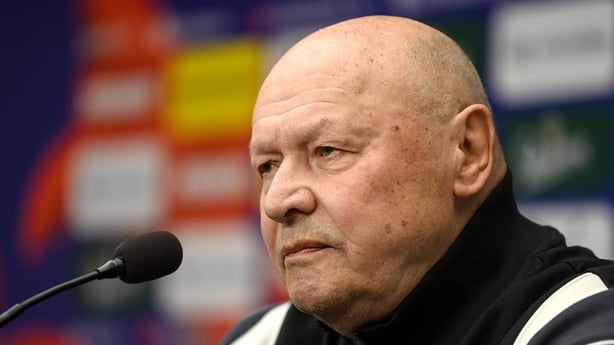
Czechia manager Miroslav Koubek
Koubek praised the “outstanding” Troy Parrott and said that his team must “eliminate” the Ireland striker – meaning that in the Dara O’Shea rather than the CIA sense of the word.
Regardless of the Czech’s current mindset and the fractious mood among the football family over there, they remain favourites tonight.
But Ireland’s manager – who seemed bound for the exit door last October and is now safely in place until Euro 2028 – has shown himself to be astute in the field of psychology.
Miguel Delaney in the London Independent reported this week that Heimir’s ‘team-talk’ before kick-off in Budapest consisted of making his players wait until the final moments and then walking in to say, “What are you looking at me for? It’s up to you now.”
The hope is the confidence boost generated by surmounting that task will power them through these play- offs. Séamus Coleman said yesterday he didn’t think the team could have coped with this hype and pressure two years ago.
The nation back home – and the invading army in Prague – will be hoping they have the tools to meet the moment. It’s up to them now.
Watch Czechia v Republic of Ireland from 7pm on RTÉ2 and RTÉ Player. Follow our live blog on RTÉ.ie/sport and RTÉ News app or listen to commentary on Inside Sport on RTÉ Radio 1
Listen to the RTÉ Soccer podcast on Apple Podcasts, Spotify or wherever you get your podcasts.