
Main PointsKey Reads
Órla Ryan – 17 minutes ago
EU ministers seek united strategy on energy price crisis
European Union finance ministers will on Friday seek to coordinate their response to the energy price surge due to the Iran war, ensuring that the measures aid the vulnerable and move Europe further away from fossil fuels, while keeping the fiscal cost and demand in check.
Oil and gas prices have spiked since the US-Israeli strikes on Iran began on February 28th, creating a price shock similar to the energy crisis Europe went through after Russia invaded Ukraine in 2022, even as EU countries are now getting a lot more energy from renewable sources.
“EU-level coordination is essential to prevent market fragmentation and leverage economies of scale, thereby reducing the overall need for intervention,” the European Commission said in a note preparing the ministers’ discussions.
But because European governments don’t know how long the disruption to oil and gas shipments through the Strait of Hormuz will last, they are cautious about launching fiscally costly policies that might soon be unnecessary but will be hard to roll back.
EU finance ministers have invited the head of the International Energy Agency, Fatih Birol, to brief them on the latest developments.
“Short-term measures to provide relief to consumers (households and industries) could be considered,” the Commission said. “However, a key lesson from the 2022-2023 energy crisis is that many of these measures were broad and untargeted, leading to inefficiencies and very large fiscal costs.”
– Reuters
Órla Ryan – 33 minutes ago
More than 370,000 children displaced in Lebanon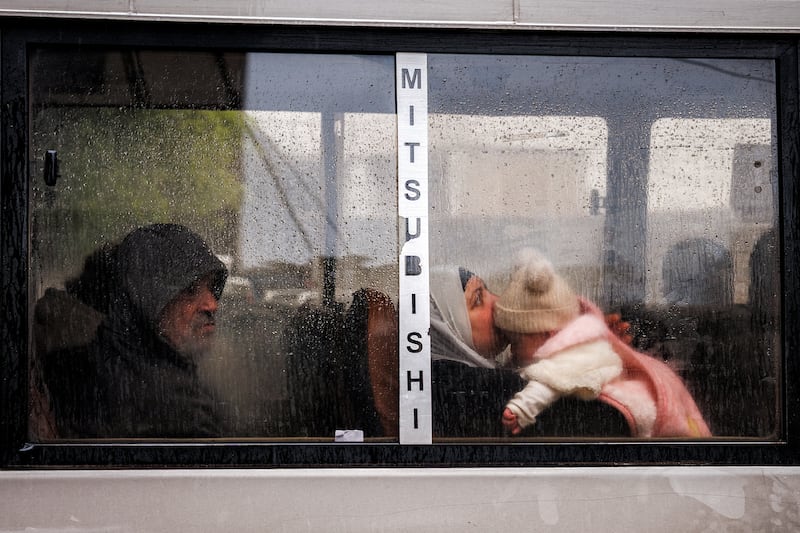 A woman holds a child as she rides in a bus in central Beirut on Thursday. Photograph: by Dimitar Dilkoff/AFP via Getty Images
More than 370,000 children have been forced from their homes in Lebanon amid Israel’s offensive against Hezbollah, with at least 121 children killed and 399 injured, Unicef’s representative in Lebanon, Marcoluigi Corsi, said on Friday.
Millions of people in Lebanon and Iran have been displaced since the start of the war.
– Reuters
Órla Ryan – 47 minutes ago
Transit through Hormuz will face ‘harsh measures’ – Iran
Iran’s Islamic Revolutionary Guard Corps said on Friday that shipping “to and from ports of allies and supporters of the Israeli-American enemies” is prohibited through any corridor or to any destination, Iranian state media reported.
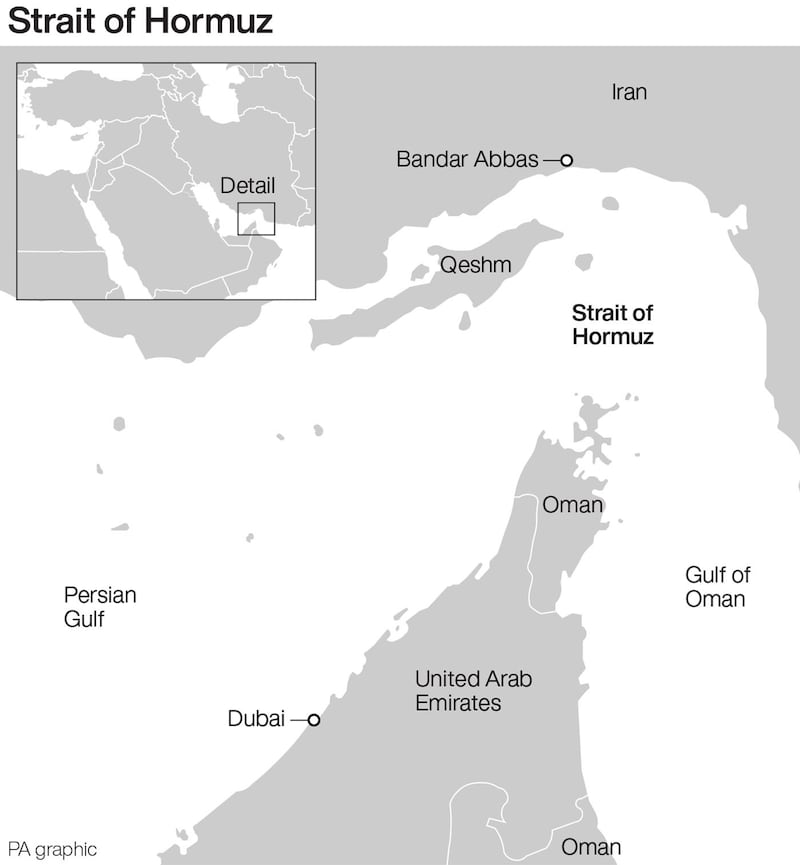 The IRGC said the Strait of Hormuz is closed and any transit through the waterway will face “harsh measures”. Image: PA Graphics
The IRGC added that the Strait of Hormuz is closed and any transit through the waterway will face “harsh measures”.
Three container ships of various nationalities were turned back from the Strait of Hormuz after warnings from the IRGC revolutionary guards’ navy, according to reports.
– Reuters
Órla Ryan – 54 minutes ago
Oil prices rise again
Oil prices rose by about 2 per cent on Friday to more than $110 (€95) a barrel.
Gas prices in Europe were also buoyed by low storage levels.
“Storage levels in the EU have dropped to 28 per cent and fears are growing that it will become difficult to reach EU storage targets ahead of the next heating season,” analysts at trading group Mind Energy said.
The European Commission on Thursday urged EU governments to start refilling gas storage caverns as soon as possible to prepare for next winter, EU diplomats said.
– Reuters
More from the UN Human Rights Council debate in Geneva this morning:
High Commissioner for Human Rights Volker Turk implored all sides to end their attacks and return to talks.
“US and Israeli attacks have increasingly struck densely populated residential areas and destroyed civilian infrastructure,” he said.
“Homes, medical facilities, schools, courts, transport networks and energy installations have been hit across all 31 provinces of the country.
“The targeting of nuclear facilities is reckless beyond comprehension. These attacks raise serious concerns over compliance with international humanitarian and human rights law.”
Read Turk’s full speech here.
Starmer says Iran and Ukraine wars could reshape global order British prime minister Keir Starmer said the Iran and Ukraine wars could have “huge implications” for the future. Photograph: Adrian Dennis/PA Wire
British prime minister Keir Starmer said the Iran and Ukraine wars could have “huge implications” for the future and could reshape the global order.
“How they end and on what terms could well define us for a generation,” Starmer told Sky News.
“And that’s why it’s really important that we approach this with our values and principles. That’s what we’ve applied in Ukraine, and that’s what we’ve applied in Iran. And, certainly, we’re working with others to de-escalate the situation in Iran.”
British foreign secretary Yvette Cooper is in France today for the meeting of G7 foreign ministers in Vaux-de-Cernay, near Paris, where she is expected to speak with US secretary of state Marco Rubio.
On top of the agenda is the conflict in the Middle East, with reports suggesting Rubio will ask ministers for help reopening the Strait of Hormuz.
In comments ahead of the summit, Cooper said Iran “cannot hold the global economy hostage”, adding that she wants to see a “swift resolution” to the Middle East crisis. She also expressed “deep concern” over Russia’s ties with Iran “that have been longstanding in terms of shared capabilities”.
– The Guardian
Message from the Editor
 Irish Times Editor Ruadhán Mac Cormaic
Thanks for reading. If you’re interested in world news, The Irish Times has the largest network of foreign correspondents of any Irish news organisation.
Our team provides sharp reporting, in-depth analysis and thought-provoking commentary. Receive our Global Briefing newsletter in your inbox every morning to enjoy Denis Staunton’s guide to understanding world events; what’s happening, why it matters and how it affects you.
At The Irish Times, our journalism is free of any personal, political or commercial control. Unlike most publishers, we have no shareholders to satisfy, no media baron owner in the background telling us what we can and cannot publish.
We are owned by a Trust that mandates us to uphold a set of public-interest values. Those values describe a worldview that is outward-looking, tolerant, curious, interested in divergent views and attentive to the needs of minorities.
Our watchwords are fairness and accuracy. Our goal is to enable you to make informed and independent judgments. And any profit we make goes towards supporting our journalism.
Ruadhán Mac Cormaic
Editor
To join Ireland’s biggest community of news subscribers, sign up here
Iran’s Revolutionary Guards are urging civilians in the region to leave arras where US forces are stationed, according to Iranian media.
– Reuters
UN urges US to conclude probe into deadly Iran school strike “There must be justice for the terrible harm done,” UN High Commissioner for Human Rights Volker Turk said on Friday (file photo). Photograph: Fabrice Coffrini/AFP via Getty Images
The UN human rights chief has urged the United States to conclude its investigation into a fatal strike on a primary school in Iran at the start of US-Israeli attacks last month and publish the findings.
“Senior US officials have said the strike is under investigation. I call for that process to be concluded as soon as possible, and for its findings to be made public,” Volker Turk told the UN Human Rights Council in Geneva during an urgent debate called by Iran.
“There must be justice for the terrible harm done,” he said.
Some 175 people, many of them children, were killed in the strike.
– Reuters
US troops using citizens as human shields, says Iranian foreign minister
From outset of this war, U.S. soldiers fled military bases in GCC to hide in hotels and offices. They use GCC citizens as human shield.
Hotels in U.S. deny bookings to officers who may endanger customers. GCC hotels should do same. pic.twitter.com/U2U4je0059
— Seyed Abbas Araghchi (@araghchi) March 26, 2026
Local people in Persian Gulf states are being used as human shields, the Iranian foreign minister has said, according to the semi-official Tasnim News Agency.
“From outset of this war, US soldiers fled military bases in GCC [Gulf Cooperation Council] to hide in hotels and offices. They use GCC citizens as human shield.
“Hotels in US deny bookings to officers who may endanger customers. GCC hotels should do same.” Abbas Araghchi said in a post on his X account on Thursday.
– The Guardian
US and Iran plan to meet soon in Pakistan, says German minister
Germany’s foreign minister said the US and Iran have had indirect negotiations and representatives from both sides plan to meet shortly in Pakistan.
“Based on my information there have been indirect contacts, and preparations have been made to meet directly. That would be very soon in Pakistan, apparently,” Johann Wadephul told Deutschlandfunk radio on Friday
– Reuters
European Central Bank ‘should not rush to raise rates’
The European Central Bank (ECB) should not rush to raise rates in response to surging energy costs, as its “baseline” outlook remains intact and there is no sign yet that inflation is becoming entrenched, Cypriot central bank chief Christodoulos Patsalides said.
With energy prices surging, euro zone inflation is set to breach the ECB’s 2 per cent target as early as this month, prompting policymakers to debate whether to raise interest rates to head off second-round effects.
Patsalides, who sits on the ECB’s rate-setting governing council, said he would not hesitate to raise rates if he saw evidence that inflation was getting entrenched in the 21-nation bloc, but added there was no such evidence yet.
“We don’t have sufficient information to make a decision as to whether this should be looked through or whether we should be making a decision on interest rates,” Patsalides said in an interview. “I would not rush into any decision.”
– Reuters
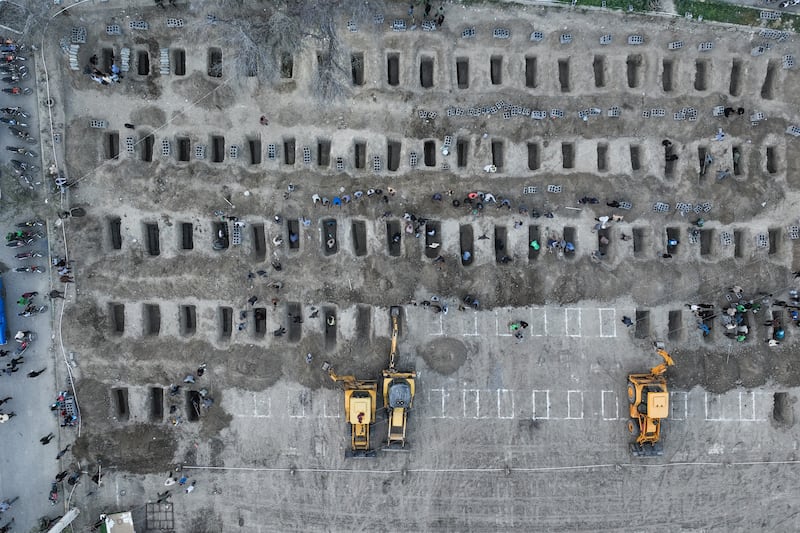 Mourners dig graves for children killed in a strike on a primary school in Iran’s Hormozgan province in Minab on March 3rd. Photograph: Iranian Press Center/AFP via Getty Images
The United Nations Human Rights Council will this morning hold an urgent debate on “the aerial attack on Shajareh Tayyebeh Girl’s School in Minab, Iran, as a grave breach of international humanitarian law and international human rights”.
The debate, which will be broadcast here, is due to begin in Geneva shortly (8am Irish time).
An ongoing military investigation determined that the United States was responsible for a deadly Tomahawk missile strike on an Iranian elementary school.
Trump had initially blamed Iran for the strike.
Some 175 people, many of them children, were killed.
More on those Israeli strikes on Iran:
Israel’s military said it carried out strikes on targets in Tehran early on Friday, according to AFP.
A brief military statement said Israeli forces “completed a wide-scale wave of strikes targeting infrastructure of the Iranian terror regime in the heart of Tehran”.
The military said in a separate statement that it had also struck “ballistic missiles and aerial defence systems production sites across Iran”. It reported hitting missile launchers and storage sites in western Iran, as well as missile production sites in the capital.
– Guardian
How many missiles does Iran have left?
Iran has maintained large and dispersed stockpiles of weapons for scenarios exactly like this, experts say.
“Around 1,400 missiles have been confirmed launched, though the exact types are muddier in terms of quantity,” says Ryan Bohl, a senior Middle East and North Africa analyst at the risk intelligence company Rane.
“It can be said that a significant portion of their arsenal has been deployed and/or destroyed.”
Read the full story here.
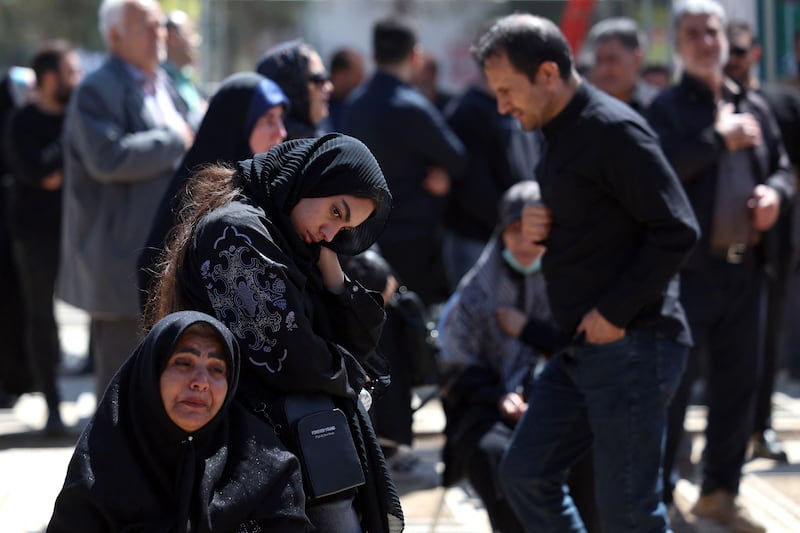 Iranian women mourn during a funeral for victims of the Middle East war at the Behesht Zahra cemetery in southern Tehran on Thursday. Photograph: AFP via Getty Images
The war has killed more than 1,900 people in Iran and nearly 1,100 in Lebanon to date. Eighteen people have died in Israel, while three Israeli soldiers have also been killed in Lebanon.
Thirteen US military members have died, as well as a number of civilians on land and sea in the Gulf region. Millions of people in Lebanon and Iran have been displaced.
– Associated Press
Israel strikes ‘in the heart of Tehran’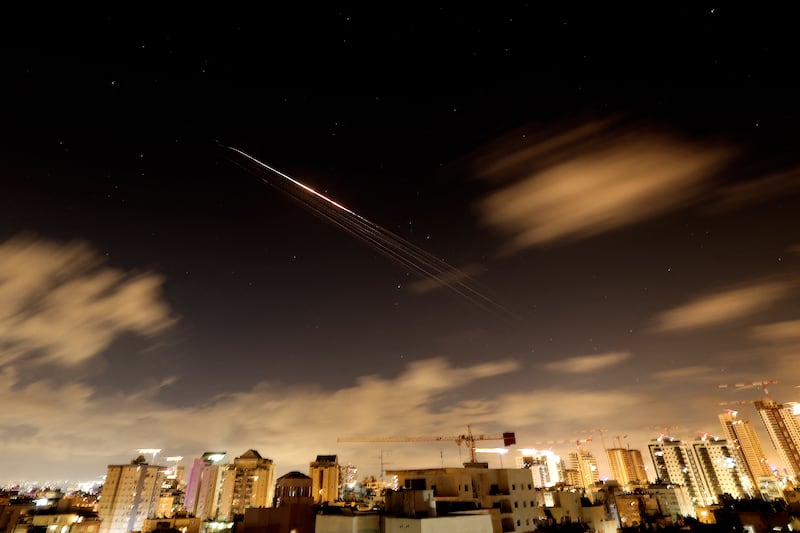 Rocket trails are seen in the sky amid a fresh barrage of Iranian missile attacks above the Israeli coastal city of Netanya on Friday. Photograph: Jack Guez/AFP via Getty Images
Israel’s military said early on Friday it had conducted a wave of strikes “in the heart of Tehran”, while smoke was seen billowing in the Beirut skyline.
Israel has moved thousands of troops across the border into Lebanon, where Israeli officials said they want to take control of the entire area south of the Litani River – some 20 miles north of the border.
Iranian media reported on Friday that a Thai-flagged cargo ship that came under attack from Iran in the Strait of Hormuz and was abandoned by its crew has run aground.
– Associated Press
Efforts to reopen Strait of Hormuz
The United Arab Emirates (UAE) has told allies it would participate in a multinational maritime taskforce intended to reopen the Strait of Hormuz as it lobbies to form a coalition to ensure shipping can is pass through the vital waterway, the Financial Times is reporting.
The newspaper says the UAE told the US and other western states it would take part, according to three people familiar with the situation, two of whom said Abu Dhabi would deploy its own navy.
The move reflects the country’s hardened stance towards Iran as it bears the brunt of Tehran’s retaliation to war from the US and Israel, it says. The report could not be immediately verified.
It also says the UAE is working on a UN Security Council resolution with Bahrain to provide any future taskforce with a mandate, but Russia and China could oppose the move, one of the people said.
Gulf states are concerned that Iran could seek to maintain control even if the war ends, the report says. There is a growing conviction among some Gulf states and the Trump administration that there is no easy means to reopen the blocked strait without naval escorts.
– Guardian
At his press conference at the White House earlier, Donald Trump took another swipe at Nato, the UK and Australia for not being more involved in his war on Iran.
Trump said: “[British prime minister Keir Starmer] did something that was shocking: he didn’t want to help us. And maybe in particular that country, you know, the longest bond, the longest ally.
“Australia, too, Australia was not great. I was a little surprised by Australia. I wouldn’t say anybody was great, other than the five countries in the Middle East. We never really had very much support.”
– Guardian
Oil prices fall
Oil fell as Donald Trump again pushed back a deadline for striking Iran’s energy, offering the market near-term respite while prolonging uncertainty over the course of the war well into April.
Global benchmark Brent shed as much as 2.7 per cent to near $105 (€91) a barrel, before paring losses, while West Texas Intermediate was near $93 (€80).
Brent crude is on pace for a record monthly gain in March, as the war between the US, Israel and Iran rocked the oil-rich Middle East. With Tehran forcing the near-complete closure of the Strait of Hormuz, the conflict has severely restricted flows of energy that are vital to the global economy.
Trump’s move “takes some near-term heat out of the market, but risks still lean to the upside”, said Ewa Manthey, commodities strategist at ING Groep NV.
With about eight million barrels a day of supply already offline, and a much larger volume of flows through the Gulf still vulnerable, “the geopolitical premium is unlikely to fade meaningfully,” she said.
While there was a roughly 60 per cent probability of the war finishing by the end of this month, there were 40 per cent odds of a longer conflict, possibly through June, according to Macquarie Group analysts. The latter scenario could drive oil to $200 (€174) a barrel, they wrote in a note.
– Bloomberg
Israeli strike hits Beirut suburbs
Lebanese media said an Israeli strike hit Beirut’s southern suburbs early on Friday. Several explosions were heard from the Hizbullah stronghold and smoke was billowing from the area after the raid, Agence France-Presse reported.
Israel has previously issued sweeping evacuation warnings for the area but provided no specific warning in advance of Friday’s strike. It was unclear if there were any casualties.
Israel has sent ground troops into south Lebanon in a push to establish what it calls a “defensive buffer” zone, and Hizbullah said its fighters kept up its attacks on troops there early on Friday.
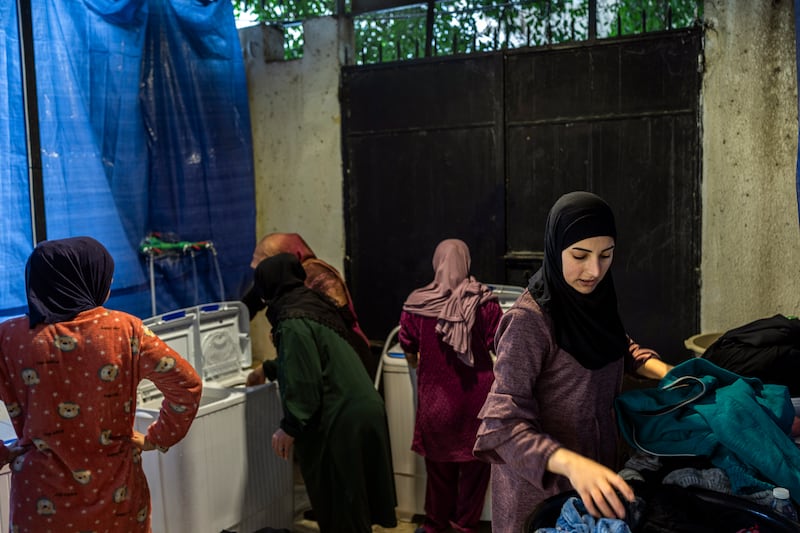 Displaced women wash clothes at a temporary shelter at a school in Beirut, Lebanon. Photograph: Diego Ibarra Sánchez/The New York Times
Trump extends deadline for Iran
US president Donald Trump has extended his deadline for Iran to open the Strait of Hormuz by 10 days to April 6th after saying talks are “going very well”.
The president made the statement on Thursday in a social media post, saying: “As per Iranian government request, please let this statement serve to represent that I am pausing the period of Energy Plant destruction by 10 Days to Monday, April 6, 2026, at 8 PM, Eastern Time,” Trump said on his Truth Social platform.
“Talks are ongoing and, despite erroneous statements to the contrary by the Fake News Media, and others, they are going very well.”
Later Trump told Fox News: “I gave them a 10-day period, they asked for seven.”
He also continued to declare victory in the war, adding: “In a certain sense, we have already won.”
The extension allows more time for talks, as well as for the US to amass additional forces in the region. These already include Marine Expeditionary Units and soldiers from the US army’s 82nd Airborne Division, according to people familiar with the matter.
Separately, the Wall Street Journal said the Pentagon is looking at sending up to 10,000 extra ground troops.
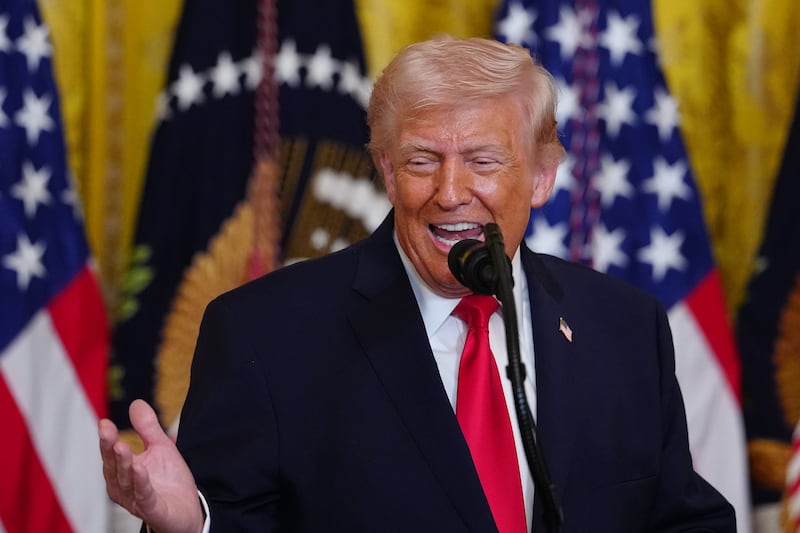 US president Donald Trump: exteneded deadline. Photograph: Julia Demaree Nikhinson/AP
Earlier, the US president had urged Iranian leaders to negotiate an end to the near-month-long war or face further assassinations of senior officials amid intensified action by the US and Israel.
That threat came as Israel said it had had “blown up and eliminated” the Revolutionary Guards’ naval commander, Alireza Tangsiri, and several senior officers in a strike on the Iranian port of Bandar Abbas.
Heavy strikes by Israeli or US warplanes were also reported around Isfahan, home to a major Iranian airbase and other military sites, as well as one of the nuclear sites bombed by the US during the 12-day war in June.
Iran has strenuously denied it is “begging to make a deal”, as Trump claimed, and continued its retaliatory strikes across a swathe of the Middle East on Thursday.
Loud explosions were reported in Tel Aviv, the central Israeli city of Modi’in and Jerusalem throughout the day as Israel’s air defences worked to bring down incoming missiles. In the Gulf, Iranian attacks were also intercepted.