
Based on forward indicators, such as the number of planning permissions granted, it expects output to remain in the mid-30,000s both this year and next.
The expert view is that Ireland needs about 50,000 new housing units a year to cope with the pent-up demand. Last year the figure was just over 36,200. The ESRI’s forecast is for about 37,400 units this year, and 38,000 in 2027.
“We will keep these forecasts under review and do not discount the possibility that new measures such as Vat reductions for apartment construction could lead to increased output,” the think tank says in a Quarterly Economic Commentary published today.
“The recent increases in energy prices also risk weighing on housing output if building costs rise.”
The higher cost of fossil fuels has a direct impact on the construction industry, as it makes the cost of producing materials such as cement more expensive, as well as increasing transportation costs.
Previous ESRI research has found that a permanent 1pc increase in building costs leads to a 0.84pc reduction in housing completions three quarters after the price shock. “Any sustained increase in building costs from higher energy prices is therefore likely to put downward pressure on output,” the commentary says.
Other factors such as labour shortages in the construction sector may also put downward pressure on output.
Because of the ongoing war in the Middle East, the ESRI has revised its forecast in relation to Consumer Price Index (CPI) inflation. It had expected this to be 2.1pc in 2026, but says the impact of higher oil and gas prices will push this up.
The ESRI now expects inflation to be 3.2pc this year, and 2.7pc in 2027, but a prolonged conflict could push this up further, and dampen economic activity.
It has advised the Government against cutting indirect taxes on energy products, because such cuts are poorly targeted. Flat-rated energy credits are better, but welfare changes are the most effective means of approaching the energy price shock.
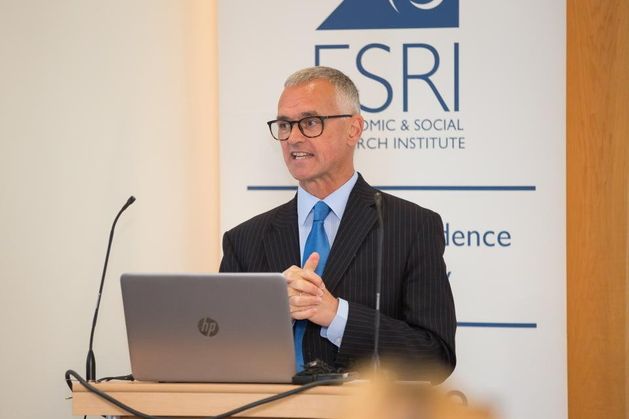
Professor Alan Barrett of the ESRI said: “What the Government announced yesterday is a blend of these. Based on our hierarchy, they got some things right and some things less so.”
He said fuel-allowance increases are a targeted measure, but the cuts to excise on petrol and diesel are not. The last time the ESRI looked at the effect of cuts in taxes, Prof Barrett pointed out, it estimated that 50pc of the cost of the measure went to the top 40pc of households.
“Targeting is really critical,” he added. “We have made the point on budgetary over-runs in recent years. If budgetary discipline is to be restored, it is important that targeting is managed, and resources are used as effectively as possible.”
The ESRI expects the Irish economy to continue to grow in 2026 and 2027, although at a slower pace than last year. The forecast for growth in Modified Domestic Demand is 2.1pc for this year, followed by 2.8pc for 2027.