
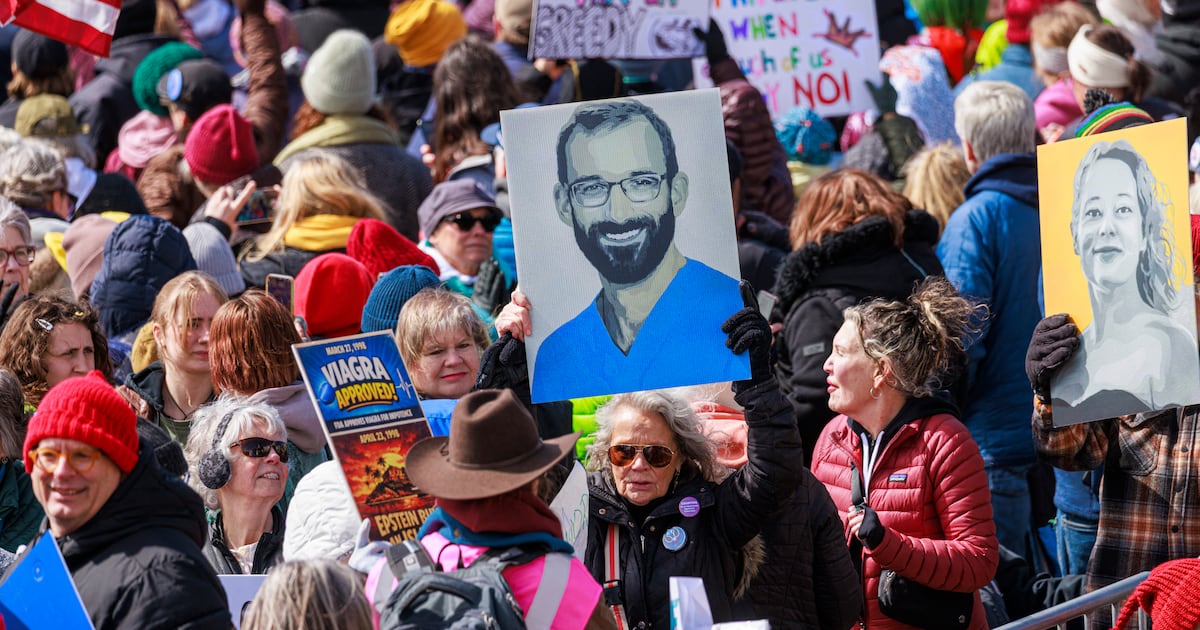
Demonstrators decrying US president Donald Trump’s policies took to city streets across the country on Saturday in the third edition of the “No Kings” rallies, with Minnesota taking centre stage. Organisers are hopeful it will be the largest single-day nonviolent protest in US history.
More than 3,100 events have been registered in all 50 states, with more than nine million people expected to participate. Singers Bruce Springsteen and Joan Baez were due to headline a rally at the state capitol in Minnesota, where upward of 100,000 people are expected to gather in an area that became a flashpoint over Trump’s crackdown on illegal immigration and the incursion of federal immigration agents into Democratic-led urban centres.
The Trump administration’s aggressive immigration enforcement actions were just one item on a long list of protesters’ grievances that also included the war in Iran and the Trump administration’s rollback of transgender rights.
In New York City, Donna Lieberman, executive director of the New York Civil Liberties Union, described Trump as the nation’s “bully-in-chief” and said Minneapolis residents “forced the wannabe king to withdraw his shock troops”.
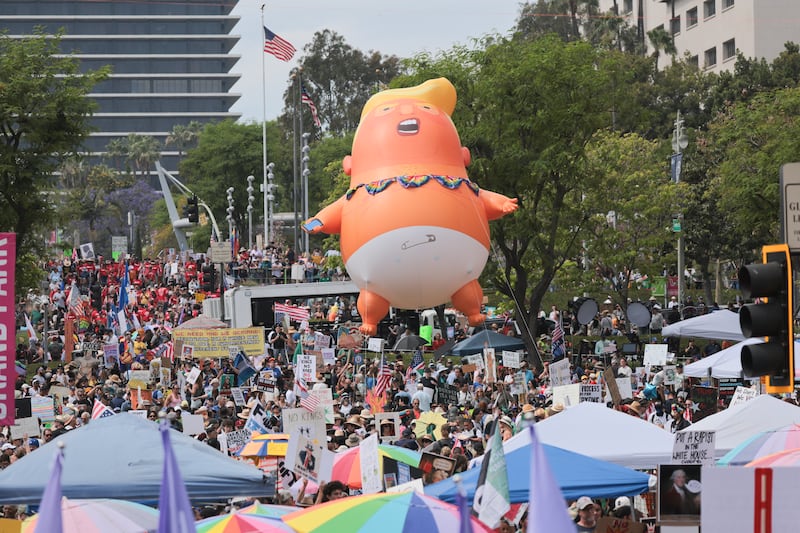 Protesters gather in front of Los Angeles City Hall during the ‘No Kings’ national day of protest against US president Donald Trump. Photograph: Etienne Laurent/AFP via Getty Images
“They want us all to be afraid to protest,” she said during a news conference.
“They want us to be afraid that there’s nothing we can do to stop them. But you know what? They are wrong – dead wrong.”
Other major rallies are taking place in Los Angeles and Washington, but two-thirds of the events are happening outside major city centres, a near-40 per cent jump for smaller communities from the movement’s first mobilisation last June, organisers said.
“The defining story of this Saturday’s mobilisation is not just how many people are protesting, but where they are protesting,” said Leah Greenberg, co-founder of Indivisible, the group that started the No Kings movement last year and led planning of Saturday’s events.
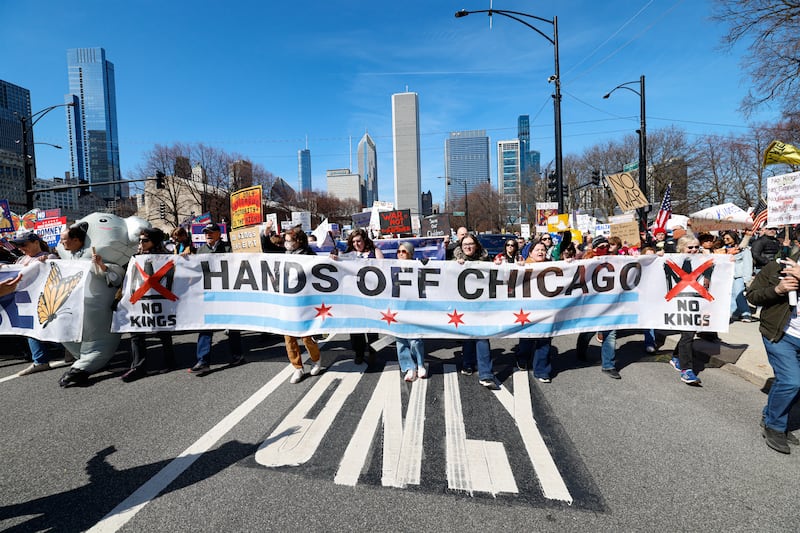 Demonstrators in Chicago march against the Trump administration. Photograph: Kamil Krzaczynski/Getty Images
With midterm elections later this year in the US, organisers say they have seen a surge in the number of people organising anti-Trump events and registering to participate in deeply Republican states like Idaho, Wyoming, Montana and Utah.
Competitive suburban areas that have helped decide national elections are seeing “huge” increases in interest, Greenberg said, citing as examples Pennsylvania’s Bucks and Delaware counties, East Cobb and Forsyth in Georgia, and Scottsdale and Chandler in Arizona.
“Voters who decide elections, the people who do the door-knocking and the voter registration and all of the work of turning protests into power, they are taking to the streets right now, and they are furious,” she said.
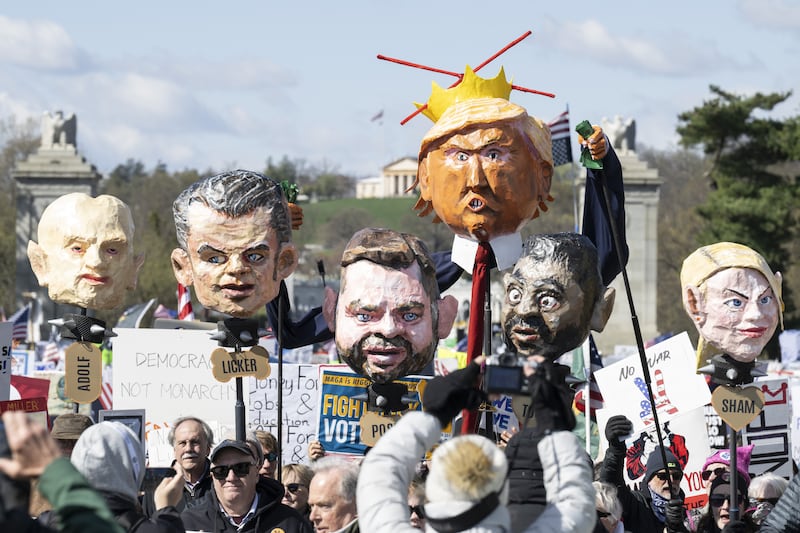 Activists display large puppets of political leaders ahead of the No Kings March in Washington DC on Saturday. Photograph: Luke Johnson/European Pressphoto Agency
White House spokeswoman Abigail Jackson in a statement dismissed the rallies as “Trump Derangement Therapy Sessions” of interest only to journalists.
In northern Virginia just outside Washington, DC, several hundred people began gathering on Saturday close to Arlington National Cemetery before a planned march across the Potomac River to the capital city’s National Mall.
Some passing drivers honked their horns in support but others slowed down to berate the protesters.
“You’re all idiots,” one man shouted from his car.
John Ale, 57, a retired air-conditioning and heating contractor, said he drove 20 minutes from his home in Virginia to join the march.
“What’s happening in this country is unsustainable,” he said. “The middle class, the little people, can’t afford to live anymore. And he (Trump) is breaking the norms, the things that made us function as a country.”
The No Kings movement launched last year on Trump’s birthday, June 14, drew an estimated four to six million people across roughly 2,100 sites nationwide. The second mobilisation in October involved an estimated 7 million participants in more than 2,700 cities, according to a crowd-sourcing analysis published by prominent data journalist G. Elliott Morris.
That October event was largely fuelled by a backlash against a government shutdown, an aggressive crackdown by federal immigration authorities, and the deployment of National Guard troops to major cities. Saturday’s events come amid what organisers said was a call to action against the bombardment of Iran by the US and Israel, a conflict that is now four weeks old.
Morgan Taylor, 45, attended the Washington protest with her 12-year-old son, and said she was enraged by Trump’s military action in Iran, which she called a “stupid war.”
“Nobody’s attacking us,” Taylor said. “We don’t need to be there.” – Reuters and AP