
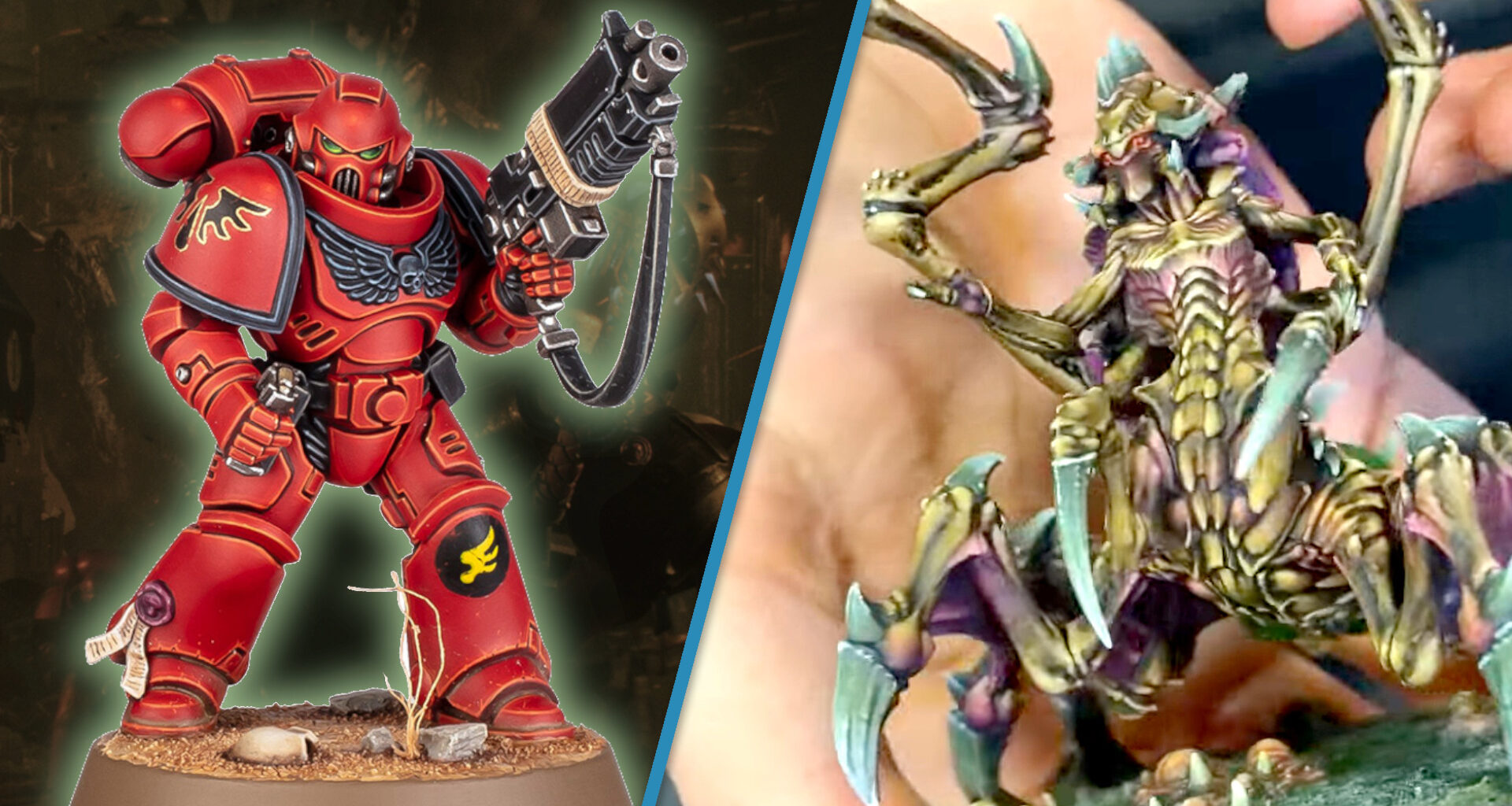
It’s early on day three of Adepticon as I write this, and Archon Studio has already sold out of the limited founders edition of the Starcraft Tabletop Miniature Game starter set. The Polish team crossed the Atlantic with 500 early release copies of its upcoming wargame, just under $100,000 worth of stock, and it’s all gone. Having demoed the game at the very start of the con I’m not surprised that my fellow nerds are so eager – and speaking to studio CEO Jarek Ewetowski, he’s confident that the game is going to be a success in the wider retail market.
The million dollar question is how Starcraft TMG will fare when the behemoth of Warhammer 40k 11th edition arrives this summer. While no other business in the wargaming industry operates on the same scale as Games Workshop, Archon is one of very few companies with the in-house manufacturing capacity to produce plastic miniatures in the bulk needed to support a global army-scale wargame. The models are great, but that alone won’t be enough.

First impressions – game good
Ewertowski says that “the number one design priority” at the earliest concepting stages for Starcraft was to make it “completely different” from Warhammer 40k. My brief demo of the game at the Archon booth has left me eager to dig into the system and properly review it – the ways that it stands out from Warhammer 40k are fascinating.
The game uses both alternating activations and phases within a turn; so players alternate moving units in the movement phase, then choose to shoot, move, or charge in the assault phase, and so on. It’s a system that allows players to respond to their opponent more dynamically, while keeping an orderly turn structure that doesn’t require quite as many difficult decisions as full alternating activations. Critically compared to 40k, it should mitigate against alpha strikes wiping out one player’s force.
The Supply system builds on that. Neither player starts with any forces on the board, but instead deploys them from their army roster. It’s a riff on RTS build queues, allowing players to respond to their opponent’s forces rather than losing the game at list construction. The amount of troops that you can field at any one time is capped by a Supply limit, which rises over the course of the game, feeding into a sense of escalation.
Supply isn’t spent, but rather is occupied by the troops you have deployed to the table, so losing a unit frees that Supply allowance up to bring on more reserves. This should act as a brake on the death spiral a force can fall into where losing troops both hurts your ability to hold objectives and hurts your ability to fight back.

The way forces degrade in Starcraft also seems very interesting. Infantry units that are whittled down to their last few models have a Supply value of zero – and Supply is used to determine whether units can control objectives, and the amount of victory points an opponent earns for destroying the unit. So a degraded unit can’t hold objectives, rewards no VP if destroyed, and frees up its controller’s Supply budget to bring on reinforcements. And yet, thanks to another system, these little units can’t be ignored.
Many weapons specify a Surge target, a type of unit they’re particularly effective at dealing damage to. This is a substantial bonus, but critically it doesn’t scale with the size of the unit – it’s still a really good buff when a unit is down to its last couple of models. This means that, instead of huddling on objectives or playing keepaway, remnant units will die like heroes trying to engage their preferred target.

Sustaining momentum after the initial (Zerg) rush
Adepticon is a massive event in the wargaming calendar, and its audience of tournament goers, painting enthusiasts, and other hardcore wargamers. Many of them have already tested Starcraft as part of its free public beta. This is the easiest market that Starcraft will ever encounter; the success of the game beyond the convention hall will depend on the wider community response, and critically, adoption by retailers.
At the start of the month, Archon presented Starcraft to US retailers at GAMA, and reception was muted and sometimes critical. Archon is launching the game with the Founders Edition starter sets, and the discount they’re offering to retailers on those sets was at the very low end of what retailers were hoping to see. It is also offering some aggressive bundle deals direct from its store, potentially cannibalising retail sales.
It seemed like a strategy that was marginalising retail in favor of direct to customer sales, with better margins for Archon at the expense of retailers. Ewertowski tells Wargamer that Archon took that criticism and has reworked its offer to be more favorable for retailers. He declines to reveal the precise discount that’s being offered to distributors, but says it should enable much more competitive pricing for retailers. The studio is also very close to opening a direct order program for US retailers who want to place orders with Archon directly.
The exception is the Founders’ Edition starter sets, which will still offer a low margin for retailers. Ewertowski says that’s because the sheer value offered by the bundles means that Archon is also working with thin margins. The goal is to offer such a tempting deal for players that, by the time Wave one is fully delivered to customers, there will be “50 to 60,000 Starcraft players” all over the world.

The Founders Edition starter sets are a one-time deal that is never going to be repeated, and Ewertowski confirms that regular single-player starter sets, and multi-kit bundle box sets, will be available via retail channels as part of the second wave of releases. Organised play kits to allow stores to run events will accompany the third product wave. Then there are plans for retail-only products that won’t be on sale on the Archon webstore.
Ewertowski hopes that Archon has recovered rapidly from its initial fumble – he tells me that retail orders have been strong since the studio has announced its new strategy. As the shadow of 11th edition 40k looms over the tabletop landscape, I have to wonder if Archon’s massively discounted founders editions and bundles were designed to recruit an army of new players before Games Workshop’s apocalyptic summer release. Ewertowski declines to comment.

I’m eager to trial the full game, and you can expect a review here on Wargamer as soon as I’ve had time for proper tests. To make sure you don’t miss our biggest stories, sign up to the regular Wargamer weekly newsletter. And to join the conversation, hop into the friendly Wargamer Discord community.