
A few days after every major championships, the media desk at World Athletics send us out a neatly collated results book. These do tend to pile up over the years, but, like travel guides or a good cookbook, can be a lasting memento of a particular time or place.
One thing is evident after a quick flick through the results book from last weekend’s World Indoor Championships. Over the three days of competition in Torun, Poland, there’s no slide whatsoever in any standard of performances, many athletes repeatedly improving in what they do.
World Athletics also awards each championship a competition performance score. Based on the quality and depth of results across the 27 events in Torun, the score of 49,516 surpasses the previous World Indoors best from Belgrade four years ago (49,348). With 46 national records, and 174 personal bests, many of those athletes who didn’t win medals still came away smiling.
By her own admission, Kate O’Connor had gone to Torun intent on improving on the silver medal she won in the pentathlon at last year’s World Indoors in Nanjing, China, So, even if the bronze medal she won this time was tinged with some disappointment, her performance once again soared to fresh heights. No good resting on any laurels.
Not only would O’Connor’s 4,839 points have won her the gold medal in Nanjing, compared with 12 months ago she went faster in the 60m hurdles and 800m, went longer in shot put and long jump, and equalled her high jump height. All after nursing a knee and Achilles strain in the two weeks before. Such a trajectory is often the prerequisite for any success at this level.
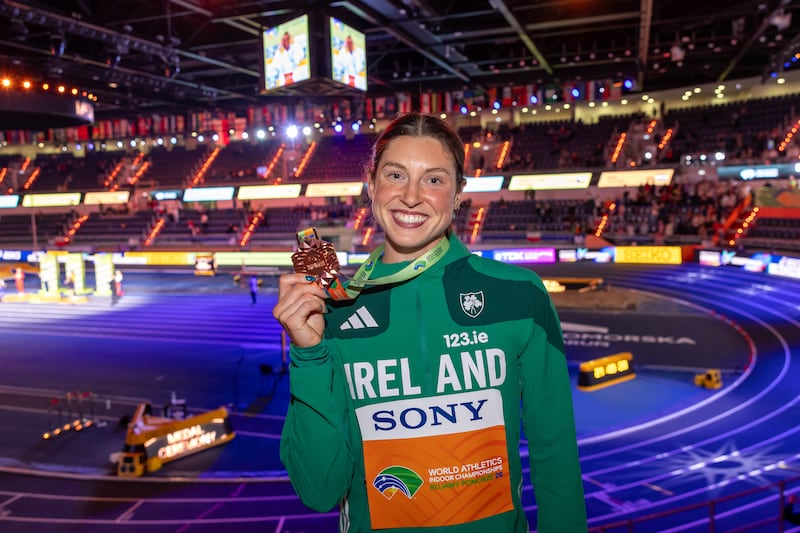 Kate O’Connor celebrates with her bronze medal for the Women’s Pentathlon at the 2026 World Athletics Indoor Championships, Toruń, Poland. Photograph: Morgan Treacy/Inpho
At 25, O’Connor was the oldest athlete on the pentathlon podium. Gold medal winner and rising Dutch star Sofie Dokter is 23, while silver medal winner and world heptathlon champion Anna Hall from the US turned 25 on Monday. Just 49 points separated the medals, so even if O’Connor fell short of gold, she’s still exactly where she wants and needs to be as the LA Olympic cycle reaches mid spin.
Consider, too, the mark left by Cooper Lutkenhaus, the high school student from Texas, who at age 17 years and 93 days last Sunday won the 800m in 1:44.24. With that he became the youngest athlete to win a medal of any colour at the World Indoors, also leaving the chasing pack wondering what they must do to catch up.
All of which also highlights Ireland’s lack of any relay presence in Torun – and perhaps more worrying, the lack of any individual Irish male or female 400m runners. Even when Rhasidat Adeleke made it known she wouldn’t be competing at the World Indoors, the expectation was that there would be still enough quality and depth for an Irish mixed 4x400m team, or certainly an Irish women’s 4x400m. In the end, neither materialised; nor has there been any clear explanation as to why not.
[ IOC bans transgender women from competing in female categories in Olympic GamesOpens in new window ]
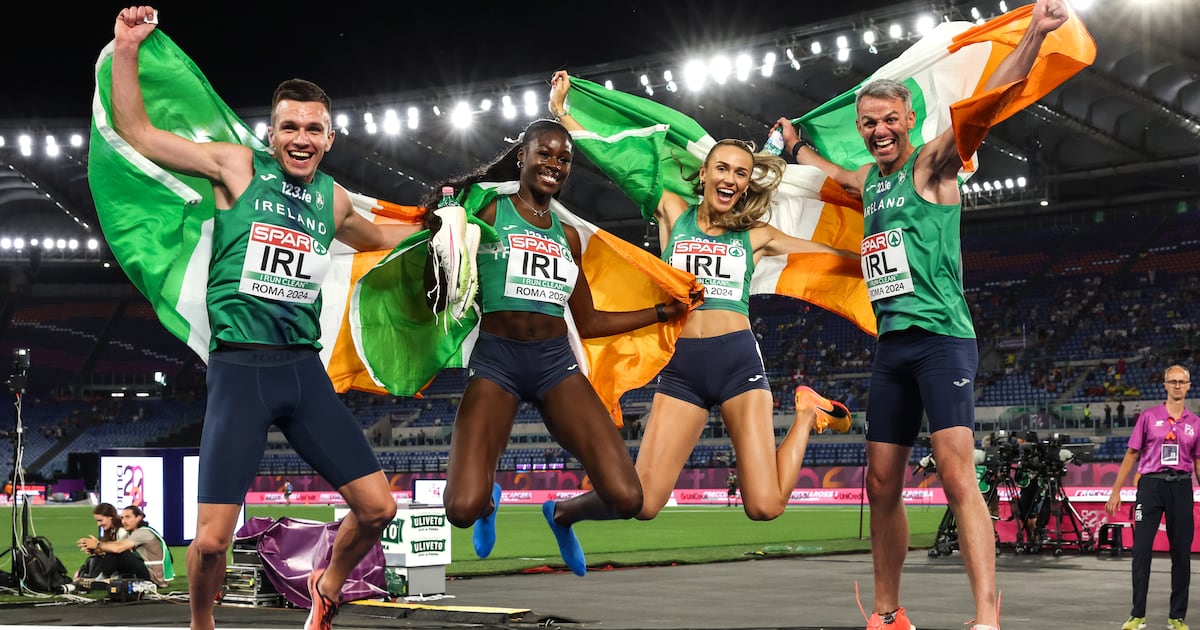
The resounding message after the Irish women’s 4x400m relay finished fourth in the 2024 Paris Olympics – just 0.18 of a second off bronze, remember – was how this upward trajectory was likely to continue. Two months before Paris, at the European Championships in Rome, the Irish mixed 4x400m quartet won gold, before the women also won silver. Adeleke played a key part in both.
Sport Ireland had also given their substantial backing to the Irish relay project, with Sharlene Mawdsley and Sophie Becker joining Adeleke on the maximum grant amount of €40,000, with Chris O’Donnell also boosted to this podium level of funding for his role in the mixed 4x400m relay in Rome.
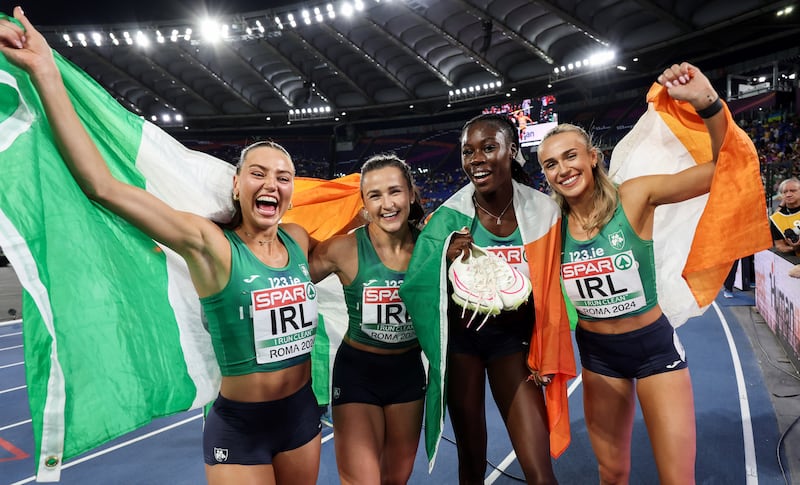 Sophie Becker, Phil Healy, Rhasidat Adeleke and Sharlene Mawdsley celebrate winning silver medals in the women’s 4x400m relay final at the 2024 European Athletics Championships, Stadio Olympico, Rome. Photograph: Morgan Treacy/Inpho
Mawdsley and Becker took part in a select number of races indoors, Mawdsley winning the National Indoor 400m title on the same day Becker won the 200m title. Both then bypassed Torun, part of their reasoning being the European Championships in Birmingham in August is the far bigger deal this year.
In the absence of any Irish relay interest last weekend, it was still notable the top four teams in the mixed relay in Torun were European, as were five of the six finalists in the women’s 4x400m. They’ve all moved up another gear, it seems, the chase also on for the others to catch up.
With injury forcing Adeleke out of the World Championships in Tokyo last September, and with Thomas Barr retired after 2024, the mixed relay quartet of Mawdsley, Becker, Conor Kelly and Jack Raftery could only finish sixth in their heat in Japan. They were almost four seconds off the Irish record set in Rome. Later in the women’s 4x400m heats, the Irish quartet finished last in their heat, almost 10 seconds off the national record set in Paris.
There is another important relay stop before the European Championships in Birmingham, with the World Athletics Relays set for Gaborone in Botswana from May 2nd-3rd. It’s the first time the event has been staged in Africa, and at this stage it appears unlikely Adeleke will make that trip – or indeed Kelly, who is in his first year of competing at the University of Texas.
Botswana will decide 12 of the 16 relay qualifying spots for the 2027 World Championships in Beijing. That may seem a long way off at this point, but the next World Athletics Relays after that aren’t until May 2028, in the Bahamas, which will serve as the main qualifying pathway to the LA Olympics later that summer.
For Adeleke, the most important event outdoors this summer was always going to be the European Championships. Especially as she looks to get back to her 400m best after missing the business end of last season. It’s still too soon to tell, but that results book from Torun may also prove another sign that Ireland’s relay prospects are in danger of dropping the baton.