
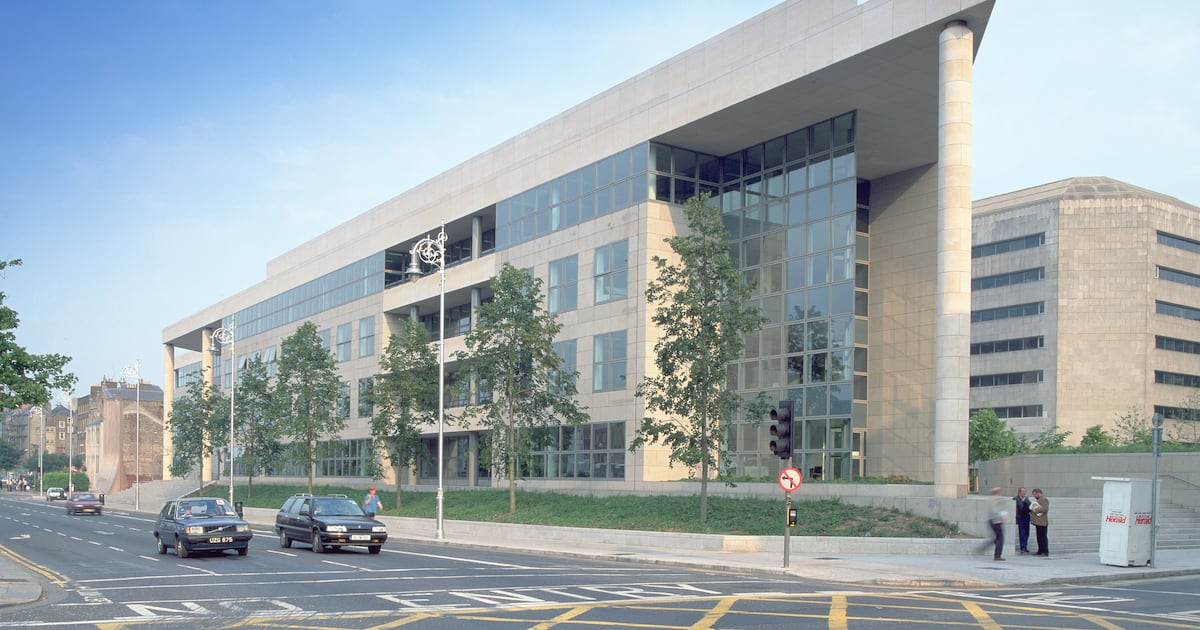
Senior officials of Dublin Corporation, as it was known for centuries, used every stratagem in their bureaucratic arsenal to achieve a long-standing objective of building new civic offices at Wood Quay, right in the heart of the medieval city, between the mid-1980s and mid-1990s. And now, incredibly, their successors want to walk away from it all.
Wood Quay, on the south bank of the Liffey, was an obvious location, not far from the old Tholsel on Skinners Row – later widened and renamed Christchurch Place – where the board of aldermen and common council of the city held their meetings until 1791, and only a few hundred metres from City Hall, on Cork Hill, flanking the ceremonial entrance to Dublin Castle.
The office blocks were to be built on what turned out to be Europe’s most important Viking site, containing the story of Dublin’s early development. A High Court judge, Liam Hamilton, designated it a national monument in June 1978 after walking along wattle streets unearthed in an archaeological excavation headed by Pat Wallace, who was later to become the director of the National Museum of Ireland.
Three months later, 20,000 people took part in a Save Wood Quay protest march through the city led by Rev Prof FX Martin, chairman of Friends of Medieval Dublin. More than 200,000 signed a petition calling for the site to be spared, as did more than 80 social and cultural organisations in Ireland and abroad, including the Council of Europe.
But it was all to no avail. Dublin Corporation colluded with the Commissioners of Public Works to concoct a “consent order” under the National Monuments Act of 1930 permitting the removal of archaeological material from the site so that the civic-offices project could proceed. This order was upheld by the Supreme Court in May 1979.
A final effort by Friends of Medieval Dublin to prevent the destruction of Viking remains was Operation Sitric, a three-week occupation of Wood Quay by archaeologists, artists, writers, politicians, trade unionists and concerned citizens in June 1979. This bought some time for Wallace’s dig, but that was all.
Then, after Dubliners had elected a new batch of city councillors pledged to defend Wood Quay, the officials warned them that they could be personally surcharged if they voted to pull out of the civic-offices project. With the Fianna Fáil government remaining deaf to demands that it foot the bill, the officials got their way.
Construction of phase one of the new civic offices, designed by Sam Stephenson, was completed in 1985. The two granite-clad “bunkers”, with their recessed slit windows, were a perfect metaphor for a city administration dug in against the citizenry.
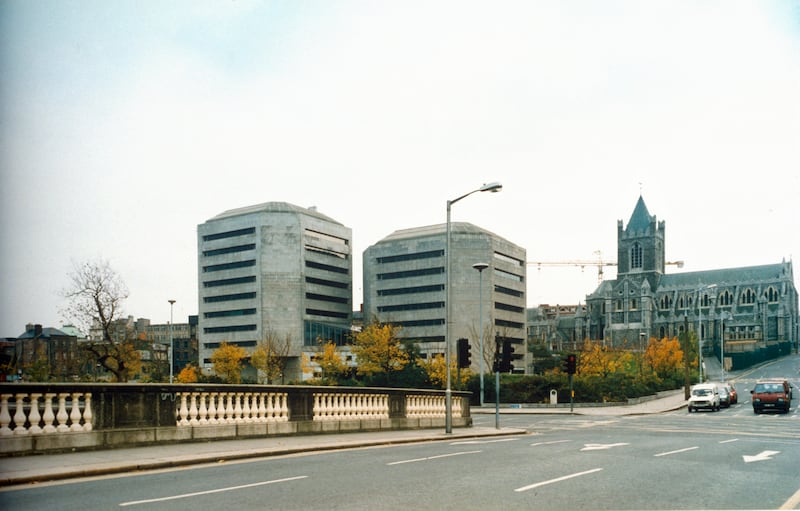 Dublin City Council’s civic offices complex at Wood Quay. The two original ‘bunkers’ were completed in 1985. Photograph: courtesy of Scott Tallon Walker
The rest of Stephenson’s project – two more blocks, bringing it down to the quayfront, and a sunken city-council chamber under a glazed roof in the hill below Christ Church – never materialised. Instead, following a limited architectural competition, Scott Tallon Walker was selected to design an elongated, partly offset building on the quay.
Completed in 1994, this was the first public building on the Liffey since James Gandon delivered the Custom House and Four Courts in the late 18th century. Ronnie Tallon sought to pay homage to these august predecessors by using Wicklow granite and marking the entrance with a generous four-storey portico and grand flight of steps.
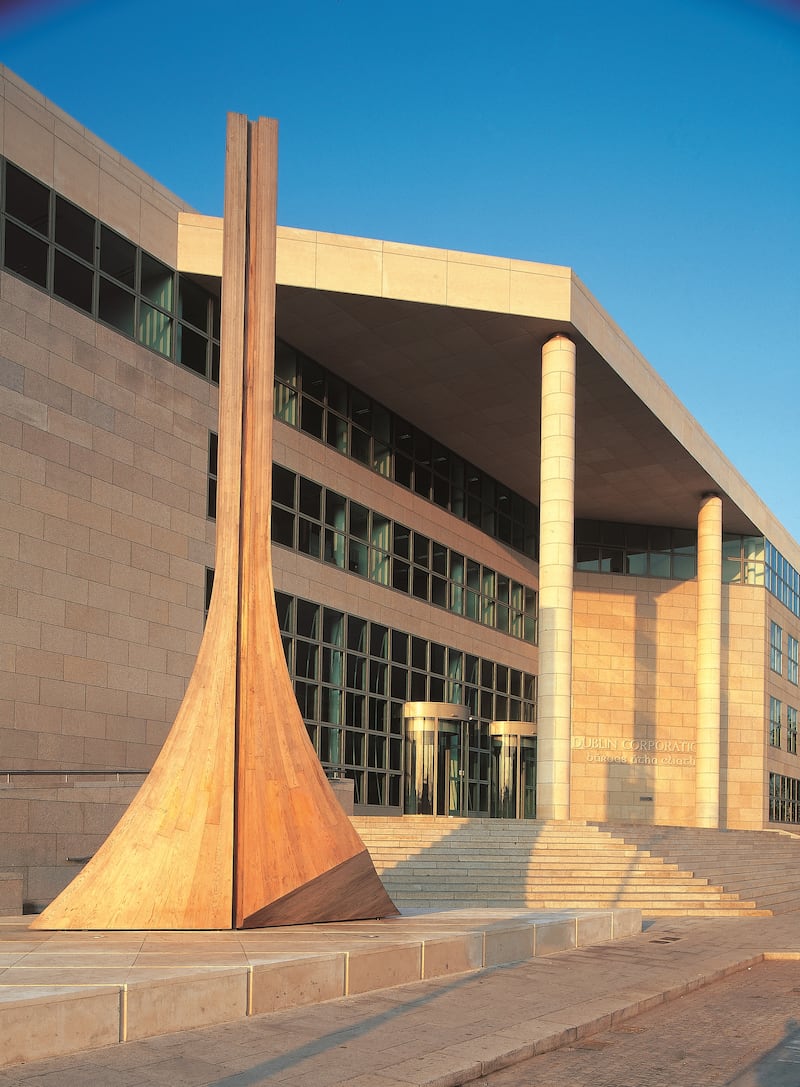 Dublin Civic Offices: the new building was open and transparent. Photograph courtesy of Scott Tallon Walker
With Michael Warren’s tall wooden sculpture, evocative of the prow of a Viking longship, placed in front, Tallon’s new civic offices were open and transparent, projecting an entirely new image of Dublin Corporation. Arranged around a full-height central atrium, the building was also at the cutting edge environmentally at the time for being naturally ventilated.
It won an international energy-conservation award for a combined heat-and-power system, developed by Tim Cooper of Trinity College Dublin, which provides 90 per cent of its electricity while capturing excess heat as hot water to provide district heating for the west end of Temple Bar, as well as for Christ Church.
But now this purpose-built civic building, barely more than three decades old, is at risk of being demolished, along with Stephenson’s bunkers, because Dublin City Council’s chief executive, Richard Shakespeare, wants to relocate its offices from Wood Quay to the former College of Technology site on Lower Kevin Street, off St Stephen’s Green.
[ Opinion: Is the Wood Quay monstrosity finally going to be demolished?Opens in new window ]
The justification given for this extraordinary gambit is that it would cost too much to increase the civic offices’ energy performance from the current building energy rating of D1 to a minimum B by 2030. Estimates ranged from more than €250 million last December, when the move was first mooted, first to “€350 million to €400 million” and, lately, to “€487 million to €504 million”.
The figures are contained in a report prepared by the Arup consultancy at Shakespeare’s request. But such is the secrecy surrounding the project that this report and another, by the council’s city architects division, showing design concepts for developing 530 social and affordable homes on the Wood Quay site, have not been made public.
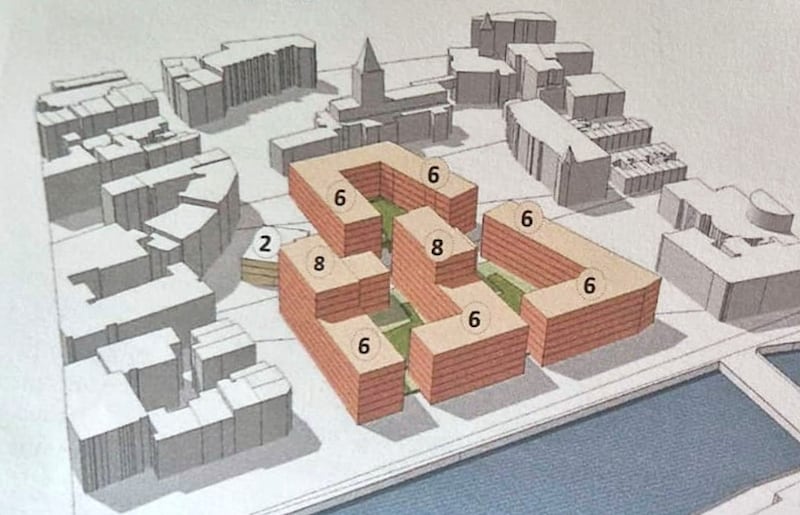 Wood Quay: Dublin City Council’s indicative block layout of its proposed six- to eight-storey apartment buildings, with Christ Church at the rear
A lengthy report in the Dublin Inquirer on March 13th revealed that councillors who attended a closed-door briefing at the Mansion House in February “were given hard copies of a presentation, and told not to share them around. The documents were watermarked with the councillors’ names, so if they did share them, it’d be easier to catch.”
The council told the Dublin Inquirer that this is in line with its statutory governance processes, under which “certain commercially sensitive material” is shared with councillors before wider publication. “Further documentation will be made available as the project progresses.”
Citizens who will ultimately pay for it all are being kept in the dark about the huge costs involved in relocating the civic offices, including the development of a new Dublin City Council headquarters at the “Camden Yard” site on Kevin Street, along with “up to 300 social homes” there, as well as redeveloping Wood Quay for social and cost-rental apartments.
There are also caveats in the city architects’ design concept and capacity study of the Wood Quay site, which says that it “has been prepared in the absence of detailed site information such as topographic surveys, utility surveys and site investigation surveys” and that “no consultation has taken place” with the council’s planning department.
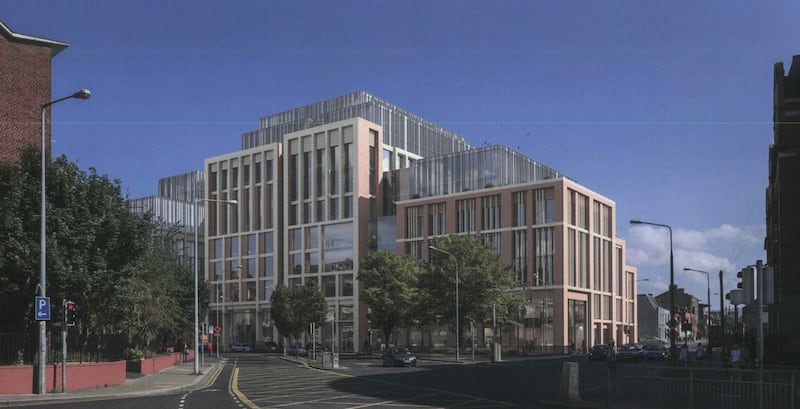 Camden Yard: an impression of the new complex that Dublin City Council plans to move its civic offices to, in a perspective from Kevin Street. Photomontage: Henry J Lyons Architects/Visual Lab
 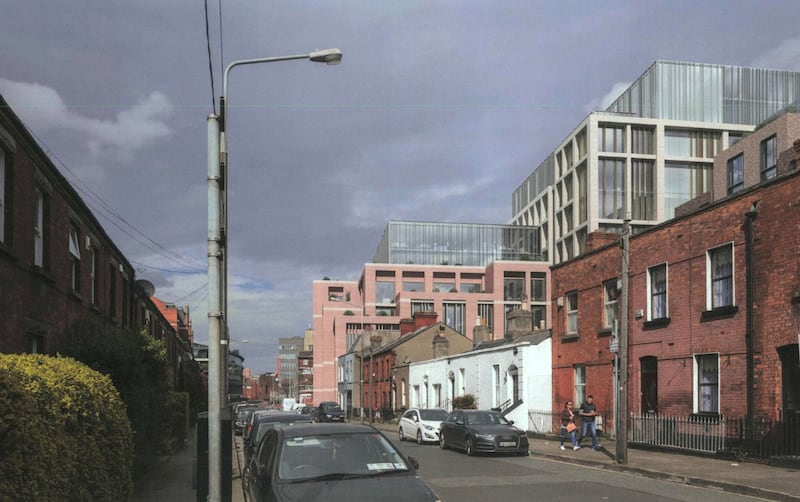 Camden Yard: the planned civic offices from the rear, on New Bride Street. Photomontage: Henry J Lyons Architects/Visual Lab
At the Mansion House meeting, councillors were told that new housing would be built on the footprint of the existing offices. It is clear, however, from the indicative layout of new six- to eight-storey apartment blocks that they extend beyond this footprint, while also stepping back to frame views of Christ Church from the quays.
Contrary to what many people might think, much of the Wood Quay site would still have to be “archaeologically resolved” before it could be developed beyond the footprint of the civic offices. This includes the grassed amphitheatre between the 1980s and 1990s buildings, as well as the large open area on the slope below Christ Church.
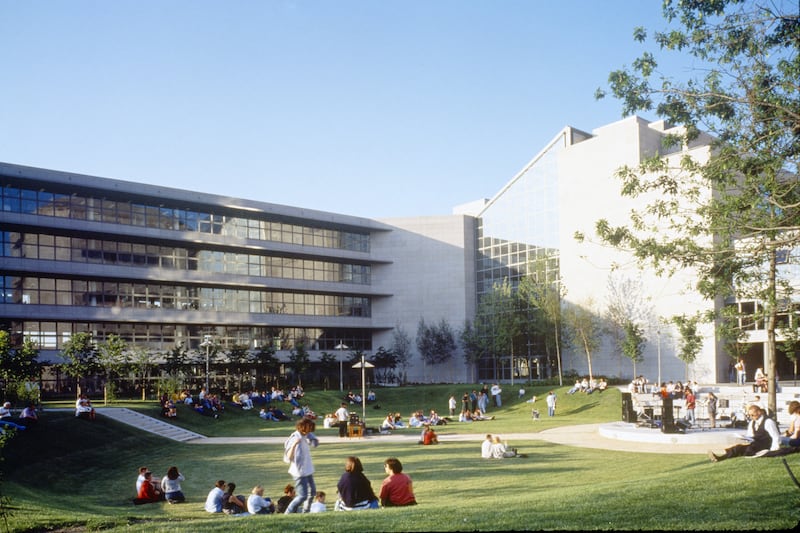 Dublin civic offices: the Wood Quay complex includes a grassed amphitheatre. Photograph courtesy of Scott Tallon Walker
Demolition of the civic offices would be contrary to the Dublin city development plan 2022-2028, which aims to “promote and support the retrofitting and reuse of existing buildings rather than their demolition and reconstruction, where possible”, having regard to both embodied carbon and the additional use of resources for new construction.
Whereas few would shed tears over demolition of the bunkers, the cost in embodied carbon would be enormous, because both blocks are substantial reinforced-concrete buildings with granite cladding. And given their design, with blank chamfered corners and minimal windows, it would be impossible to convert them to residential use.
The same is true, for different reasons, of the Scott Tallon Walker building. After 30 years of use it’s probably due for an energy upgrade, and this could be done for a lot less than Shakespeare’s figures would suggest. Scott Tallon Walker sensitively renovated the similarly sized former Bank of Ireland complex on Baggot Street in recent years for about €90 million.
The National Inventory of Architectural Heritage rates the civic offices as regionally important. It specifically refers to the glazed atrium inserted between the two original blocks, saying it “provides a contrast to the solidity of the granite cladding”, and remarks that the complex “remains a controversial but focal point and landmark structure in the city”.
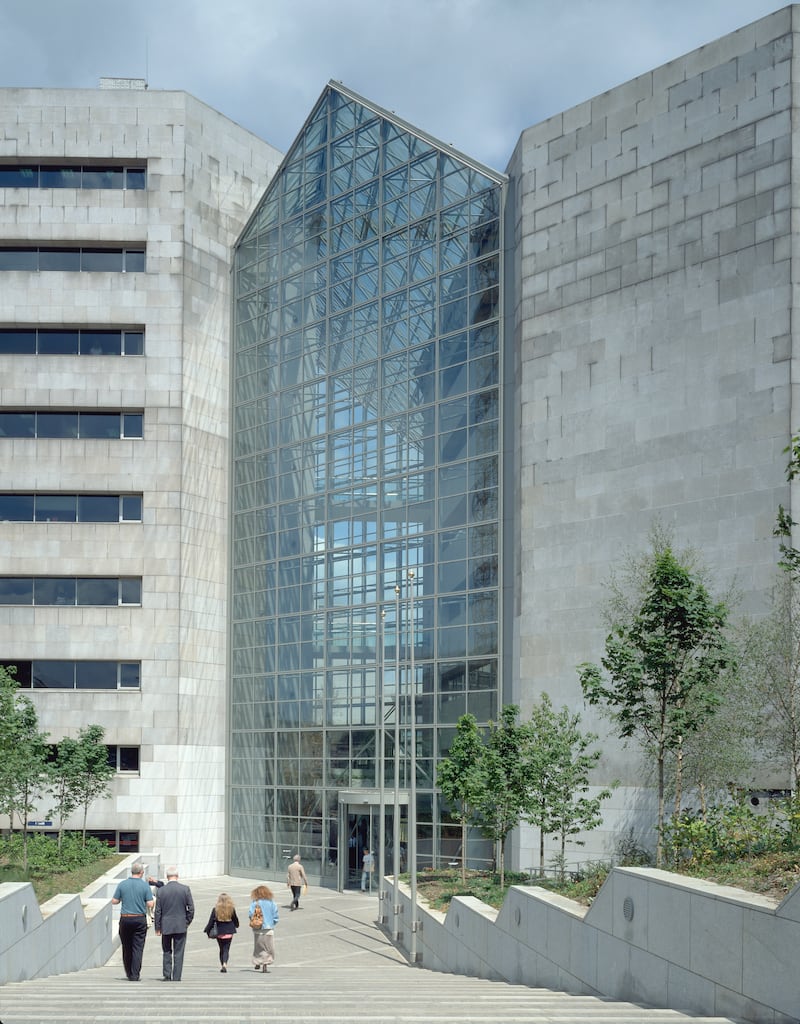 Dublin civic offices: the National Inventory of Architectural Heritage rates the complex as regionally important. Photograph courtesy of Scott Tallon Walker
Dublin City Council has agreed to pay €90 million for the 1.46-hectare site at Lower Kevin Street, which stretches south to Camden Row. This is significantly less than the €140 million that Westridge Real Estate shelled out for it in 2019, bankrolled by a disparate group of North American investors in GA Development Dublin Icav. (Icav stands for Irish commercial-asset vehicle.)
What it proposed in May 2020 for the former College of Technology site was an enormous office development of 53,000sq m in blocks of up to 11 storeys on the Kevin Street frontage, along with two blocks at the rear, up to 14 storeys high, containing 299 apartments – a staggering 87 per cent of them either studios or one-bedroom units.
Local residents were shocked by the scale of this scheme, which was designed by the architectural firm Henry J Lyons. More than 60 objections were lodged complaining about its overbearing visual impact on the area, which is characterised by two-storey houses and five-storey flats, as well as about the preponderance of one-bed units in the build-to-rent blocks.
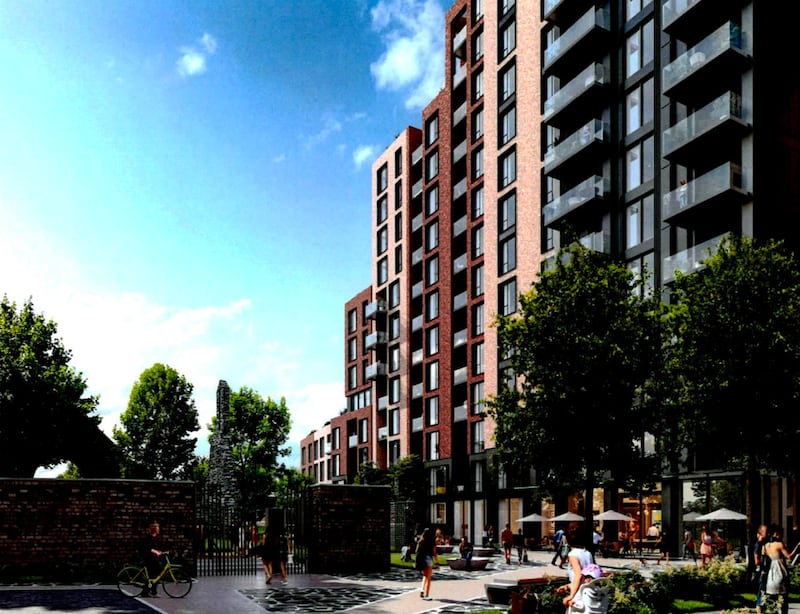 Camden Yard: an impression of a residential block of mainly studios and one-bed units in the new complex. Photomontage: Henry J Lyons Architects/Visual Lab
It was all approved by Dublin City Council’s planners, citing the ministerial guidelines on building heights and build-to-rent apartment design standards imposed in 2018 among the top three reasons for doing so. After refusing requests for an oral hearing, An Bord Pleanála granted permission in August 2021.
The former College of Technology was then demolished and the site cleared for construction, but this came to a standstill in June 2024 because of a failure to secure corporate tenants for the office space. With only structural work up to first-floor level completed, it was put into receivership with a guide price of €90 million, and finally sold to the council.
Shakespeare’s aim is to finish the office development as planned, even though its overall floor area would be far greater than what the council needs to accommodate its staff, so permitting the excess space to be leased to other occupiers. Indeed, that speculative element is part of the plan.
The council’s public library on Kevin Street, dating from 1903, would become a little lost soul, dwarfed by a grossly overscaled and generic office development that would fail to convey any sense of being a civic building, while the huge slab of apartments at the rear would have to be reconfigured to comply with the unit-mix requirements of the city plan.
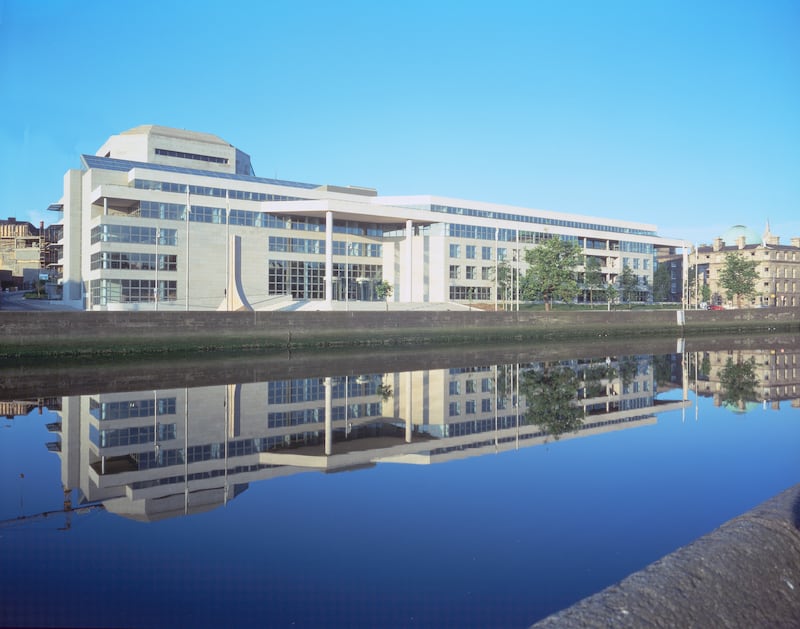 Wood Quay: Dublin civic offices. Photograph courtesy of Scott Tallon Walker
At a time when Dublin City Council’s tenants are facing rent hikes averaging 30 per cent, why not treat Camden Yard as a housing site and hold an open architectural competition with a brief to design an exemplary social- and affordable-housing scheme, setting building heights of six to eight storeys to show respect to the urban context?
In the meantime, Dublin City Council should defer a decision on the matter when the current, deeply flawed proposal comes before it on Monday, April 6th. Then, after all the documentation is released into the public domain, we can have a rational discussion about how best to deal with the civic offices at Wood Quay.