

 Most people think stress fades once a tough phase passes. A deadline ends, a loss softens, life moves forward. But the body does not always follow that timeline. It stores patterns, reactions, and even fear in ways that are not visible at first. Months or years later, this stored stress can surface as fatigue, pain, or strange health changes that seem to have no clear cause.This is not just a feeling. Science shows that the body keeps a record of stress, and it can shape health long after the original trigger is gone.
Watch
Here’s what stress does to your health
Stress is not just in the mind, it lives in the body
Stress often gets dismissed as “mental,” but the body treats it as a full physical event. When stress hits, the brain sends signals that release hormones like cortisol and adrenaline. Heart rate rises, muscles tighten, and digestion slows.This response helps in short bursts. It prepares the body to act. But when stress keeps returning, the body does not fully switch off. It stays alert, almost as if danger is still present.Over time, this becomes a baseline. The body forgets what true calm feels like.
What happens inside: The system that never resets
As Mr S Giriprasad, Psychologist, Aster Whitefield, explains, “From a psychological and neurobiological standpoint, the idea that the body remembers stress is not merely metaphorical, it reflects how deeply our stress systems are wired. When we encounter stress, the hypothalamic–pituitary–adrenal axis releases cortisol and related hormones to help us adapt. In acute situations, this response is protective. However, when stress is prolonged or repeated, the system does not reset easily and begins to recalibrate itself.Over time, cortisol spikes add up to what scientists measure as allostatic load. That’s the body’s total wear from constant stress. High cortisol weakens immunity and disrupts sleep. It skews metabolism and harms heart function. Stress rewires the amygdala, hippocampus, and prefrontal cortex. The brain starts responding to fear differently. Memory fades under long-term pressure. Choices get distorted. And that damage stays – even after the stress stops.”In simple terms, the body adapts to stress so deeply that it starts functioning differently even when the threat is gone. 
Chronic stress increases allostatic load, disrupts hormones, and alters brain function. Symptoms may appear long after the stressful phase ends, often in subtle ways.
The hidden cost: Allostatic load and long-term wear
Doctors use the term allostatic load to describe the wear and tear caused by repeated stress. It is like running a machine at high speed for too long. Parts begin to strain.Government-backed research supports this. The National Institutes of Health (NIH) explains how chronic stress affects multiple systems in the body, including immunity, metabolism, and cardiovascular health.Similarly, the Centers for Disease Control and Prevention (CDC) outlines how long-term stress is linked with conditions such as high blood pressure, heart disease, obesity, and diabetes.These are not sudden illnesses. They build slowly, often without obvious warning signs.
Why symptoms show up years later
A person may go through a stressful period in their 20s and feel “fine” afterward. Then, in their 30s or 40s, unexplained symptoms begin.This delay happens because the body has been compensating quietly. The nervous system stays slightly overactive. Hormones remain slightly imbalanced. Inflammation stays low but constant.Mr Giriprasad notes, “These shifts tend to stick around even after it has ended. The nervous system stays on edge, going off at small cues like a loud noise or a crowded room. That’s why people show up years later with tiredness, long-term pain, gut issues, or unexplained swelling.”What looks like a new problem is often an old story the body never finished processing.
The body’s signals: Subtle but persistent
Stress stored in the body rarely announces itself loudly at first. It shows up in ways people tend to ignore:Constant tiredness despite adequate restFrequent headaches or muscle tightnessDigestive discomfort without a clear causeTrouble sleeping or waking up feeling unrestedIncreased sensitivity to noise, crowds, or pressureThese are not random issues. They are signals that the body is still carrying a load. 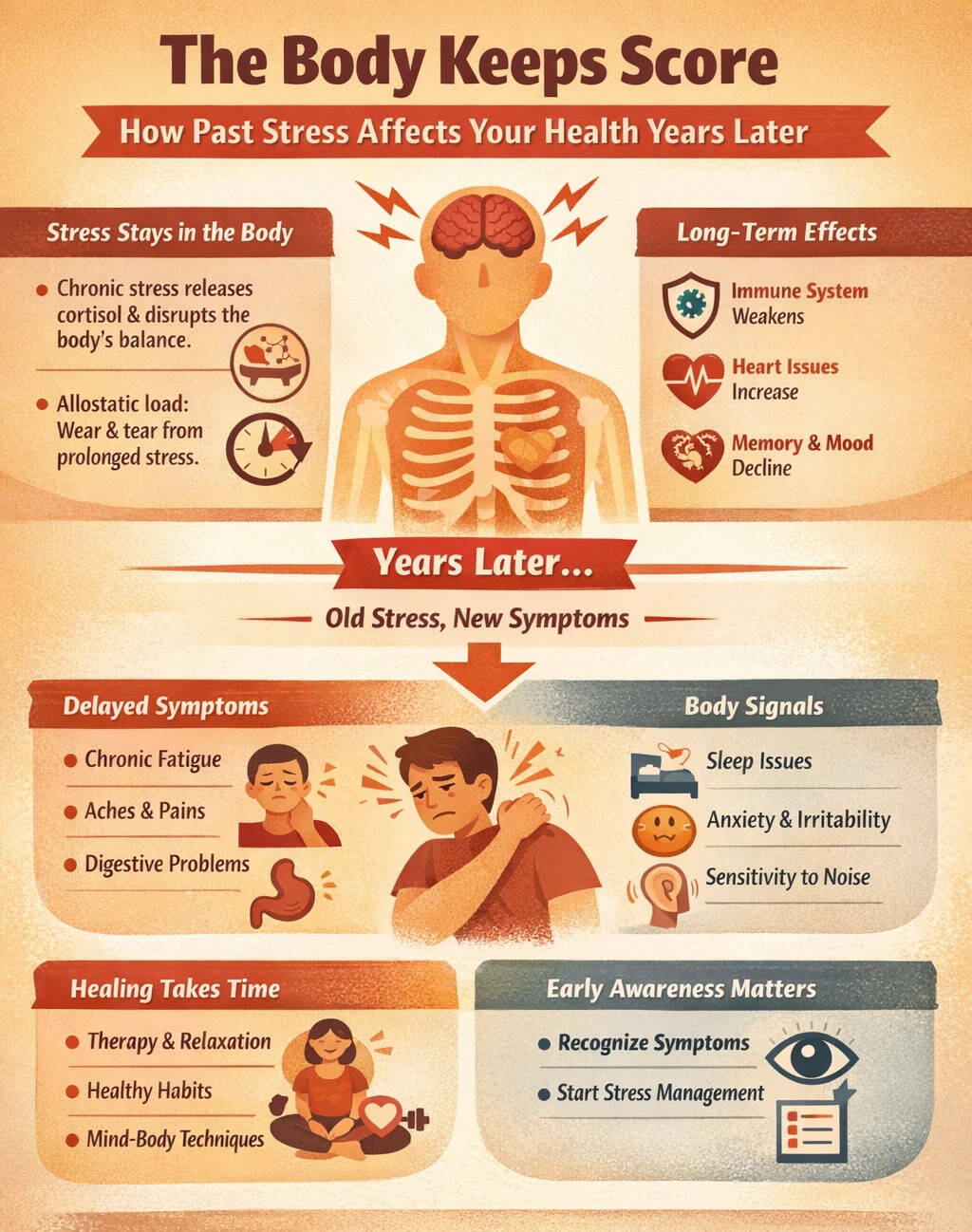
The good news is that with awareness, therapy, and consistent lifestyle changes, the body can gradually heal and regain balance.
Can the body unlearn stress? Yes, but slowly
The good news is that the body is not permanently damaged. It can relearn safety, but it takes time and consistency.Mr Giriprasad explains it clearly, “From a psychologist’s perspective, stress leaves behind a physiological imprint, but it is not irreversible. Through therapy, body-based regulation techniques, and supportive lifestyle changes, the brain and body can gradually relearn safety, allowing stress responses to soften and overall health to improve.”This means small, steady actions matter more than quick fixes. Regular sleep, movement, therapy, breathing practices, and emotional awareness all help reset the system gradually.
Why early awareness changes everything
Stress often accumulates silently. People push through, adapt, and move on without pausing to process what happened. But the body keeps a count.Recognising early signs can prevent years of hidden damage. Addressing stress is not about weakness. It is about maintenance, much like caring for the heart or bones.Medical experts consultedThis article includes expert inputs shared with TOI Health by:Mr S Giriprasad, Psychologist, Aster Whitefield.Inputs were used to explain how past stress can continue to affect the body physically years later, and why recognising these long-term effects and consulting a doctor is important for proper management and recovery.