

Omega’s new Constellation Observatory collection debuts a new technology that allows a watch movement to be tested for accuracy without the observation of a seconds hand. The new acoustic-based method of testing watches is being introduced concurrently with the new Constellations, and to make the point that a seconds hand is no longer needed to gauge accuracy, the new watches haven’t got one: they have hour and minute hands only. That makes them the first two-handed watches to achieve Master Chronometer certification.
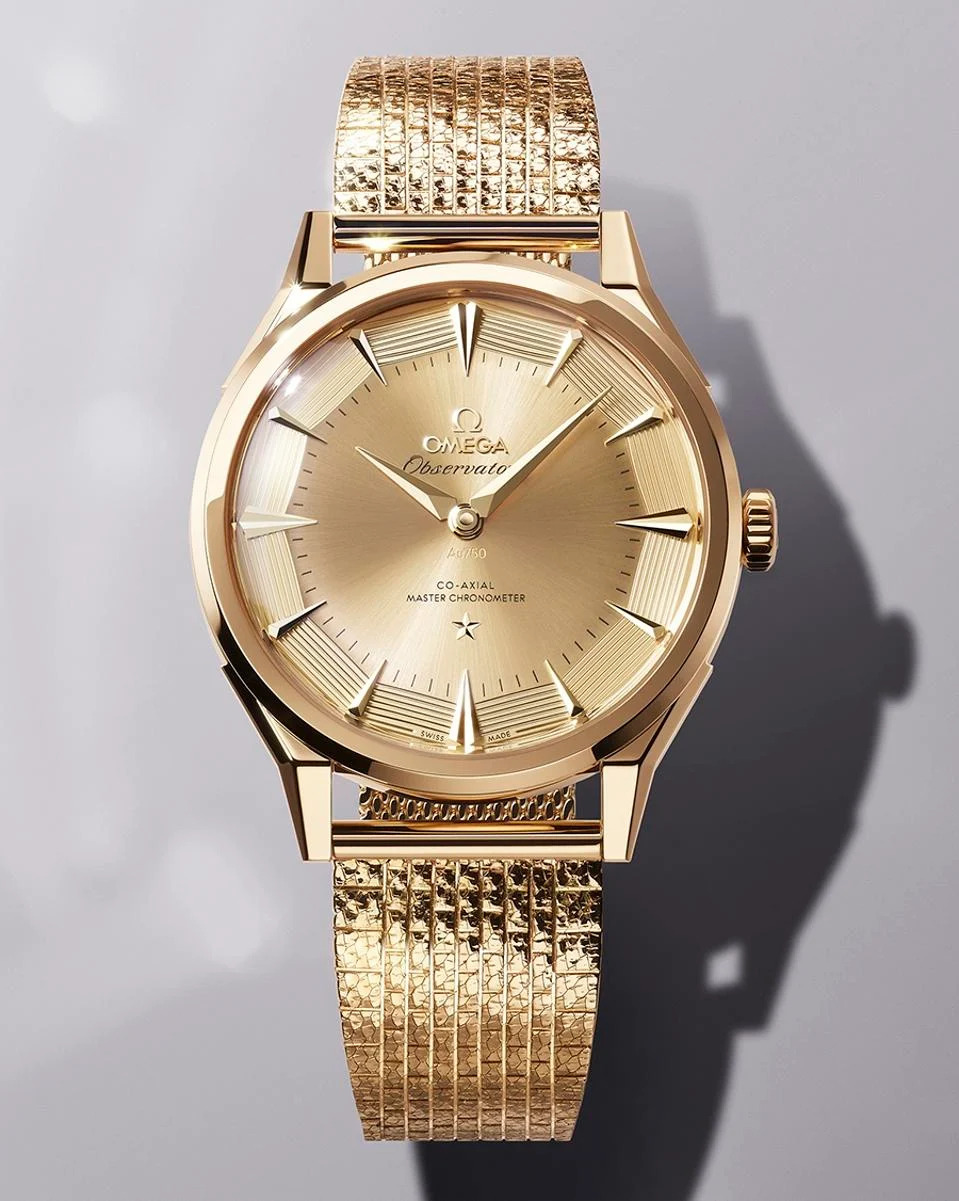
The 18k gold model in the new Constellation Observatory collection.
Omega
Before quartz movements hit the market in the 1960s, mechanical watch companies proved the accuracy and reliability of their movements by competing in observatory competitions. The watches were put through a rigorous, month-long battery of tests in various positions, at various temperatures, and were ultimately scored in a dozen categories. The competitions phased out in the late 1960s, but brands still refer to their former glory as recipients of prizes and their ability to qualify their movements as observatory-grade status.

Stainless steel models of the new Omega Constellation Observatory.
Omega
One of the key factors that enabled observatory competition judges to determine accuracy was the seconds hand, which allowed them to-the-second accuracy. The same is true for modern testing that qualifies a watch as a chronometer – a certification stating it achieves a certain standard of accuracy. Omega’s new acoustic testing method is a wireless, self-contained unit that consolidates all Chronometer and Master Chronometer certification processes into a single device. Powered by Dual Metric Technology, it continuously captures the sound of each tick and tock while recording environmental parameters: temperature, position, magnetic fields and atmospheric pressure throughout 25 days of testing. Traditional testing relied on photographing the position of the seconds hand, capturing one result per day. Dual Metric Technology generates continuous data from the first second. Watchmakers can identify not only that a variation exists, but where and when it occurs.
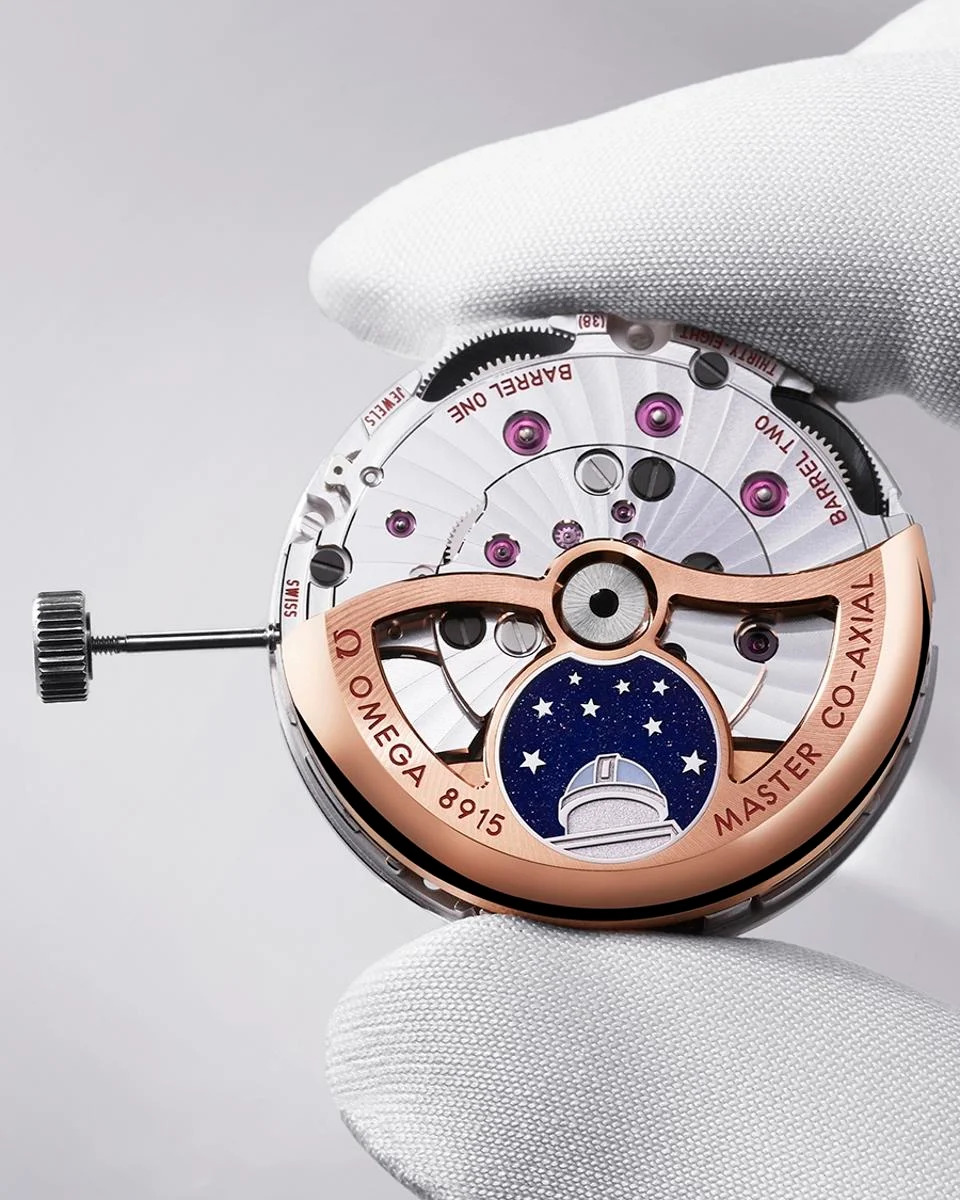
The new Omega caliber 8915 Grand Luxe.
Omega
The new test was developed by Omega’s Laboratoire de Précision, and certified by METAS, the Swiss Federal Institute of Metrology. It tests the entire assembled watch under stringent criteria: it must be accurate to between 0 and +5 seconds per day. The new Constellations undergo Chronometer and then Master Chronometer testing without the need for a seconds hand.

One of the four stainless steel versions of the Omega Constellation Observatory.
Omega
Omega developed two new movements for the new collection: the caliber 8915 Grand Luxe, finished in gold, enamel and aventurine, for the platinum and gold watches; and the caliber 8914 Standard, with a rhodium plated finish, which powers the steel watches. There are nine references with various case, dial and strap combinations: four models in steel and four in 18k gold, plus one in Omega’s proprietary platinum-gold. All have the Constellation collection’s signature kite-shaped indexes and Dauphine hands, as well as the dodecagonal (12-sided) pie-pan dial, with guilloché finish on the facets. The collection’s star motif appears at 6 o’clock, and there is an observatory medallion on the caseback. All are 39.4mm x 12.23mm. Prices range from $10,900 to $57,800.