
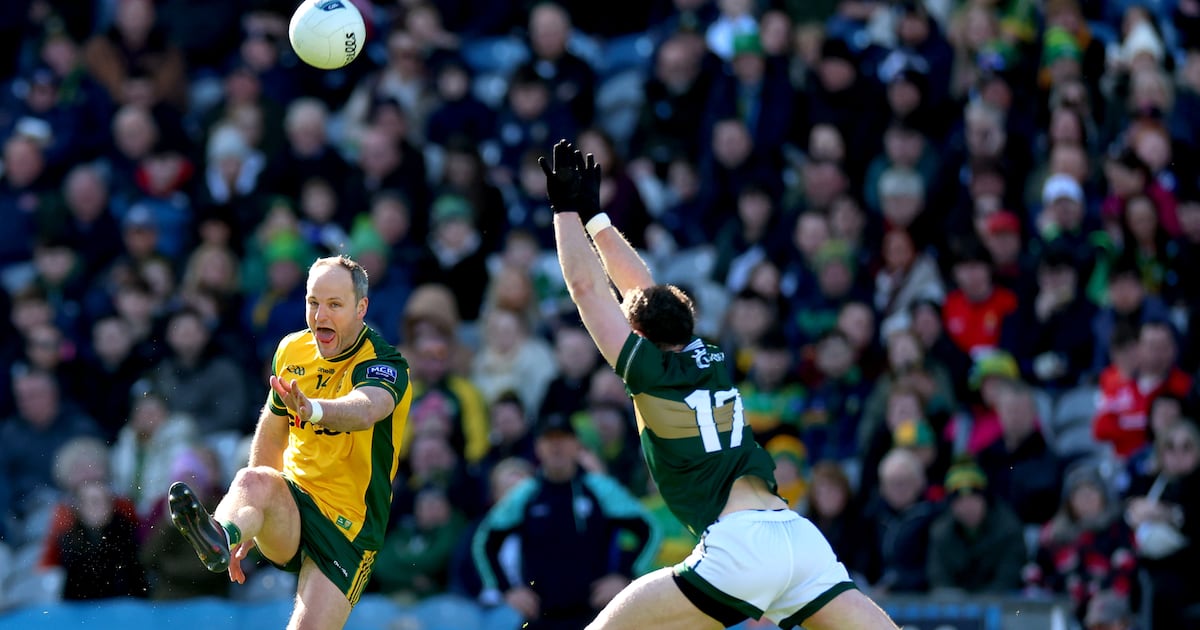
Michael Murphy’s close call
All two-eyed observers surely agree that Michael Murphy should have been sent off on Sunday. If and when we manage to stick a recorder under his, you’d imagine there’s every chance he’ll cop to it himself.
He caught Dylan Casey twice, once with a swinging arms to the ribs and then with a close fist to the jaw. There’s no defending that – and no earthly reason anyone would want to.
Donegal manager Jim McGuinness deflected the question in the press conference afterwards, launching into a soliloquy about physicality and screening that had nothing to do with the incident itself. Murphy got a yellow card from David Gough, which is the worst of all worlds from a disciplinary point of view. The incident is deemed dealt with now so the Donegal talisman escapes meaningful punishment.
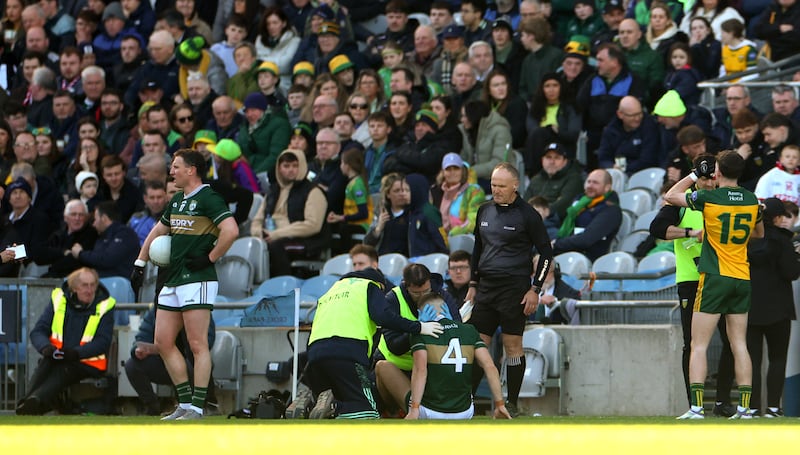 Kerry’s Dylan Casey receives treatment following a tackle from Donegal’s Michael Murphy. Photograph: James Crombie/Inpho
You’d wonder though if it might turn out to be a false economy in the long run. The commentary over the past 24 hours has had two pronounced strains. One, that Murphy has been getting away with this kind of thing for years. And two, that refereeing is in a shocking state of it can’t catch something like this happening in real time.
On the second point, what happened on Sunday was definitely a refereeing balls-up. Gough was blindsided and could only go on what his linesman told him – since that linesman was the ultra-experienced Conor Lane who was standing just a few feet from the incident, it beggars belief that yellow was the call.
As for Murphy, even his most ardent admirers have always known he has a bit of this in him. Most likely, it’s a remnant of him being a prodigy – he’s been playing senior football since he was 17 and had to learn very early on how to mind himself. Several times over the years, he’s been guilty of leaving an arm flailing or tackling with a closed fist. Just because he’s a magical player and a deeply sound fella shouldn’t blind anyone to that reality.
Add those two factors together and it will be no surprise if the see-saw corrects itself somewhere down the line over the summer. Whatever benefit of the doubt Murphy has enjoyed down the years evaporated on Sunday. On top of that, referees are going to be keen not to be embarrassed again like they were here. Donegal might find they have to pay for this one at a later date. – Malachy Clerkin
Kerry’s tipping point?
It was former Tipperary manager and coach Eamon O’Shea who made the point about hurling being such a skilful game that even small differentials in performance could lead to lopsided outcomes. That may be some consolation for Kerry as manager Jack O’Connor processes a first National Football League final defeat.
It was O’Shea’s successor and former selector Michael Ryan, who had a more sobering reflection from O’Connor’s point of view. Speaking to The Irish Times in January, Ryan discussed his team’s experience in 2017. Like Kerry, Tipp were All-Ireland champions and looking to add the league title.
After a creditable campaign, they played Galway in the final, in another parallel, having beaten them in the previous year’s championship. They were annihilated on a scoreline not dissimilar to Sunday’s, 3-21 to 0-14.
“Now, as far as I’m concerned, you should always be trying to get yourself to the end of any competition,” recalled Ryan. “But the jeopardy is that you’re not supposed to take a beating.
“You’ve also given energy to the opposition by saying, hang on a sec, look what Galway did to these guys – notwithstanding that Galway were an excellent side, about to win that year’s All-Ireland.”
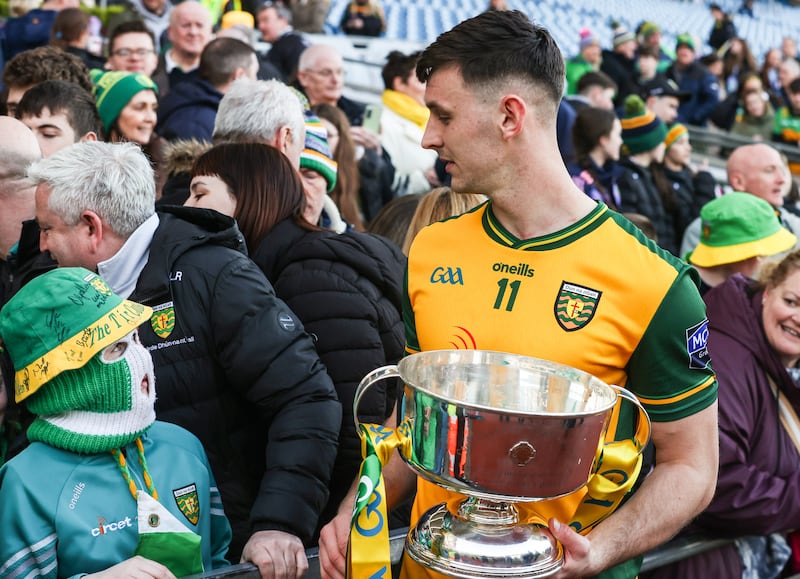 Donegal’s Michael Langan with a supporter after Sunday’s Division 1 final against Kerry at Croke Park. Photograph: Tom Maher/Inpho
As an outlier performance, Kerry are unlikely to brood on it excessively and can counter that last June they lost an All-Ireland group match to Meath by nine points. Six weekends later they were champions, having dominated Donegal in the final.
Sunday’s team was missing All Stars Paudie Clifford, Gavin White and goalkeeper Shane Ryan, three of their top performers in the All-Ireland, as well as Brian Ó Beaglaoich and Seán O’Brien, who was part of a centrefield that dominated last year’s final, both of whom withdrew before the weekend’s throw-in.
There were also low-energy performances from leading lights David Clifford and Seán O’Shea, both of whom missed more than they scored. What’s the likelihood that will be repeated on their championship return to Croke Park? – Seán Moran
Hooter headache
The hooter question bubbled up again over the weekend, with three of the four league finals throwing up an issue of some sort as full-time ticked nearer. By Sunday evening, it had got to a stage recognised by fans of The Hitchhiker’s Guide to the Galaxy, switching the hooter in for God in Oolon Colluphid’s trilogy – Where The Hooter Went Wrong, Some More Of The Hooter’s Greatest Mistakes, and finally, Well, That About Wraps It Up For The Hooter.
The closing seconds of the Meath v Cork game on Sunday may well turn out to be precisely what wraps it up for the hooter. With Cork needing to get up the pitch to try to force a two-point chance, Meath players started dragging them down in their own half. And why wouldn’t they? James Conlon got a black card for his troubles but it couldn’t have mattered less. Meath knew that all they had to do was keep Cork in their own half and they’d be home free.
This couldn’t have happened in last year’s championship. The rule back then was that the game didn’t end until the ball went out of play after the hooter. Incredibly, this was changed over the winter on the back of David Clifford’s magnificent two-pointer just before half-time in the All-Ireland final. By all accounts, the sight of Kerry holding on to the ball for long enough to let the hooter pass so they could take the final shot of the half was displeasing to enough people to bring about the change.
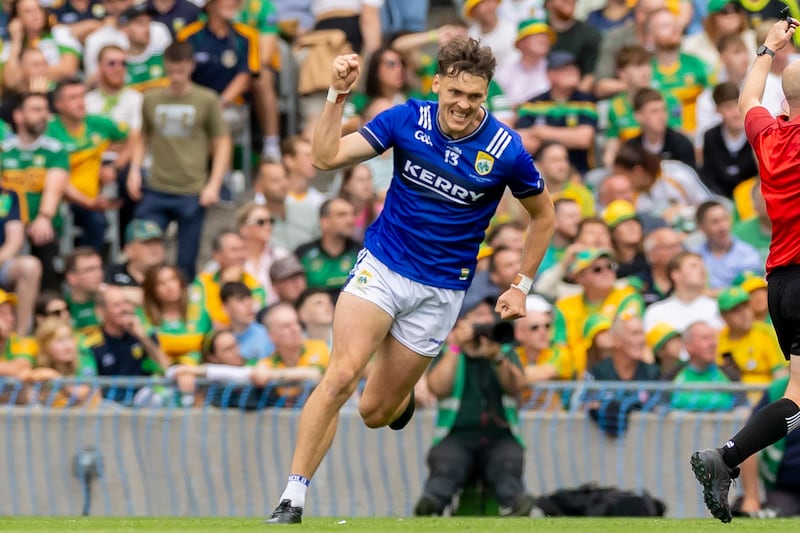 Kerry’s David Clifford celebrates a score during last year’s All-Ireland final against Donegal. Photograph: Morgan Treacy/Inpho
So now the game finishes on the hooter, meaning that teams know there is a dead stop coming on the stroke of 35 and 70 minutes. There is no less minding of the ball – it just starts earlier. And the incentive to systematically haul people down if you have a lead is staring you in the face. You’d be stupid not to do it.
Maybe the greatest development of the new rules is the way it has largely taken cynicism out of the game. At a stroke, this rule change has restored it. Hopefully Kevin McStay’s Expert Advisory Group saw enough over the weekend to act on it. – Malachy Clerkin
Bucking the league runners-up trend
Much has been made of Jack O’Connor’s extraordinary feat of delivering a league title as a side salad every time that Kerry have won the All-Ireland under his leadership: five times out of five.
That sequence cannot be continued this year, but it is alarming to look at the record of beaten league finalists on the whole.
In this century only Dublin (in 2011 and 2017) and Galway (2001), have recovered from a league final loss to win the All-Ireland, and you must scroll back to 1977 to find the previous time it was achieved: again, by Dublin. Kerry have twice bounced back from league final defeats to reach the All-Ireland, but on both occasions they were beaten: by Dublin in 2019 and by Tyrone in 2008.
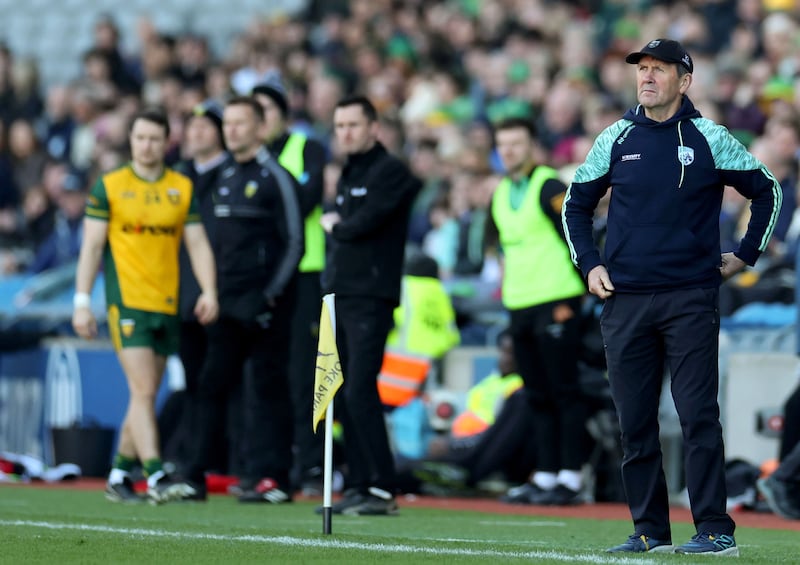 Kerry manager Jack O’Connor on the sideline during Sunday’s Division 1 final against Donegal. Photograph: James Crombie/Inpho
In total, only five beaten league finalists since 2000 have managed to get back to Croke Park for the All-Ireland final.
The performance of league final winners is conspicuously different. Last year, Kerry were the 11th team since the turn of the century to complete the league and championship double.
Anyway, Kerry are still favourites for the All-Ireland. – Denis Walsh
Two-pointers make the difference
The impact of the two-pointer was evident again at Croke Park on Sunday when both divisional finals were won by the team with the most orange-flag scores.
Meath (four two-pointers) beat Cork (one) in the Division 2 final while Donegal (four) overcame Kerry (one) in the Division 1 decider.
Meath are one of the most consistent teams at scoring two-pointers and have several long-range kickers – Ruairí Kinsella (two), Jack O’Connor and Seán Brennan nailed scores from outside the arc on Sunday.
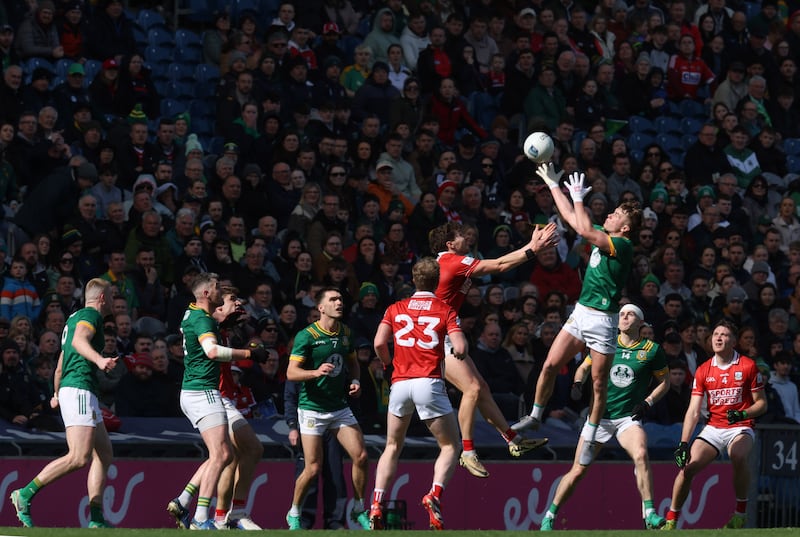 Meath’s Ruairí Kinsella fields a high ball under pressure from Cork’s Paul Walsh during Sunday’s NFL Division 2 final. Photograph: Tom Maher/Inpho
“I’ve said it before, but Meath have always had good forwards and I think we’ve an exceptional bunch at the minute,” said manager Robbie Brennan of his charges. “I sound like Aidan O’Brien with the horses, ‘exceptional bunch’, but there’s an exceptional crop of forwards there and they’re all a little bit different. That can bring challenges for opposition.
“I think the main thing is we encourage them to play and do their thing and they’re all accurate most of the time.”
Donegal had a pair of two-point scorers with Michael Langan and Michael Murphy both splitting Kerry’s posts from distance twice. Sub Paul Geaney was Kerry’s only two-point scorers late on in Sunday’s Division 1 final.
Goals might remain the highest scoring reward in football but two-pointers have become equally as powerful at swinging the momentum of games. – Gordon Manning
Carlow on the rise again
Of the four successful managers over the weekend, none were more satisfied or delighted than Joe Murphy. Carlow’s Division 4 win over Longford on Saturday evening was their first win at Croke Park since 1971, their first National League title at any level, and a first senior football trophy since the O’Byrne Cup in 2002.
And all of it pointed back to Murphy, the Carlow native who took over as manager this time last year, when former Sligo goalkeeper Shane Curran stepped down after a quite public dispute with the players. Murphy agreed to take over on an interim basis, but when a heavy Leinster championship defeat to Meath followed, then an early Tailteann Cup exit, it looked like Carlow football had reached another low.
Instead, Murphy saw the bigger picture, agreeing to a three-year term in August, and appointing a backroom team which in his own words were entirely “Carlow stock”. Their Division 4 campaign wasn’t without some shaky moments, but a final round win over Leitrim set up their shot at the title against Longford, and the players grabbed it with both hands.
Carlow were last promoted to Division 3 under Turlough O’Brien in 2018, their first promotion in over three decades, starting the so-called “Carlow Rising” era, when they also defeated Kildare in the Leinster championship. Unfortunately that rising didn’t last for very long.
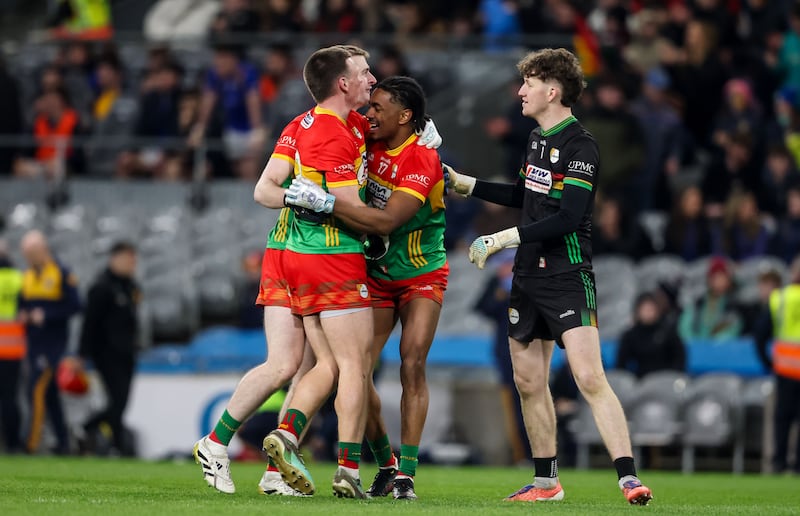 Carlow celebrate after beating Longford in Saturday’s NFL Division 4 final at Croke Park. Photograph: Nick Elliott/Inpho
“We didn’t need any outside influence to do this, we did this as Carlow people,” Murphy said on Saturday evening, the Éire Óg man previously enjoying considerable club success in his native county. “To me that’s massive, and maybe it’s a lesson for the future.”
Murphy also paid tribute to his backroom team of Mick Kehoe, Barry Hayes, Christopher Bolger and James Clarke: “I just try to keep things on the right line, and the boys have all been amazing. They’re all Carlow men and they’re bursting with pride as well.”
It’s just under two weeks before Carlow play Wicklow – one of the teams who had also been chasing hard for promotion from Division 4 – in the Leinster championship. The winners play Dublin in the provincial quarter-final, which would mark another considerable step up for Carlow, if they were to progress. But for now at least they are a team unquestionably on the rise again. – Ian O’Riordan