
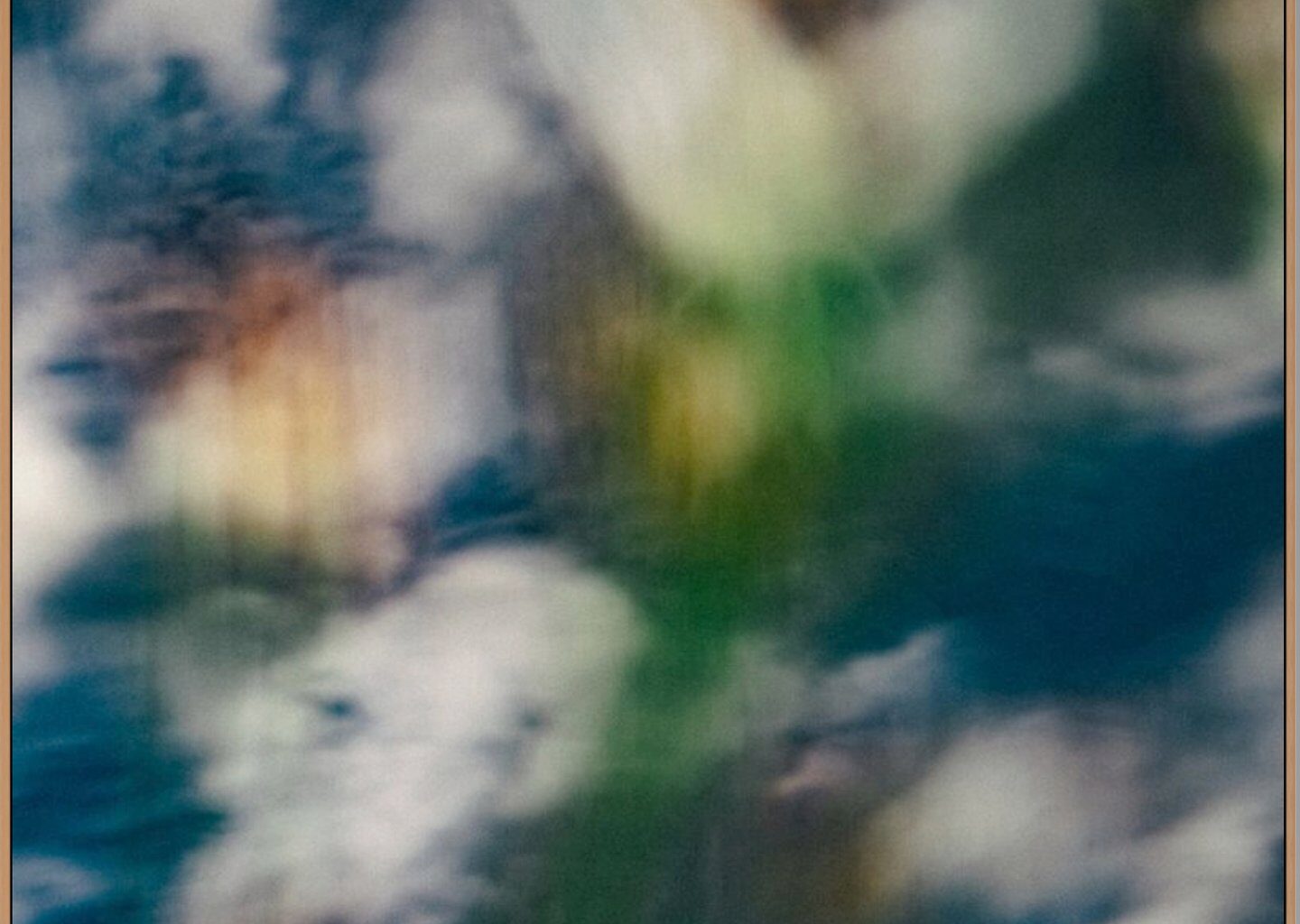
Working with intentional blur and motion, Gideon attempted to photograph time itself through the dissolution of images – in this case, it’s the commonly photographed flower, however it’s become so distorted that it’s almost transparent. “The work resists photography’s traditional function of freezing and preserving, instead embracing the medium’s capacity to register change, movement, ephemerality,” says Gideon. The artist explains that modern cameras are engineered to sharpen everything – the tricky part is, memory doesn’t work like that, and if one follows the Susan Sontag school of thought: photography is never neutral nor can photos be taken as a fact. So Gideon doesn’t attempt to recall beauty or loss in perfect detail, he focuses on capturing moments in passing – untouchable, out of reach, already gone as we remember them.
Gideon shoots with a Sony RX100 VII, a small point-and-shoot that fits into his pocket. Its long zoom flattens spatial depth, compressing foreground and background into a single plane, which is how the photographs feel more like paintings than film. “I love the camera as a tool – I see it as my paintbrush. The point of these small light ones is that they disappear in my hand and I feel more able to let the intelligence of my hand communicate, like drawing with a pencil,” says Gideon. The works are printed on museum-quality matte archival paper, removing the sheen from printed film photographs, and preventing the reproducibility of photos.
Japanese death poems, also known as jisei, come from a Zen Buddhist tradition that at the moment of death, a person achieves a particular clarity worth sharing, leaving behind a spiritual legacy rather than a simple farewell. For Gideon, the title of the aforementioned death-poem says something that he himself keeps circling back to: “a flower is most fully itself in the act of disappearing” – like the head of a dandelion full of florets – whispery, see-through and ready to blow away at the instance of a breeze. “Transience isn’t a flaw. It’s the identity. The title Because We Fall extends this to us — beautiful because it’s fleeting,” says Gideon. “It’s not a doctrine or a theology – it’s just the clearest thing I’ve arrived at after leaving spiritual leadership: pay attention, because this is passing.”