
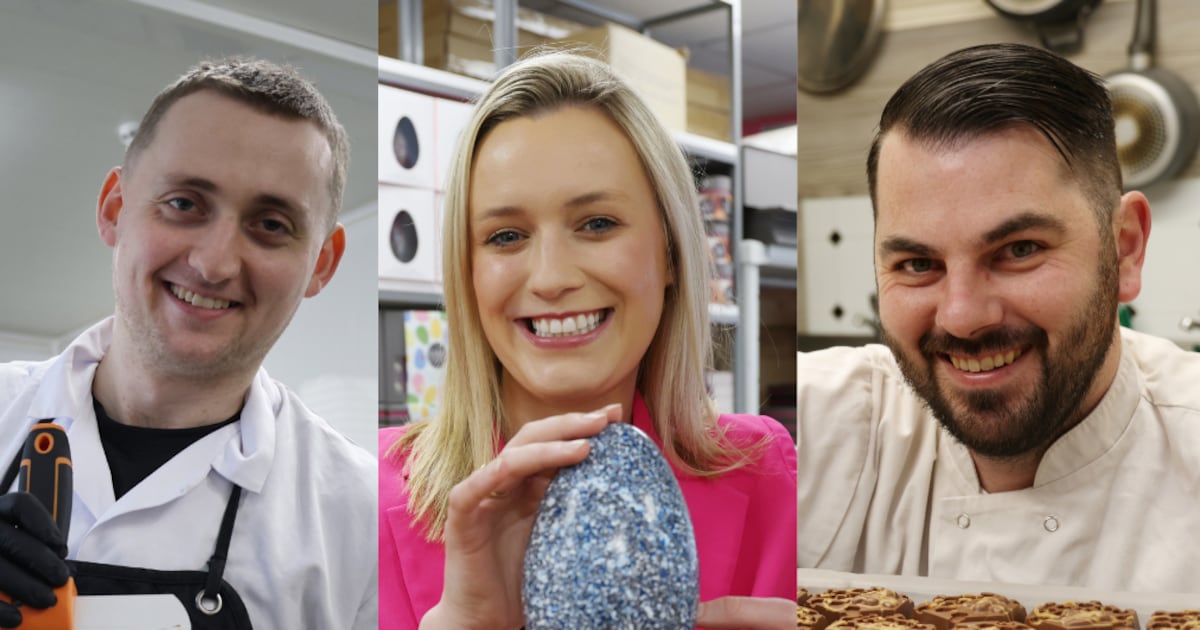
The idea of working in a chocolate factory conjures up images of opulent chocolate fountains, gorgeous scents wafting in the air and an endless supply of delectable sweet treats throughout the day.
As with most external perceptions of workplaces of course, this isn’t quite the reality. Just ask any of the country’s leading chocolatiers who have just been creating thousands of decadent Easter eggs during one of their busiest times of the year. We caught up them as they were right in the thick of it, literally.
Working on a four-day week cycle in her Galway chocolate factory, Gráinne Mullins and her team of chocolatiers develop creations for Grá Chocolates, the business she founded in 2020.
The company’s biggest seller is the classic Grá Chocolates box, consisting of five thick, glossy, hand-painted chocolate batons with fillings including salted caramel, honey, and hazelnut praline.
Grá Chocolates makes around 10,000 chocolates every week.
“The amazing thing about this job is that everyone has fantasies about working in a chocolate factory,” says Mullins. “And you do get that smell of chocolate when you walk through the door. There may not be rivers and fountains of chocolate like some people would imagine, but you do end up elbow or wrist-deep in chocolate, and I definitely smell like chocolate when I go home.”
There is also a very technical and unglamorous side to working with chocolate, according to Daniel Linehan who founded Offaly-based Bon Chocolatiers with his partner Georgia Quealy in 2020.
Linehan is speaking at the start of the year, as he and his team of chocolatiers are in the throes of creating 50,000 truffles and about 400kg of chocolate clusters for the Simply Better range at Dunnes Stores as part of that week’s production plan, before launching into creating its own Bon Chocolatiers Easter eggs the following week.
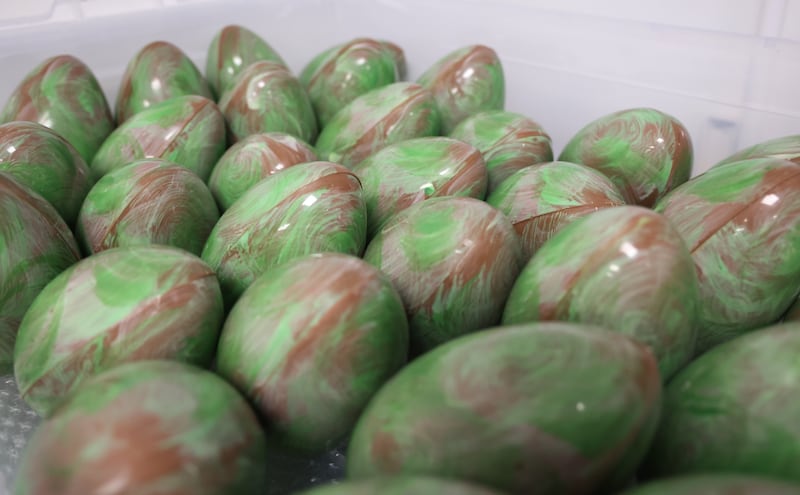 Eggs ready for Easter at Grá Chocolates in Ballybrit, Galway. Photograph: Bryan O’Brien
 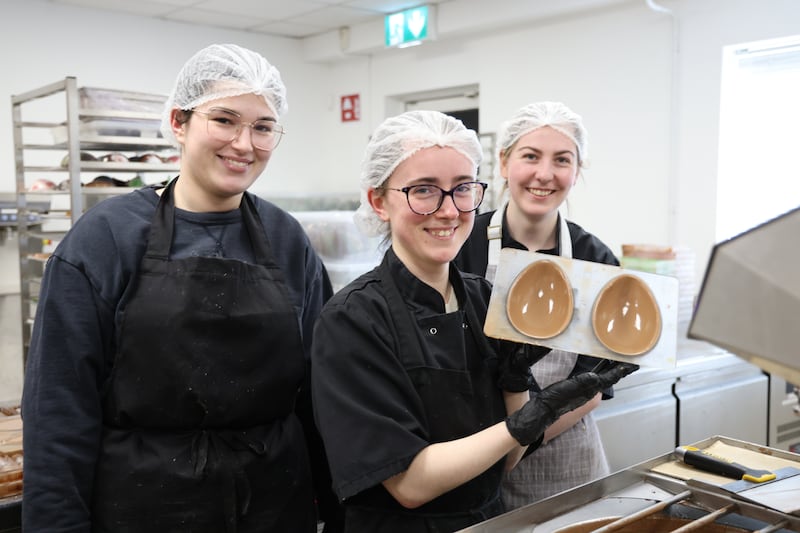 At work in Grá Chocolates (from left) Robyn Williams, Niamh Gibbons and Juliette Simon. Photograph: Bryan O’Brien
“What people often overlook when it comes to chocolate, is that it’s quite a technical ingredient,” he says. “It has rules that need to be applied for things like time, temperatures, humidity and things like that – you don’t see that in the Willy Wonka movie!
“Really what’s in our hands all the time are thermometer probes, and we’re always looking at the thermometers on the wall, and turning off and on the air conditioning, making sure the environment is right. That’s probably the least glamorous part of being in the chocolate factory.”
[ Three Irish artisans offering an immersive chocolate experienceOpens in new window ]
Within the wider food industry, chocolate is one of the more favourable ingredients for building a business, according to Daryl Johnson, who owns Buíoch Irish Chocolates. He works with four other chocolatiers in his factory in Kildare, and the company’s biggest seller is its Dubai hex, consisting of a thick hexagon of Belgian chocolate stuffed with a pistachio kataifi mix.
“I fell into this business,” says Johnson. “I set the business up with my friend Ryan, who’s a chef, during Covid. We did things like jams, chutneys and relishes but we realised how much of a pain making, packing and distributing things like that is so we switched to chocolate.
“Chocolate is more fun to work with: it’s shelf-stable [can be safely stored at room temperature for periods], you can play around with it, and there are lots of seasons where you sell a lot of it, like Christmas, Valentine’s day and Easter. And everyone loves chocolate!
“But it’s not all Willy Wonka and rainbows. People always have a very romanticised idea of what it’s like to be a chocolatier, but at the end of the day, it’s a business and you’ve to keep the whole machine chugging.”
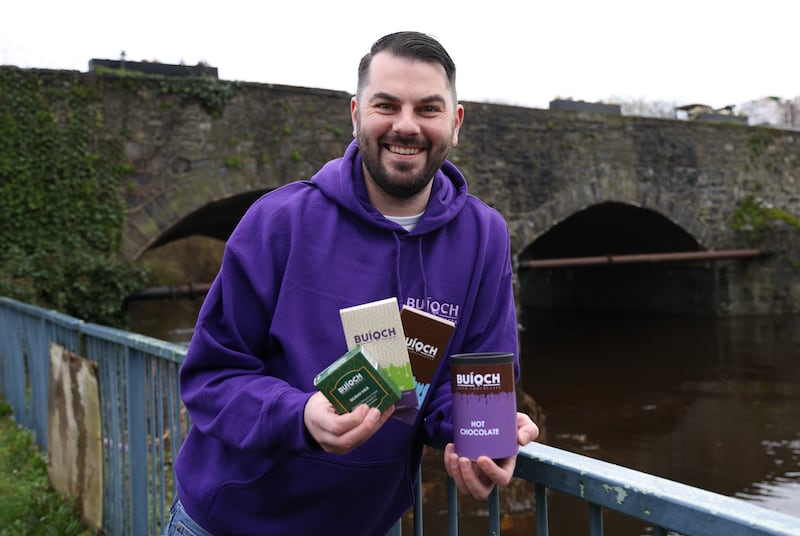 Daryl Johnson of Buíoch Irish Chocolates in Celbridge, Co Kildare. Photograph: Bryan O’Brien
 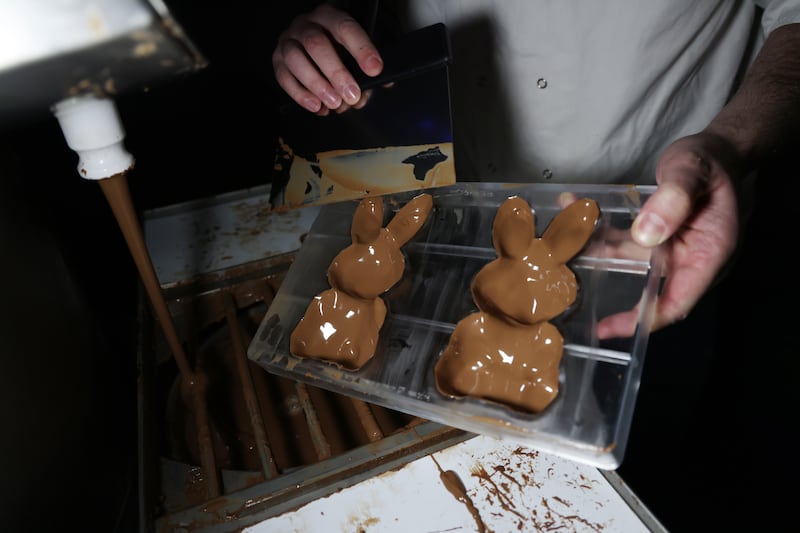 Johnson preparing chocolate bunnies for Easter. Photograph: Bryan O’Brien
With Easter on the horizon for many months now, chocolatiers across the country have long been focused on getting chocolate eggs on shop shelves and delivered to customers’ doorsteps during one of their most demanding times of the year.
Eggs from Grá Chocolates have been distributed to high-end retailers across the country, while eggs bought directly by consumers on their website will have been made to order.
“We start our busy season in the lead-up to Christmas and it’s non-stop until after Easter,” says Mullins. “The days can be longer for us leading up to Easter, but we have a very good idea of how many eggs we can make in a week.”
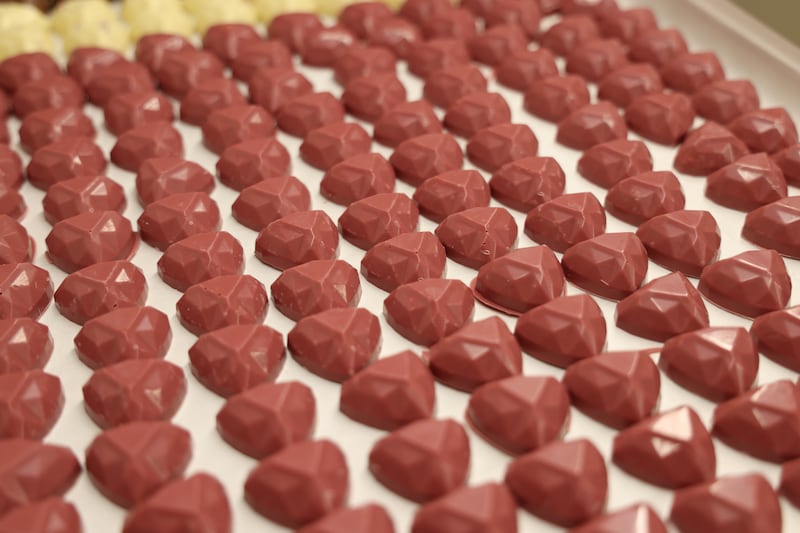 Chocolates in production at Buíoch Irish Chocolates. Photograph: Bryan O’Brien
Linehan from Bon Chocolatiers considers creating Easter eggs a high point of his work as a chocolatier, as he enjoys the creativity that can be used to design the eggs. His January plans saw him making between 3,000 to 4,000 eggs this Easter with his team.
“I love making Easter eggs,” he says. “They’re very satisfying to make, because the egg has such a large surface so you can do really nice hand painting and brushstrokes. You’re not confined by the small size of the chocolate so you can have a little bit more creativity.”
Easter eggs are not yet a part of Buíoch’s range due to space constraints in its premises. Johnson is already looking for a larger facility so the company can continue to grow. “The next big step is to get a fully fledged chocolate factory that can manufacture 10 times’ what we currently manufacture in a week,” he says.
“I don’t do Easter eggs, because I don’t have enough space for the moulds and the eggs. I do chocolate bunnies and egg-shaped bars instead. We’re making around 1,000 egg bars and 500 chocolate bunnies this Easter, but Easter eggs are in the pipeline for the future.”
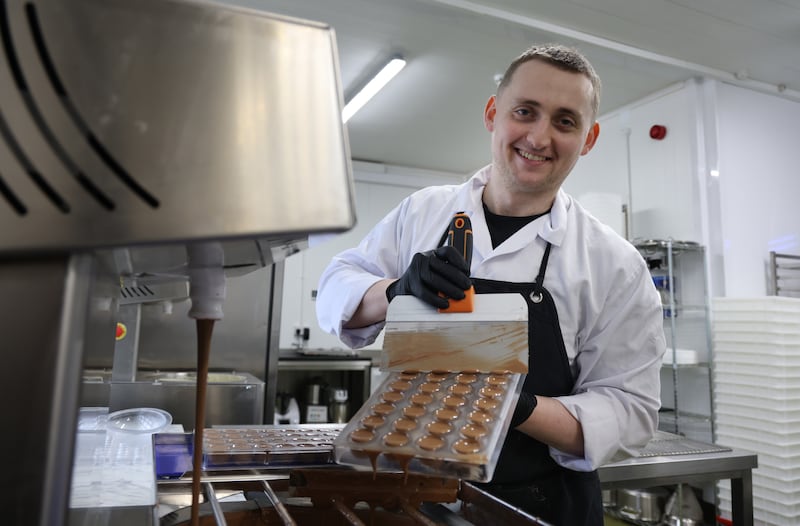 Daniel Linehan of Bon Chocolatiers in Tullamore, Co Offaly. Photograph: Bryan O’Brien
All of the chocolatiers enjoy the craft of creating their products and the hours they spend trialling and developing their chocolates. However, a strong supply chain is an essential component of the success of their businesses and their ability to create and develop their products. The rising cost of ingredients, particularly cocoa, has been a challenge that the chocolatiers have had to navigate.
“[Rising ingredient costs] have definitely stopped products coming to market,” says Linehan. “As in, maybe ideas that we would’ve previously had, we would’ve trialled them but because of the cocoa crisis, we would’ve said, ‘Let’s put a pause on that new product’, because maybe that new product is very heavy on chocolate and doesn’t have cream or caramel or anything else, so we do think, ‘Maybe we’ll wait on this’.”
Mullins adds: “Chocolate prices have gone through the roof, but our chocolate supplier is great – we try to forecast price rises together and stockpile the chocolate we need if we know there’s a price hike coming up.”
There are also times when owning and running a chocolate factory and family life can collide, which Linehan learned when Bon won the coveted Supreme Champion title at the Blas na hÉireann Irish food awards last October.
Linehan and his partner, and Bon co-founder, Quealy didn’t attend the awards as Quealy had just given birth to their daughter, Fía. In fact, the couple were driving home from the hospital with their newborn daughter when they got the call telling them they’d won.
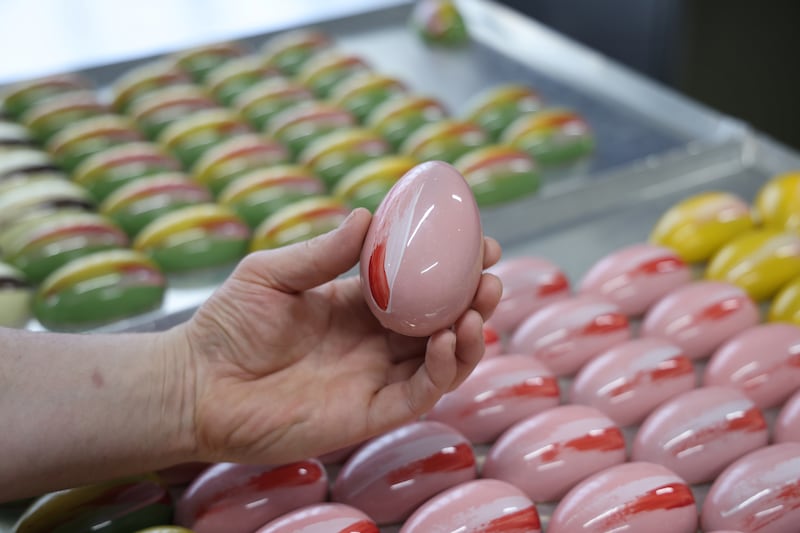 Linehan shows the fruits of his labour at Bon Chocolatiers. Photograph: Bryan O’Brien
“I’d say I never cried as much in my whole life as I did that week,” recalls Linehan. “I’m looking at Georgia and crying, because she’s a mother now, then I’m looking at Fía and I’m like, ‘Jesus, I’m a dad’, then I’m looking at our social media and I’m like, ‘Oh my God, we’ve just won this award. What’s going on?’.”
Bon Chocolatiers, Grá Chocolates and Buíoch are all part of a rich tapestry of artisan chocolate-making in Ireland, and they take enormous pride in their products being a part of celebrations year-round, not just at Easter.
[ Rising chocolate prices: ‘There’s only so much you can charge for a cookie’Opens in new window ]
Johnson, from Buíoch, says: “I think some of the big chocolate manufacturers have shot themselves in the foot – yes, they can sell their products en masse, but the flavour of chocolate just doesn’t seem to be there any more. I find that a lot more consumers are willing to support local chocolate businesses as they know they’re getting pure chocolate.”
Mullins from Grá finds it particularly rewarding when customers lodge repeat orders.
“Seeing repeat customers is so special, and people who love what we do and how we do it,” she says. “Even the name of our chocolate, Grá, lets people know that there’s a lot of love that goes into what we do. It’s very fulfilling.
“I think all of the amazing artisan chocolatiers around Ireland are collectively showing and educating our customers about what chocolate is, so it’s a really exciting time in the Irish chocolate world.”
Linehan is also more than positive about the overall Irish chocolate trade.
“There’s not one good Michelin star restaurant in Ireland, there’s loads of them and that makes that industry better,” he says. “If there’s more of us respecting the craft [of making chocolate], giving out a good product that is at a slightly higher price point, but the customer is educated enough [about chocolate quality] to realise, ‘Oh this is what we’re paying for’, I think that’s great.
“I love to see other chocolatiers doing well, and I love to see other people stepping into this industry and trying to give it a go and putting their own spin on it. I think it only drives the industry more, which is what I care about. I care about my business, of course, but I also care about the industry as a whole, because without the industry my business can’t exist.”