
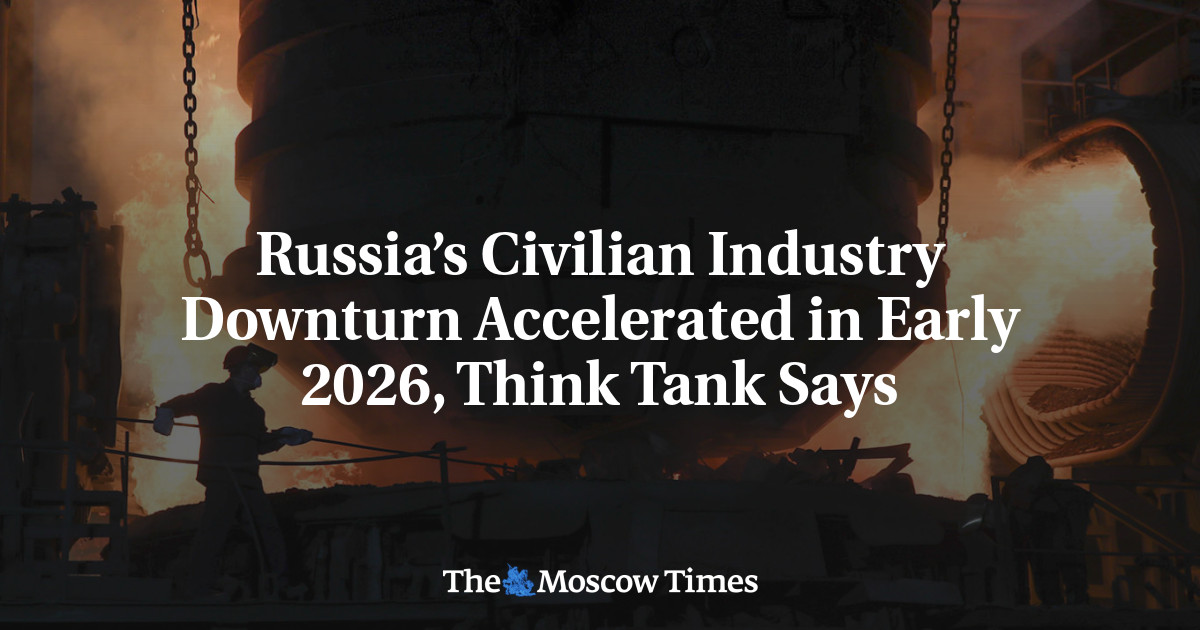
Russia’s civilian industrial sectors accelerated their decline at the start of 2026, a Kremlin-linked think tank said, citing weak investment demand and falling output across most industries.
Industrial production excluding defense-related sectors fell 2% over the winter months, according to the Center for Macroeconomic Analysis and Short-Term Forecasting (CMASF). In February, output was just 1.1% above the average monthly level of 2021, the lowest since March 2023.
The data underscore widening gaps between defense-driven growth and the broader economy as state spending on the military masks weakness in civilian industries.
Rosstat data show output declining in most major sectors. In January-February, only pharmaceuticals — up 8.3% year-on-year — and two defense-linked categories posted growth: computers, electronics and optical products rose 7.3%, while other transport equipment jumped 19.8%.
“The epicenter of the downturn is industries tied to investment demand,” CMASF said, noting companies are cutting capital spending.
Investment growth began slowing in mid-2025 and fell 2.3% for the year. The Economy Ministry expects a further decline in 2026.
Production of construction materials, which was already under pressure, fell 10-25% below the 2024 monthly average in February, with cement, concrete and brick output shrinking 1.7-2.8% per month in January-February on a seasonally adjusted basis.
Steel output fell 1.1% per month on a calendar-adjusted basis and dropped 11% year-on-year in January-February.
“The sector is moving into survival mode,” said Yaroslav Kabakov, strategy director at Finam, citing sharp cuts to investment programs.
Machinery and equipment output continued to contract, falling 2.2% in February after a 1.2% drop in January. Output is now about 75% of its 2024 average, CMASF estimates.
A tentative recovery in the auto sector has stalled. Output fell 1.5% month-on-month in February to 76.6% of the 2024 average. Executives at AvtoVAZ and KamAZ do not expect a rebound this year.
Wood processing output also declined, falling 1.4% in February and standing at 91% of the 2024 average and 80% of 2021 levels.
“February’s figures look weak and increasingly point to a sustained negative trend,” said Alexei Klimyuk of Alfa Capital.
Read this story in Russian at The Moscow Times’ Russian service.