
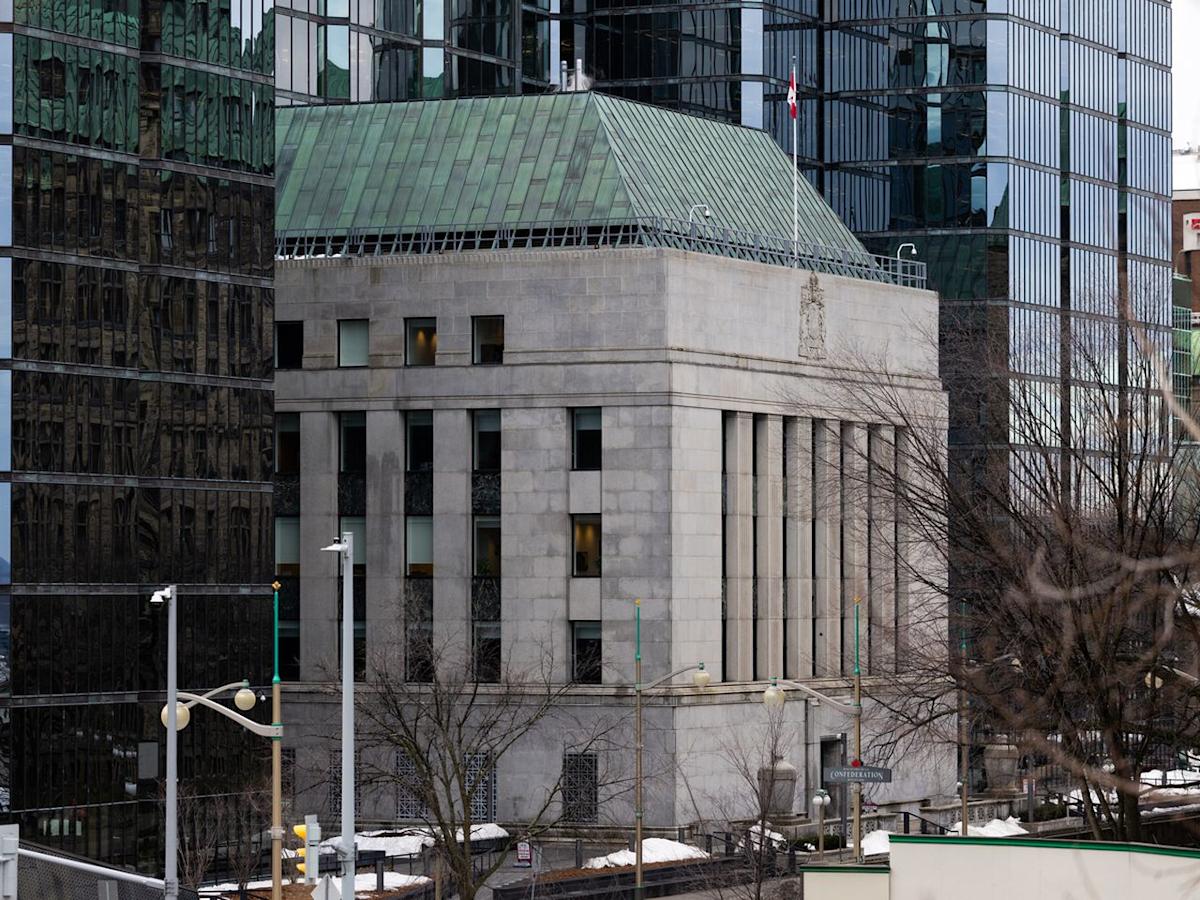
 Economists are estimating first-quarter gross domestic product growth of between 1.4 per cent and 1.8 per cent, which was the Bank of Canada’s forecast in its most recent monetary policy report. (Credit: HYUNGCHEOL PARK/Postmedia files)
Canada’s better-than-expected gross domestic product (GDP) growth has put the economy on track to get close to or meet the Bank of Canada‘s outlook for the first quarter, economists said.
Statistics Canada said GDP in January rose 0.1 per cent month over month, beating economist estimates of no growth, and the agency issued a flash estimate for an increase of 0.2 per cent in February.
Based on those numbers, economists are estimating first-quarter GDP growth of between 1.4 per cent and 1.8 per cent, which was the Bank of Canada’s forecast in its most recent monetary policy report (MPR).
Prior to the release of the latest GDP figures, many economists were calling for sub-one per cent annualized growth in the first quarter based on other data.
Here’s what economists say the GDP numbers mean for the central bank and interest rates.
“The pre-war economic data could scarcely be more stale, but Canada can at least boast, having experienced some better-than-expected output numbers ahead of the mess in the Middle East and the subsequent surge in energy and related costs,” David Rosenberg, president of Rosenberg Research & Associates Inc., said in a note.
He estimates first-quarter annualized GDP growth will be 1.4 per cent and year-over-year growth will be one per cent, which he said still falls short of the economy’s potential for growth.
Much of the growth in January came from the oil and gas sector, notably in Newfoundland and Labrador and Saskatchewan, Rosenberg said. Elsewhere, the economy “flatlined,” with industrial production shrinking by two per cent year over year.
“The bottom line is that this data release is old news and was mixed overall, despite beating market expectations,” he said.
He expects the Bank of Canada will keep rates where they are, but said if policymakers do make a move, they will cut because the economy is “expanding below trend.”
“The year 2026 is off to a strong start in terms of economic growth,” Matthieu Arseneau and Alexandra Ducharme, economists at National Bank of Canada, said in a note.
They said January’s consensus-beating result was surprising given that poor weather hit sectors such as transportation, while auto manufacturing was due to longer-than-expected retooling periods.
Growth contracted in nine of 20 sectors in January, but mining and oil and gas expanded by 1.2 per cent. Construction rose 1.1 per cent and looks to be on the rebound in the first quarter.
“Consumers also seem to be holding up well, with retail sales and accommodation and food services posting solid increases,” the pair said.
February’s outlook provided another dose of good news, with Arseneau and Ducharme estimating first-quarter annualized GDP growth will come in at 1.5 per cent, assuming flat growth in March. GDP per capita could increase 2.5 per cent year over year, the largest rise since the second quarter of 2022.
“This morning’s report is reassuring, but it doesn’t mean the Canadian economy is sailing smoothly,” they said.
The economy has been riding a “rollercoaster” as growth rose and fell over the past year, contracting 0.6 per cent annualized in the fourth quarter after rising 2.4 per cent in the third.
Challenges are baked in, including a slowing employment market, weak hiring and investment intentions on the part of business and rising energy costs for consumers.
“We remain skeptical about the economy’s overall ability to benefit from recent geopolitical developments,” they said, adding they don’t believe higher oil prices will translate into more investment from the energy sector.
With core inflation close to the central bank’s two per cent target, they said “the Bank of Canada can afford to be patient before raising rates.”
“It wasn’t great, but it wasn’t as bad a start to the new year for the Canadian economy as expected,” Katherine Judge, an economist at CIBC Capital Markets, said in a note.
She said the increase in oil and gas extraction was “broad-based” and coal mining had strong results, but overall GDP for the quarrying, mining and oil and gas sector sits below last year’s level on flat activity in the second half of last year.
Manufacturing is expected to execute a turnaround in February, after contracting 1.4 per cent in January, as auto production revs back up again.
But Judge said manufacturing in Canada was already in decline prior to the imposition of tariffs by the United States, with sector growth 4.6 per cent lower than a year ago and 8.6 per cent lower since 2019.
CIBC estimates first-quarter annualized GDP is currently tracking at the level forecast by the Bank of Canada in its MPR.
But Judge said there are obvious risks ahead, including higher oil prices that are impacting consumer consumption and the still-uncertain outcome of the review of Canada-U.S.-Mexico. Agreement.
“With risks to underlying momentum, the (Bank of Canada) is likely to keep interest rates on hold until there are signs of a sustainable reduction in economic slack, likely into 2027,” she said.
• Email: gmvsuhanic@postmedia.com