

Ireland is above the European average for building activity in terms of planning permissions granted for new homes, according to research from RationalFX.
Last year, Irish authorities granted permission for a total of 26,776 dwelling units, equivalent to 50.44 per 10,000 residents.
On that basis, Ireland ranks seventh in Europe behind Malta (162.04), Turkey (86.08), Albania (71.97), Cyprus (67.90), France (67.90), and Bulgaria (50.94).
Of the total permissions granted, 7,147 permits were issued in Dublin, highlighting the continuing central role the capital has in development activity.
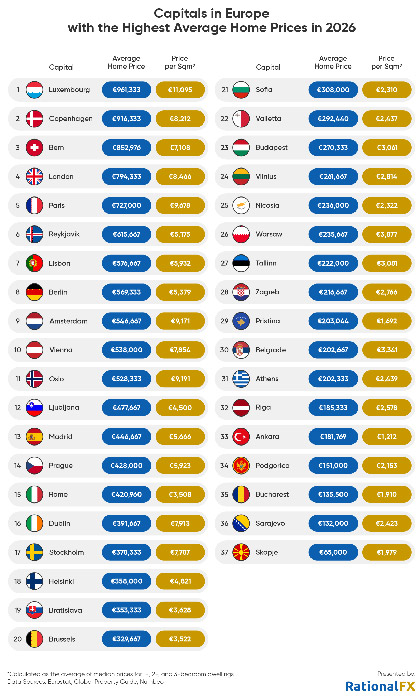
The research shows that Dublin residential property had an average price of €7,913 per square metre in January, seventh highest among European capitals and up 5.37% year-on-year.
Dublin placed ahead of cities such as Vienna (€7,854), Stockholm (€7,787), and Bern (€7,108), but well below leading markets like Luxembourg (€11,095), Paris (€9,678), and Amsterdam (€9,171).
Median home prices ranged from €295,000 for one-bedroom units to €495,000 for three-bedroom properties, resulting in an overall average of €391,667, reflecting steady but moderate price growth in the Irish capital.
Between the third quarter of 2024 and the same period in 2025, property prices in Ireland rose by 7.5%, putting the country in the mid-range for European housing market growth.
By comparison, the strongest increases were recorded in Hungary (+21.1%), Portugal (+17.7%), and Bulgaria (+15.4%), while Finland was the only country to see a decline, with prices falling 3.1%.
According to the study, home ownership in Ireland is at 69.3% while just 30.7% rent, giving a homeownership rate significantly lower than Romania (94.3%), Slovakia (93.1%), Hungary (91.6%), Croatia (91%), and Lithuania (87.4%).
The majority of people lived in houses (90.20%), the highest rate in the dataset, while 9.70% lived in flats and just 0.1% in alternative dwellings such as houseboats or campervans.
‘Ireland’s housing market increasingly reflects a transition from post-pandemic overheating toward a more tempered and selectively balanced cycle, rather than a broad-based correction,” Alan Cohen, analyst at RationalFX.
“While recent easing in Dublin signals that the most intense phase of price escalation may be abating, affordability remains structurally constrained, with demand still firmly anchored in urban centres and only gradual relief emerging through the development pipeline.
“The relatively elevated level of planning approvals suggests that supply-side conditions are improving in trajectory, yet the impact on market dynamics is likely to be gradual rather than immediate, given the inherent lags in delivery.
“The outlook points to a market characterised by moderated price growth and intermittent stabilisation, rather than decline, with persistent divergence between core urban locations and the rest of the country continuing to define Ireland’s housing landscape.”