
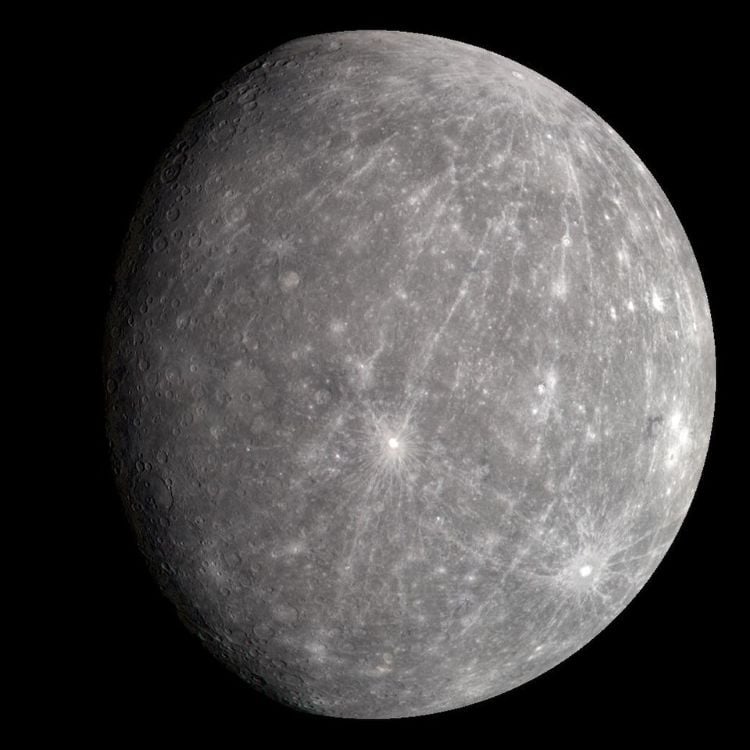
The planet Mercury is the closest planet to the Sun, and also the most difficult for spacecraft to visit and explore. This is because as spacecraft get closer to Mercury, the Sun’s enormous gravity pulls in the spacecraft, greatly increasing its speed and making it hard to slow down without large amounts of fuel. But what if a spacecraft could both travel to and explore Mercury without fuel? This could drastically reduce mission costs while delivering impactful science.
Now, a team of researchers from Brown University might be one step closer to making this mission a reality, as they propose a solar-sail-powered Discovery-class mission concept called Mercury Scout, which they introduce in a study recently presented at the 57th Lunar and Planetary Science Conference. A Discovery-class mission is a low-cost (sub-$1 billion) NASA mission designed for faster development compared to larger Flagship missions, which range in the billions of dollars. For context with Mercury, NASA’s MESSENGER mission, which became the first mission to orbit Mercury, was a Discovery-class mission. For the study, the researchers discussed Mercury Scout’s propulsion, science goals, scientific instruments, spacecraft design, and communication, and propulsion.
Arguably the most intriguing aspect of Mercury Scout is the solar-sail propulsion, which uses solar radiation to power a spacecraft. Along with not requiring fuel, the researchers note this method could also be used to control spacecraft direction and control. Additionally, with the reduced number of components and smaller spacecraft size, the researchers note that solar-sail propulsion could also prolong the spacecraft lifetime, increasing greater scientific data collection about the closest planet to the Sun. Until now, the only spacecraft to have successfully used solar-sail propulsion in space is Japan’s IKAROS mission in 2010 and The Planetary Society’s LightSail-2 successfully used solar sails to raise its orbit in 2019. NASA recently tested its Advanced Composite Solar Sail System (ACS3) technology, which was launched in April 2024 and successfully deployed its sails in August 2024. While ACS3 is currently in low Earth orbit, the spacecraft, which carries a CubeSat approximately the size of a microwave oven, has experienced a tumble, which continues to be monitored.
The overall goal of Mercury Scout will be to conduct a geological imaging mission using a narrow-angle camera (NAC), which provides high-resolution images up to 1 meter (3.2 feet) per pixel. For context, NASA’s Lunar Reconnaissance Orbiter uses a NAC with resolutions of 0.5 meters (1.6 feet) per pixel, and NASA’s MESSENGER spacecraft had a NAC capable of image resolutions up to 20 meters (65 feet) per pixel.
Using the NAC, the science goals of Mercury Scout will be to gain insight into Mercury’s crustal history, as Mercury’s crust is estimated to be approximately 26 kilometers (16 miles) thick, which is thin compared to other solar system planets. Other science goals include examining current or recent geological activity and comparing these findings with past missions like MESSENGER.
Given Mercury Scout will focus on imaging, the NAC is slated to be the only scientific payload. For heat control, given the extremely close distance to the Sun, Mercury Scout will perform a highly elliptical orbit ranging from as close as approximately 200 kilometers (124 miles) to approximately 10,000 kilometers (6,214 miles) from Mercury’s surface. For communication, Mercury Scout will incorporate a flat antenna like NASA’s MESSENGER and the Japan Aerospace Exploration Agency (JAXA) Akatsuki missions, the latter of which was tasked with studying Venus’ atmosphere until the probe failed to enter orbit and was lost.
The study notes, “This rescoped Mercury Scout concept demonstrates that a simplified, NAC-only payload combined with solar-sail propulsion can enable a focused, high-impact investigation of Mercury’s surface evolution through long-duration, high-resolution imaging. While technical challenges remain in pointing stability, thermal survivability, and attitude control, this study shows that no fundamental physical barriers prevent achieving meter-scale imaging from Mercury orbit using a propellant-free architecture.”
How will Mercury Scout help scientists explore Mercury in the coming years and decades? Only time will tell, and this is why we science!
As always, keep doing science & keep looking up!