
April 1 has once again delivered a fresh roll of photographic absurdity, with brands and creators leaning into the strange, the impossible, and the technically questionable. While some years feel phoned in, 2026’s crop of April Fools’ Day gags shows the industry still has a sharp sense of humor about its own obsessions.
One Lens to Replace Them All
If there is a single concept that encapsulates the spirit of this year’s jokes, it might be Viltrox’s “Chip Max.” Positioned as an all-in-one optical system, the idea promises a 2–1000mm range at a constant f/0.1, complete with autofocus, optical stabilization, and macro capability. No switching. No compromise. No chance!
It is an intentionally ridiculous answer to a very real desire: a single lens that does everything. By pushing the concept to its logical extreme, Viltrox highlights just how unrealistic that dream really is. The joke lands not because it is impossible, but because it feels like something photographers might secretly want.
Air, Glass, and Other Invisible Innovations
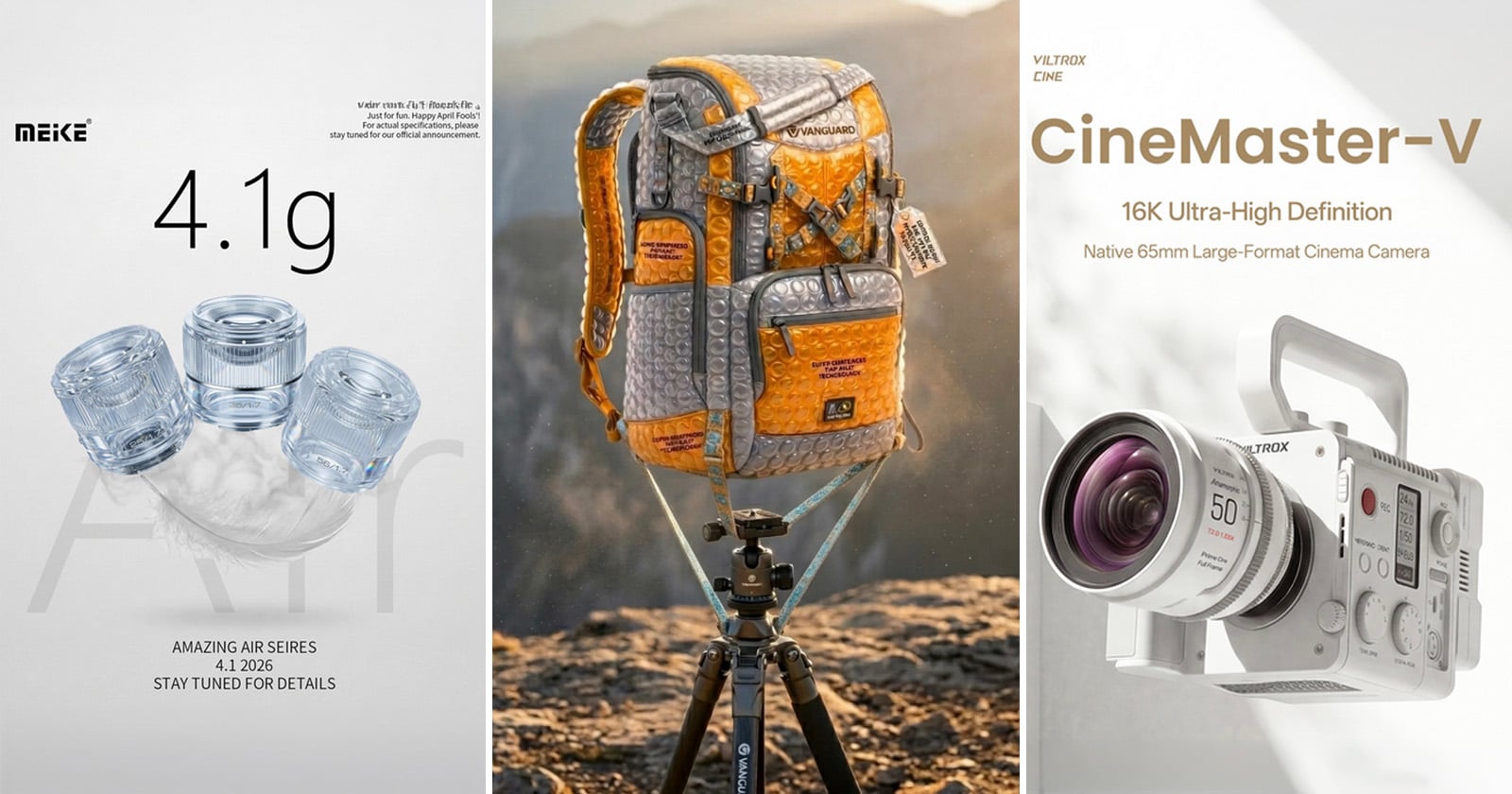
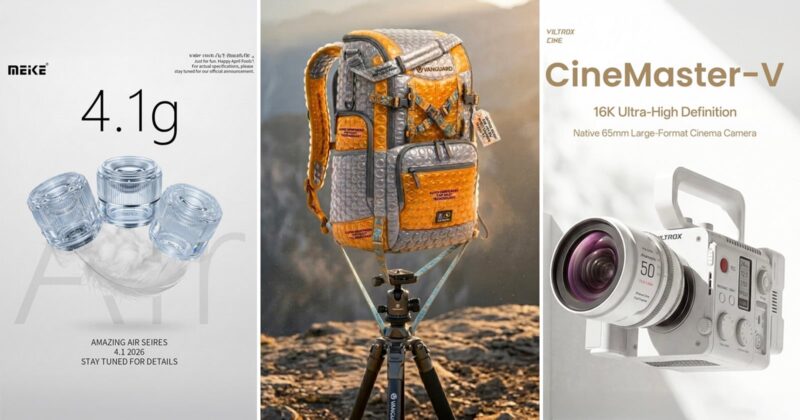
Lens makers also took aim at themselves this year. Meike’s “Air” lenses present perhaps the purest expression of minimalism yet, removing not just weight, but seemingly the glass itself. The joke lands because it builds on real trends, echoing last year’s ultra-lightweight lens pushes while nodding to earlier gags like the crystal clear lens concept.
The Pursuit of the Impossible Image
Among the most delightfully impractical ideas making the rounds is the concept of ISO 0 film, a tongue-in-cheek jab at photographers’ endless pursuit of cleaner images. Shared by creator Kamerasuki Sam, the fictional film stock promises effectively zero sensitivity to light, making every exposure an exercise in patience or futility. It is a clever inversion of the usual high ISO race, reminding us that sometimes the industry’s metrics can border on the absurd.
Another analog prank this year comes from Lomography. The company presents LomoChrome Mystery, a new film roll where every frame is a different color emulsion.
“As much as we’d like for this to be true, our skilled lab technicians have not yet found the secret to combining multiple emulsions on one roll just quite yet. Still, we hope that this encourages you to shoot your next roll of film a little more freely. Stop worrying about colors and composition, and let your imagination run free for a while,” the company says.
Equally committed to breaking the laws of physics is the Sirui 0mm f/0.95 lens. On paper, it is the ultimate spec sheet dream. In reality, it collapses under even the most basic optical reasoning. A 0mm focal length paired with an ultra-fast aperture reads like satire aimed directly at spec-driven marketing, where numbers often overshadow practicality.
Cinema Without Limits
Not content with breaking still photography, Viltrox’s Cine division aimed squarely at high-end production. The CineMaster V is introduced as a native 65mm cinema camera with a self-developed sensor, global shutter, and a staggering 16K 120fps RAW capability.
At just 3.3 kilograms and fully modular, it reads like a wish list pulled from every cinematographer’s dream spec sheet. The inclusion of proprietary color science and “engineered for every production scenario” language mirrors real-world marketing so closely that the satire becomes almost indistinguishable from reality. It is less a joke and more a mirror held up to the escalating expectations of modern cinema gear.
The Aesthetic of Innovation
Thypoch’s contribution leans into a different kind of commentary. Its concept camera combines an APS-C sensor, global shutter, and 16-bit RAW with a heavy emphasis on AI-driven image rendering. The twist comes in its presentation, offering finishes like transparent and titanium while inviting users to co-design the final product.
It is a subtle jab at the growing overlap between technology, personalization, and community-driven development. By packaging familiar buzzwords into a deliberately vague but stylish concept, Thypoch captures the tone of modern camera launches, where experience and identity are often marketed as heavily as the hardware itself.
When Weight Becomes Weightless
Not to be outdone, Vanguard’s “Lighter Than Air” camera bag takes a more literal approach to gear complaints. Filling the bag with helium promises to reduce carrying fatigue in the most impractical way imaginable. It is a playful exaggeration of a real concern for photographers, especially those hauling increasingly heavy hybrid kits into the field.
Rumors Run Wild
Even the rumor ecosystem could not resist joining the fun. Sony Alpha Rumors teased a fictional Sony a7M, a model name that feels just plausible enough to spark momentary confusion. Meanwhile, CanonNews imagined a Canon R100+, continuing the long-running tradition of iterative upgrades taken to humorous extremes.
These entries highlight how rumor culture itself has become part of the industry’s identity, where speculation can sometimes feel indistinguishable from reality.
A Reflection of the Industry
What makes this year’s April Fools’ Day stand out is how self-aware it feels. Each joke targets a real pressure point in modern photography, whether it is the obsession with specs, the race toward lighter gear, or the endless churn of product announcements.
In that sense, these gags are not just jokes. They are commentary. And like any good photograph, they reveal something true by framing it in an unexpected way.
For an industry built on capturing reality, it is fitting that once a year, it collectively decides to distort it instead.
Image credits: Viltrox, Meike, Sirui, Vanguard, Thypoch