
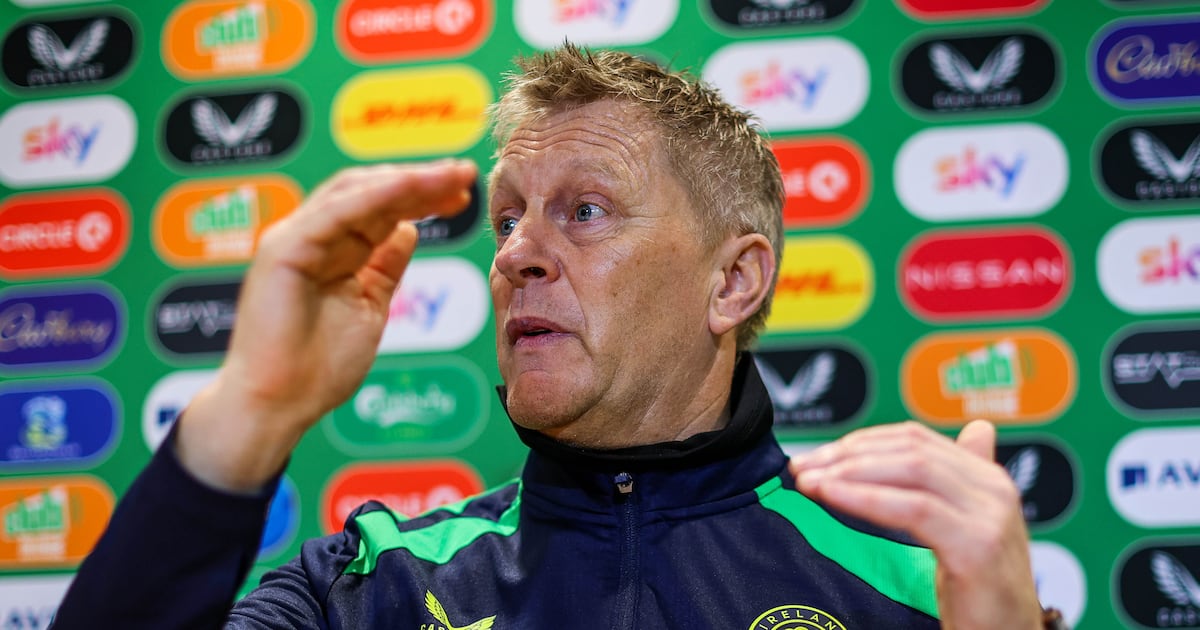
It is late Tuesday night and Heimir Hallgrímsson is giving football correspondents a presentation on a mounted screen inside the changing room at the Aviva Stadium.
The Republic of Ireland manager shows a sequence from the Portugal game in November. There are 80 minutes on the clock and Ireland lead 2-0 as Vitinha, the Paris Saint-Germain midfielder, sprays the ball from left to right and back again from right to left.
“They want to go somewhere, but can’t,” Hallgrímsson says. “That’s controlling the game without having possession.”
Eventually, Rafael Leão errs under pressure from Chiedozie Ogbene and concedes an Irish throw-in.
Repetition is key to everything Hallgrímsson intends to achieve between now and Euro 2028.
“If you know what we are trying to do then all your criticisms are welcome,” he says, clearly in no hurry to depart, an hour after the 0-0 draw with North Macedonia. “Because we will learn from your criticism … So now you know how we want to play and what we are trying to achieve.”
The Icelandic coach gave a similar presentation in late August, before the World Cup qualifying campaign began with a 2-2 draw against Hungary in Dublin, when Adam Idah’s late equaliser salvaged a point before the 2-1 loss away to Armenia three days later.
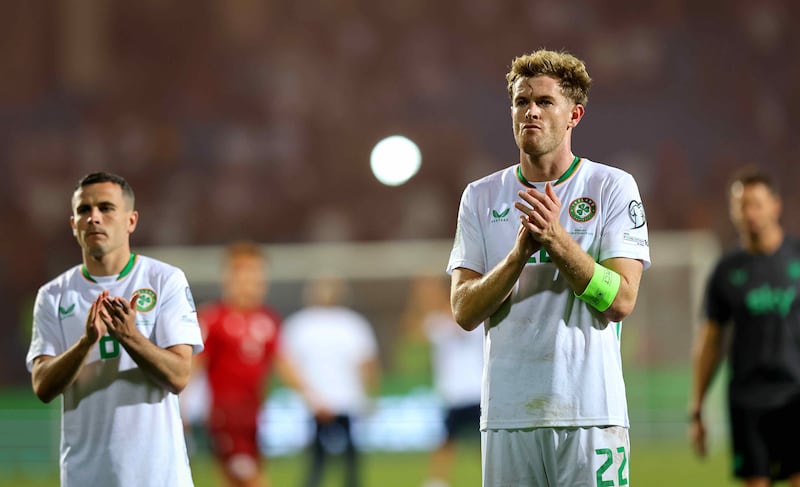 Nathan Collins, right, after Ireland’s defeat to Armenia last September. Photograph: Ryan Byrne/INPHO
Hallgrímsson put the defeat in Yerevan down to the players struggling to cope with altitude. The situation seemed far worse than his summation. Then again, victories over Portugal and over Hungary in November made Ireland contenders to reach the World Cup.
“We want to be the best organised and the best defensive team, and that’s what we work on every time we come and meet,” he says, noting the first of his five principles.
Number two: “We want to improve set-plays in every camp that we come together as a team.”
Number three: “The focus on discipline is so important at this level. We conceded too many yellow cards in this campaign that led to, for example, Liam Scales being unable to play against the Czechs.
“We want to be the hardest-working team. We have talked about duels and that is something that we have been improving a lot.”
Principle number four is represented by a picture of Sammie Szmodics: “We would like to be a forward-thinking and fast-attacking team.”
The fifth principle – leadership – comes with an image of Séamus Coleman, who will either continue playing up to Euro 2028 or retire this summer, potentially to transition into a coaching role at Everton.
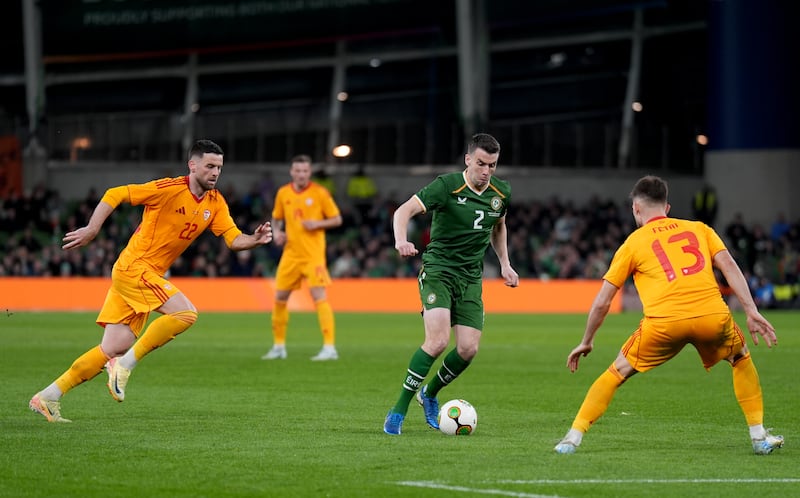 Séamus Coleman battles for the ball with North Macedonia’s Isnik Alimi and Imran Fetai on Tuesday at the Aviva Stadium. Photograph: Niall Carson/PA
“I’d like to have him as a player [for Euro 2028]. Séamus is just one-of-a-kind as a person, as a leader and as a footballer. There aren’t many who could do what he is doing.
“But there are so many players now we can call leaders. ‘Batteries’ I call them. We need as many of them as possible, with good characters.”
As Hallgrímsson delivers his lecture to attentive journalists, his assistant coach John O’Shea audibly exhales at the back of the room. The Czech Republic have just beaten Denmark in another penalty shoot-out in Prague to secure the last spot at this summer’s World Cup in North America.
“We have different opinions [within] the coaching staff,” Hallgrímsson says. “I really think it’s good that the Czechs won. It shows us how close we are to this.”
Turning to O’Shea, he says: “I know it’s a dagger in the back.”
O’Shea: “The dagger has gone through my back.”
Still, the miracle of Budapest is as good a foundation as Hallgrímsson could have wished for after the miserable night in Yerevan last September.
There is time either to replace Coleman or to keep him on ice before the Euro 2028 campaign commences next March. And with 10 more internationals this year, the management has scope to settle on a midfielder who can bring the control that Ireland have lacked since Roy Keane’s retirement.
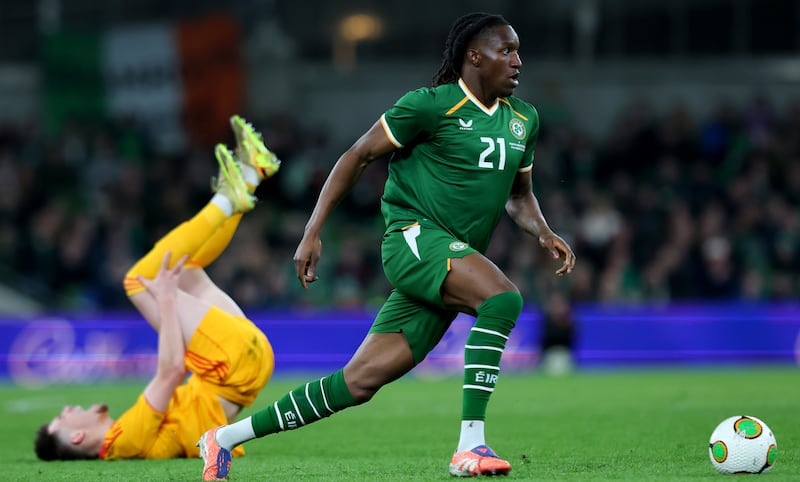 Stoke City’s Bosun Lawal in action for Ireland against North Macedonia. Photograph: Ryan Byrne/INPHO
Josh Cullen will return from knee surgery. Twenty-two-year-old Bosun Lawal possesses the attributes to develop into a Premier League regular.
The search for talent, on and off the island of Ireland, is a priority for the FAI, with 17-year-old Chris Atherton at Chelsea making his debut for the under-19s against Poland last month, having recently switched from Northern Ireland.
“John would probably know more about him,” Hallgrímsson says.
“He has a bit of work to do,” O’Shea says.
The three friendlies that were meant to be World Cup warm-ups will be a tough sell for the FAI as Hallgrímsson gathers his players from English Championship clubs in Murcia, Spain, to face Grenada on May 16th before Qatar at home and Canada in Montreal.
There follows a tumultuous four-game Nations League schedule in late September/early October that includes two fixtures against Israel.
“I think the turning point was Portugal away,” Hallgrímsson says of the 1-0 loss in October. “We played one of the best attacking teams in the world at their home. And after the game we were obviously disappointed, but the players looked at each other and said, ‘We can play any team in the world and they will not score’.
“And we can win against whatever team. If only that game would have come one camp earlier, then we would have had automatic qualification.”
Hallgrímsson slams his notepad shut. “Now we close this book and go on for the next one,” he says.