
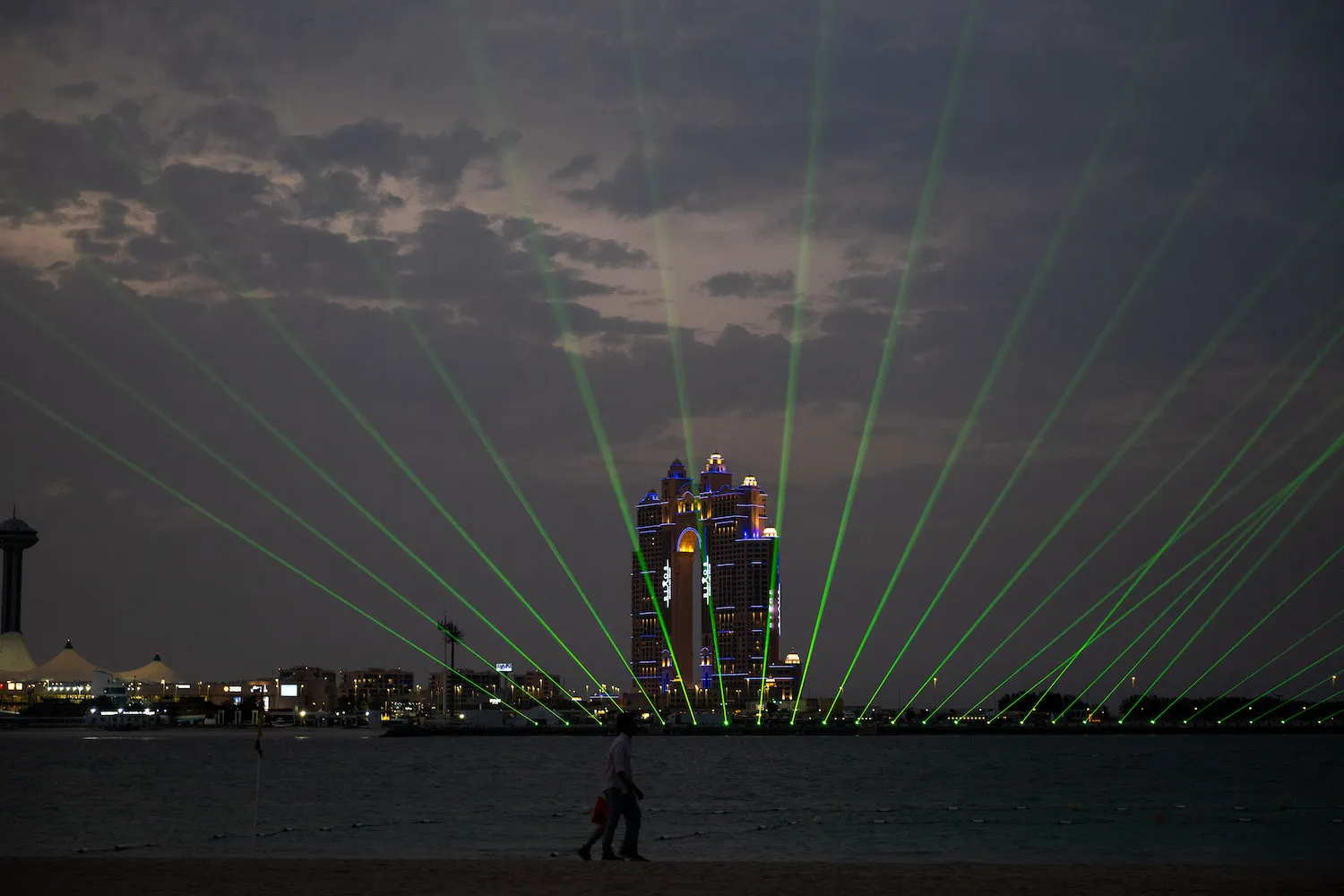
There’s a reason U.S. President Donald Trump, the self-styled “Dealmaker-in-Chief,” chose to visit Saudi Arabia, Qatar, and the United Arab Emirates for his first overseas trip after returning to the White House in 2025.
The deals (cumulatively valued at trillions of dollars) promptly flowed, largely toward the technology companies whose executives had accompanied Trump on his trip.
Less than a year later, many of those same investments are under threat from a war that Trump started.
Nvidia and Tesla—whose CEOs, Jensen Huang and Elon Musk, respectively, both joined Trump in attending an investment summit in Saudi Arabia on last year’s trip—were on a list of 17 U.S. companies whose Middle East infrastructure Iran vowed to target this week, as it continues to retaliate against U.S. and Israeli attacks. The list also included Apple, Google, Microsoft, Meta, Intel, Oracle, Cisco, HP, IBM, Dell, Palantir, GE, Boeing, J.P. Morgan Chase, and Spire Solutions. The one non-U.S. company Iran also namechecked, Emirati tech giant G42, has signed a slew of deals with Microsoft, Oracle, Nvidia, and OpenAI as the UAE tries to parlay its oil wealth into artificial intelligence supremacy.
And then there’s Amazon, whose CEO, Andy Jassy, also attended last year’s Saudi conference with Trump and whose data centers in the UAE and Bahrain have repeatedly been hit by Iranian drone strikes.
Foreign Policy reached out to the companies listed above about the war’s impact on their business as well as their current and future investments in the region. All of them either declined to comment or did not respond. But the missiles and drones Iran has fired at its Arab Gulf neighbors have punctured an image that many of them have spent years and billions of dollars building: of a safe, prosperous bubble insulated from wider regional turmoil and as a rapidly growing tech hub for Western companies to expand their foothold and footprint.
“Is the allure of Dubai and Abu Dhabi gone? We’re going to have to see,” said Adam Farrar, a senior geoeconomics analyst at Bloomberg Economics who served on the National Security Council under former U.S. President Joe Biden and during Trump’s first term. “There is certainly a perception that they can reconstitute quickly if and when the conflict stops, but the broader question is: Can they bring the talent necessary to maintain these systems and develop these companies that were relying on these data centers moving forward? We simply don’t know,” he added. “The Gulf has planted the flag of data centers and AI as the future of their economic growth, and so there are real questions as to what their economic futures look like if they’re unable to get the investment from these companies moving forward.”
The war has also sparked a broader conversation about the region’s relationship with the United States and with Trump in particular. The Gulf countries have long relied on Washington to guarantee their security, hosting U.S. military bases and buying billions of dollars’ worth of U.S. aircraft, equipment, and weapons systems. That dynamic also holds true for tech, as evidenced by the Silicon Valley-Gulf dealmaking sprees of the past decade that have only accelerated under Trump.
“The pivot to tech is very much about Trump and opportunities to anchor their economic diversification with the United States,” said Sanam Vakil, director of the Middle East and North Africa program at the London-based think tank Chatham House. “This is the president that they heavily invested in monetarily as well as politically.”
Trump attempted to reassure those countries in a speech Wednesday night, thanking “our allies in the Middle East” and specifically mentioning Saudi Arabia, Qatar, the UAE, Kuwait, and Bahrain. “They’ve been great, and we will not let them get hurt or fail in any way, shape, or form,” he said.
Those words may not fall on receptive ears in Gulf capitals these days, at least behind closed doors, said Ali al-Ahmed, director of the Washington-based Institute for Gulf Affairs, given the disillusionment that has set in from the war over many aspects of the U.S. relationship. While the U.S.-made air defense systems and military bases meant to help them maintain that regional safety bubble have largely held up and prevented the damage from being much worse, they have also made the Gulf a bigger target for Iranian assault.
“The Gulf experience with America has gotten them what?” Ahmed asked. “They spent money on top of money, money on top of money, and they are still exposed.”
Despite any potential dissatisfaction on the part of the Gulf with Washington and the war, they are highly unlikely to disengage from the United States on the security front in the short term, experts said.
“The Gulf states are inevitably going to have to hold on to the U.S. because there aren’t any alternatives—the U.S. is the only anchor that they have and the only country that’s able to protect them,” Vakil said. “But over a longer period of time, they are certainly going to be asking questions and looking to build more indigenous resilience,” she added. Some of that hedging is already in evidence, with multiple Gulf states signing 10-year defense agreements with Ukraine last week to benefit from its experience dealing with Russian missiles and drones.
The U.S. tech ecosystem is relatively less entrenched in the region, but it would still be difficult to dismantle. And even with the war, the long-term incentives for both sides could just end up being too strong.
Foremost among them is the Gulf’s sheer abundance, according to Mohammed Soliman, a senior fellow at the Middle East Institute in Washington and author of the new book West Asia: A New American Grand Strategy in the Middle East. “Who is going to give you 5 gigawatts of electricity to bring online 5 gigawatts of compute? No one outside of China is capable of doing that,” he said. (Compute refers to the hardware capabilities required to train and run artificial intelligence, such as processors, memory, and storage.) “Second, who has the capital to fund that? It’s $30 to $50 billion for 1 gigawatt of compute—that’s a major capital expenditure.”
And while Trump has consistently pushed to build more data centers in the United States, the immense needs of the technology industry and Silicon Valley firms’ global footprint mean geography does matter, even in the cloud. When it comes to AI at speed, physical distance can lead to data latency issues. “Will you be servicing India from Virginia, or are you going to be servicing it from Abu Dhabi? Are you going to be servicing Egypt, or Nigeria, or Morocco from Saudi or from Texas? Those are fundamental questions,” Soliman added. “When you add all these factors together … those fundamentals are not going to go away.”
The Gulf states’ investments in U.S. tech have continued apace even during the war. On March 3, less than a week after the United States and Israel first attacked Iran, the Qatar Investment Authority (QIA) sovereign wealth fund announced an investment in Silicon Valley AI infrastructure company Ayar Labs, backed by former Intel CEO Pat Gelsinger. And earlier this week, QIA and the Abu Dhabi sovereign wealth fund Mubadala both invested in the U.S. health tech company Whoop.
“The continuity has actually expressed itself in fundraising deals for companies that have happened amidst war,” said Ahmed Helal, a former advisor to the Qatari finance minister who launched the U.S.-Qatar Economic and Investment Dialogue.
And while investment from the Gulf has always outstripped investment to the Gulf, the Gulf states remain in a position to use their immense wealth to woo U.S. investors and companies that may be feeling more skittish as a result of the war.
“I think that there will be lots of carrots offered to ensure the long-term commitment to the market,” said Helal, who is now managing director for the Gulf practice at The Asia Group, a geopolitical consulting firm. It won’t just be carrots, though. “If [foreign companies] make a rash decision—which I don’t think they will—of exiting out of caution or fear of security, they will find it to be a real uphill struggle to go back in,” he added.
There’s also the sizable presence of Chinese companies in the region such as Huawei, Tencent, and Alibaba that will be well positioned to cash in and give the Gulf a “strategic optionality that frankly is going to be reinforced in a post-conflict era where the U.S. security guarantee hasn’t been delivering,” Helal said. The Gulf states’ overarching message to watchers and suitors for their tech opportunities is not that dissimilar to the one they employed before the war, he said: “We’ve got a high concentration of sovereign capital that is unrivaled, and we’re long-term investors—we’re not bound by election cycles, our investment theses are chasing returns for generations of wealth … and we’re betting on the technologies of the future.”