
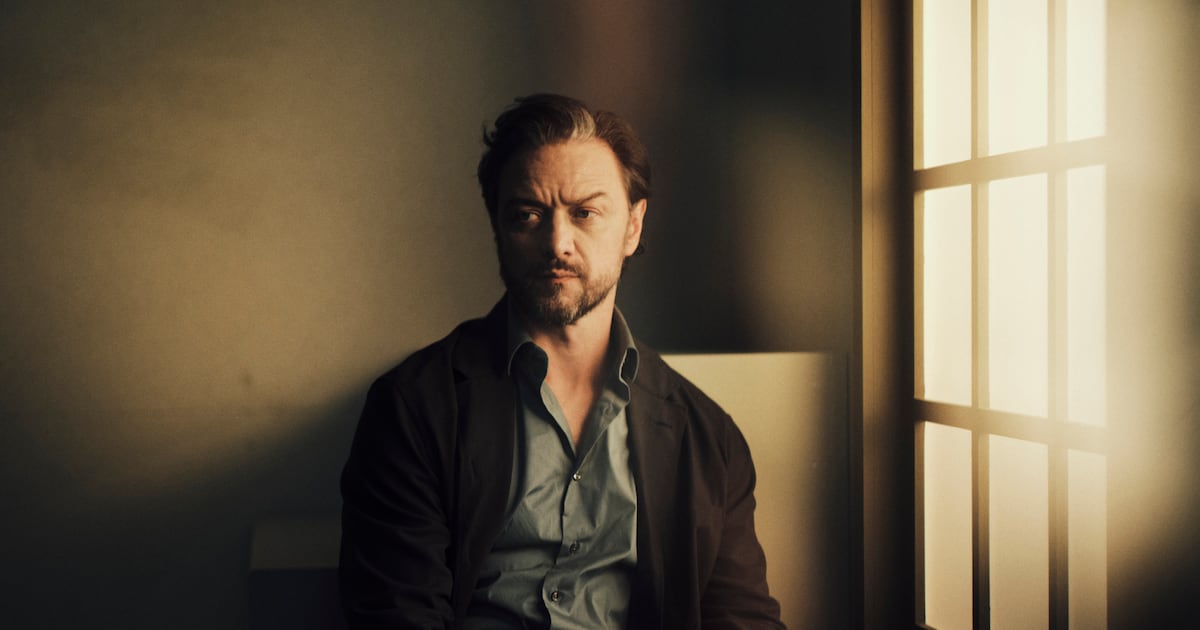
James McAvoy blusters into the room with the same unpretentious energy I remember from 20 years ago. The agreeable Scottish actor really has been on our screens for that long.
I remember bumping into him at Cliveden House, the Buckinghamshire mansion where key incidents from the Profumo affair played out, as he helped launch The Chronicles of Narnia: The Lion, the Witch and the Wardrobe back in 2005.
“That was a wild, wild ride,” he says, laughing. “I actually had two experiences at Cliveden within a couple of years of coming down from a council estate in Glasgow. I did this Stephen Fry film, Bright Young Things, about young, skint aristocracy. And he took us to Cliveden for three nights to just help us understand what it was like to be in that time.”
Things seem to have gone all right since then.
“Yeah, I have been having a nice time. It’s been a good career. I’m talking like it’s over. Ha ha!”
Little chance of that. Possessed of a mischievous, sometimes subversive charm, McAvoy looks never to have been short of work. He broke through on telly with shows such as State of Play and Shameless. That extravagantly horned performance as Mr Tumnus in Narnia led on to a lead role opposite the Oscar-winning Forest Whitaker in The Last King of Scotland. He charmed in Atonement. He was the younger Professor Xavier in the X-Men films. He more recently played a kaleidoscope of personalities for M Night Shyamalan in Split and Glass.
McAvoy is, perhaps, perfectly placed. He is a plausible leading man with enough eccentric grit to take on weirder character roles. If he will allow me to say so, he has grown comfortably into middle age.
“I think I got to a point, maybe in my late 20s, maybe slightly earlier, where I felt like I’d established a sort of handhold or a foothold in the business. Maybe two footholds. Maybe two handholds. But that doesn’t mean, when you start trying to hang on for your entire life and your entire career, that you don’t need to find new handholds. Right? There is always uncertainty.”
Which brings us neatly to his first feature as director. A new foothold, perhaps? California Schemin’ tells the unlikely but true story of two Dundee lads who, constantly rejected when rapping in their own accents, eventually secured a record deal by pretending to be Americans. Gavin Bain and Billy Boyd, performing as Silibil N’ Brains, somehow managed to keep the act up for three years. What did the duo make of McAvoy’s film?
“I think we’re actually fairly sympathetic to them in the film,” he says. “I think they’re really happy with it and really proud of it. I’ve watched them laugh watching it. I’ve watched them cry watching it. I wouldn’t speak for them, but I think they are satisfied. I’m sure they get quibbles because we had to take licence. We’re there to tell a story. We’re not there to serve them as people.”
Amid all the larks, the film does have something serious to say about how others perceive Scottish people and how Scots perceive themselves. McAvoy finds prominent space for a mural quoting a famous line from Trainspotting: “It’s s**te being Scottish.” There is a sense that nobody will take the boys seriously unless they ape another less wind-blasted nationality. Did McAvoy have experience of that when starting out?
“The sound that comes out of our mouth seems to make people go ‘Ahhhh!’ sometimes,” he says. “Not all the time. I wouldn’t even say it’s the majority of my experience, but it is a significant percentage of my experience.
“Somebody not being able to understand is not their fault. I’ve got no problem with somebody saying, ‘I’m so sorry, I don’t understand what you’re saying.’ That is a completely acceptable reaction, as opposed to, ‘Oh, my God, oh, my God, oh, my God! What is that?’ Something about porridge. Something about cabers. ‘Have you seen Braveheart’?”
That sounds familiar. Something about leprechauns. Something about four-leaved clovers. Have you seen The Quiet Man?
“I don’t know how it is in Ireland, but in the UK, outside of the main hubs in the south or the main narrative areas that are welcomed in the American industry, regionality is not embraced. It’s not just a Scottish problem. It is a UK problem as well.
“Maybe it’s slightly different in Ireland because Ireland has its own government, has its own finance, has its own cultural output that serves itself. But in Scotland, like many parts of the UK, we are underrepresented.”
 James McAvoy in California Schemin’
He seems to have walked himself into an inevitable, possibly difficult question about the thorniest issue in Scottish politics. You could read his answer above as an implicit argument for independence. I can understand if he doesn’t want to answer. That is an easy way to get into trouble.
“It’s not that I think I’ll get in trouble,” he says. “It’s just that I think that I’m, professionally speaking, apolitical. Right? I think I’m a storyteller. If I want to tell a story about independence I’ll make a film about it.”
But he’s also a talker. After a bit of humming and hawing, he launches himself into the maelstrom.
“When speaking to somebody who is of Celtic extraction, somebody who, in particular, is Irish, there are so many similarities with Scottish people, even more so west-of-Scotland people. Not all of us, but with myself anyway. I am pretty much 75 per cent f**king Donegal. We’re so similar, and yet we’re so different. And I think the difference is independence. I’m trying to phrase this in a way that isn’t going to become the headline and just sounds negative. Ha ha!”
He makes a few more qualifications.
[ ‘Inside I’m Dancing’ wins Audience Award at Edinburgh film festivalOpens in new window ]
“Without weighing in too heavily on independence and having a political opinion, I think there is something to explore culturally in the independence topic for my nation. There are many things to explore in my nation culturally.”
Make of that what you will.
McAvoy was born in 1979 to working-class parents. His parents split up when he was young, and he ended up living with grandparents in the Drumchapel quarter of northwest Glasgow.
He briefly considered becoming a priest before an encounter with David Hayman led to a role in The Near Room, that tireless Glaswegian actor and director’s 1995 film. McAvoy tells me he had never been in an acting group. He had never done youth theatre. He didn’t know anyone in his neighbourhood who had acted. Nonetheless, he made it to what is now the Royal Conservatoire of Scotland and, following graduation, was thrown straight into work.
Looking at that list, I don’t see any obvious big breaks. He attracted attention opposite David Morrissey and Kelly Macdonald in the excellent BBC drama State of Play. He won acclaim as a man with cerebral palsy in Damien O’Donnell’s Irish drama Inside I’m Dancing, from 2004. By the mid-2000s he looked to be with us for the duration.
“Yes, I feel there are a lot of actors who go straight from zero to 90,” he says. “I worked with a lot of them in my 20s. But it wasn’t like I had to wait until I was 35 to suddenly get a place in the industry. I remember feeling like I was allowed to work a lot, between 20 and 25, without being the poster-person on whom it all rested. So if it didn’t succeed, you weren’t f**ked. That didn’t happen to me. I got to play interesting, small roles: playing a guy with f**king horns. Ha ha!”
Playing the “guy with f**king horns” in Narnia was a handy earner, but the move up to Professor X in X-Men: First Class placed him among blockbuster aristocracy. We think of those colossal projects as being in a whole different medium from independent film. You are part of a vast army, a sprawling nation, a mighty species.
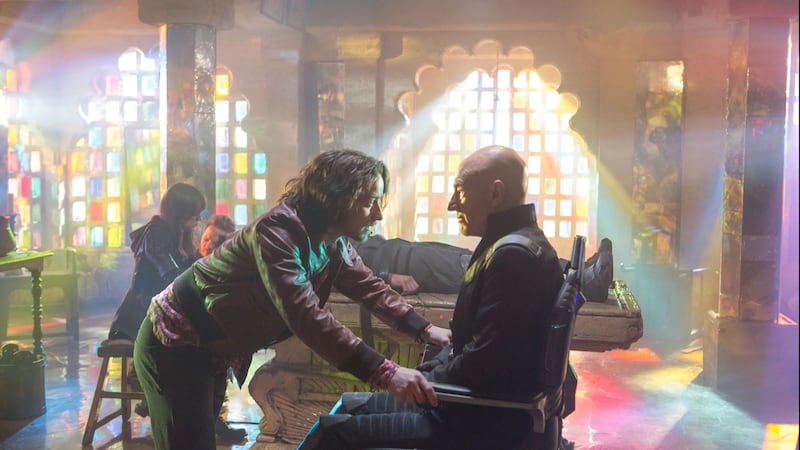 James McAvoy and Patrick Stewart in the 2014 film X-Men: Days of Future Past. Photograph: Alan Markfield/Marvel/Twentieth Century Fox
“If you take away the machine of it, which is four and a half months or six months, as opposed to four and a half weeks or six weeks, you’ve got more time between takes, because there’s big set-ups and you’ve got a whole technical train, as opposed to a guy with a camera on his shoulder,” McAvoy says.
“But it’s actually the same stuff. It’s actually the same thing. When the scripts aren’t good, and when it feels like there’s more money than storytelling, then it can be really tricky. But otherwise I’ve had really good experiences of what you’d call bigger films.”
McAvoy, who was married to his fellow actor Anne-Marie Duff from 2006 until 2016, now lives with his wife, Lisa Liberati, assistant to M Night Shyamalan on Split, in London and (less often) her home city of Philadelphia.
It hardly needs to be said that he remains a supporter of Celtic FC and an unreconstructed Scot. Not a syllable of his accent sounds altered. Like so many actors, McAvoy long harboured a desire to get to the other side of the camera and take control of his own destiny – he plays a ruthless record executive in California Schemin’ – but it has taken longer than he might have hoped. Maybe a quarter of a century.
“I’ve been a lucky-bastard actor who has had nice offers of acting work for which you get paid a lot more than being a first-time director,” he says with impressive honesty. “I felt a strong impulse to do it in my 20s, and I worked with a lot of first-time directors who were brand new at it and not very good. And I thought, ‘Oh, no. I know how to do this.’
“And learning things from other people’s mistakes is not as positive an outcome as it is trying to unpick the magic of masters that you can’t even f**king recognise. As soon as I started to work with some really good people I realised magical stuff was happening and I couldn’t f**king see how.
“When people are doing beautiful art it’s very hard. Sometimes you’re going, ‘I don’t even see how you’re doing this’.”
Anyhow, McAvoy worked it out and delivered an enjoyable flick that premiered noisily at Toronto International Film Festival in 2025. Life ticks along. He has two sons, one from either marriage. He has another two films coming out this year. If he is not comfortable with his lot then he is doing a very good impersonation of seeming so. But he accepts this profession is hard to predict.
“I do feel like I’m all right,” he says. “You can’t do 30 years in the business if you don’t make peace with the fact that you don’t know what’s next. Well, you might last 30 years, but you’ll be a f**king nervous wreck.”
Sage advice.
California Schemin’ is in cinemas from Friday, April 10th