
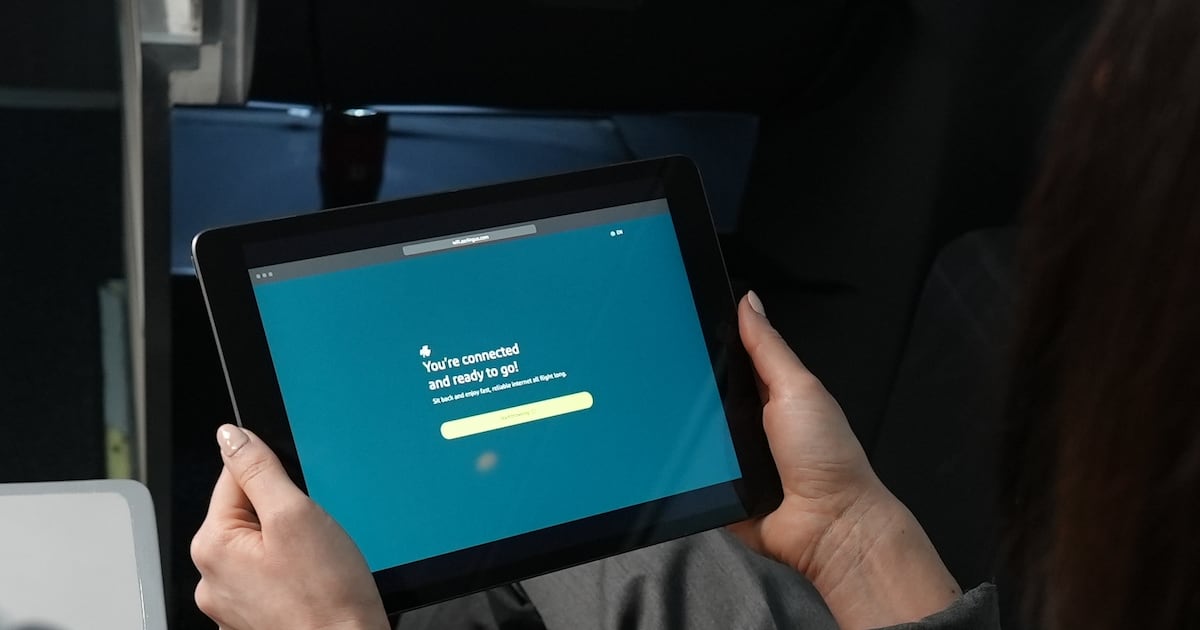
Last weekend the first Aer Lingus flight operating the Starlink wifi service left Dublin for New York. Good for them. The online connection, to be rolled out “over the coming years”, will be free to all passengers. It is apparently zippy. Lynne Embleton, the airline’s chief executive, declared it a game-changer.
Nothing to complain about there. Right?
Let me have a go. I like a challenge. Someone else can whinge about Elon Musk’s role as the mastermind of Starlink. Frankly, the news that the process requires the distribution of 10,000 satellites about the thermosphere is so Moonraker-adjacent I can barely put my paranoia into words. Plus, I don’t know what I’m talking about and am sure to get told off by those who do.
No, my only partially performative weariness stems not from anything specific in this week’s news but from a more general concern that one oasis of tranquillity is to be forever disrupted.
It has taken longer than feared. Airborne wifi has been creeping up on us for years, but it has proved persistently awkward, unreliable and expensive. Many airlines still don’t provide the service at all.
“No. Currently, we do not offer wifi on our flights. Sorry,” Ryanair tell us on their website. Just a few months ago Michael O’Leary, the chief executive of that airline group, got in a “spat” with Musk about the attendant costs and complications of Starlink. O’Leary is keen on offering wifi “in the next three to five years”, but it isn’t there yet.
A few of us will not be pressing Ryanair to get their skates on. For the past 20 years or so – since the smartphone rendered the internet nearly ubiquitous – air travel has provided one of the few reliefs from constant digital connection. Nobody can phone you. Stupid games won’t work. You are unable to update spreadsheets. There is no temptation to indulge in social-media arguments with vapid strangers from Omaha.
For an hour or two (or three or four or 11) you are cast back into a stillness that, though common just a few decades ago, now feels like an emanation of the dark ages. In a good way. Without the Black Death or the Visigoths.
[ Elon Musk calls Michael O’Leary an ‘utter idiot’ in clash over Starlink wifiOpens in new window ]
There was no better place to wade into a fat Victorian novel. You could sleep without the urge to reach nervously for the phone each time you came to. All disasters could wait until touchdown and the beeping, buzzing return to life of the nagging smartphone.
Please don’t make airline wifi work. Please don’t put it on every flight. Please don’t make it free. Won’t somebody think of the Levellers?
“But you don’t have to use it,” I hear you say. That cacophony is the noise of addicts laughing at the suggestion they turn down the offer of a free fix when detained in a metal tube for hours on end.
Never mind the confinement. If the service really is free, efficient and unbroken then the plane becomes like anywhere else. You may as well set aside an hour or two for offline contemplation when sitting alone at home.
Ha ha! As if that’s going to happen. Tell it to the hippies and the self-help evangelists. We are weak and are not going to reject the opportunity for voluntary digital enslavement. Have you not noticed what we’ve done to ourselves over the past three decades?
It seems as if Ruben Östlund’s film The Entertainment System Is Down will not be in the Cannes official selection for 2026 when the festival announces its line-up next week. The Swedish director’s feature, apparently delayed until 2027, stars Keanu Reeves, Kirsten Dunst and Samantha Morton in a satire imagining the anarchy that ensues when, well, the entertainment system crashes on a long-haul flight.
It’s an intriguing idea, but, in truth, the gradual development of the entertainment service – from a movie with sound provided by headphones that were little more than plastic tubes up to dozens of video options – offered no change comparable to being put right back in immediate contact with the ghastly world you thought you had escaped when the seat-belt light came on.
The online embrace is so complete one could easily forget one had left home at all. You are still huddled over the same interface and still hearing the same hectoring beeps.
In a few years the only place a person will get free of online badgering is when under general anaesthetic. Even then they’ll find a way to get at you as the surgeon is prising out kidney stones.
“Just wanted to reach out to the part of your brain that has been rendered receptive to texts, WhatsApp and Facebook Messenger. Please revert when the paralysis has passed.”
More awful things have happened. More awful things still will continue to happen.