
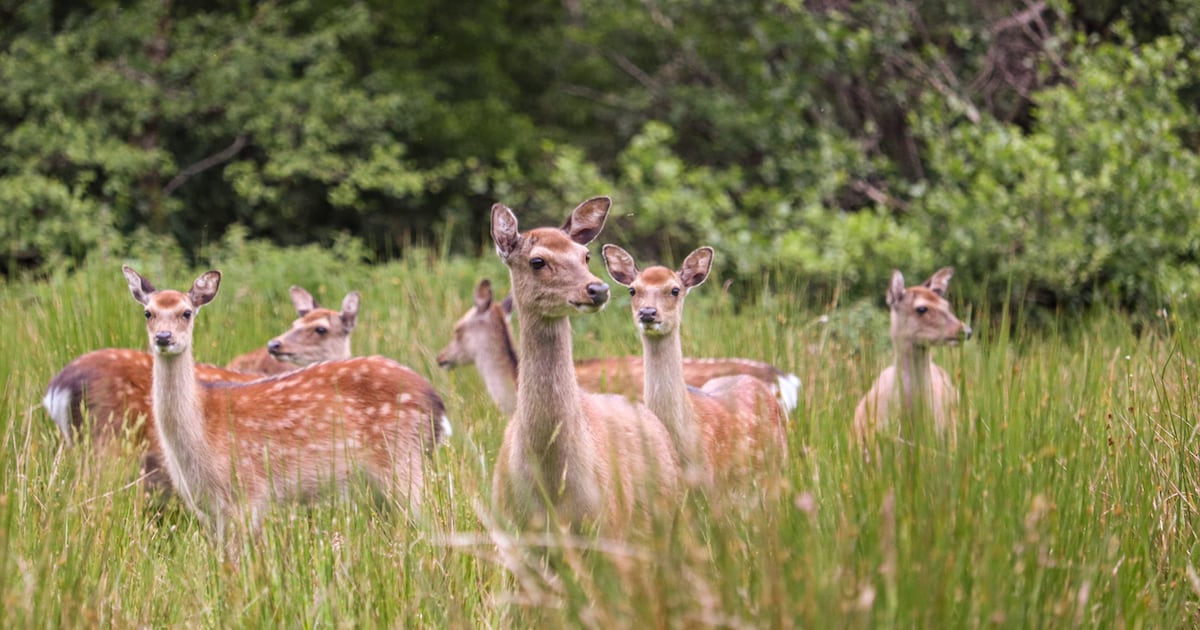
I’ve decided to get a licence to kill. Ireland’s native woodlands are being eaten alive by overabundant deer. We have no wolves – they were hunted to extinction 2½ centuries ago – so unless we reintroduce them (unlikely), it’s up to us to do the killing. And most of us have ceded that work to hunters and farmers, as though the mess of conservation is someone else’s problem to solve with someone else’s hands.
I’m not a natural-born killer; I find it stressful and unsettling to hold that kind of power over another species. But 15 years ago, I kept two pigs outdoors, and I made myself a promise: as someone who eats meat, I would help kill and butcher them myself and use every part of the pigs, nose to tail, but if I found it impossible to do, I would go vegetarian. I still eat meat.
It was visceral. Two biscuits to position them for the stun, then seconds to winch, cut their throats, bleed out, and it was done. If you’re reading this wincing over a sausage sandwich, it’s worth holding this in mind: 3.3 million pigs are killed in Ireland each year, along with 1.8 million cattle, 3.2 million sheep and 100 million chickens. That’s roughly 275,000 animals a day. In the time it’ll take you to read this piece, 700 animals will be dead.
Killing and butchering my pigs was pretty mentally and physically exhausting, but it made me realise that until then I’d outsourced everything to someone else’s hands. Deer need culling, and the byproduct is a free source of wild, high-protein, high-iron meat. So why not give it a go?
Last year, I wrote about the ecological crisis unfolding in our native woodlands from deer pressure. I walked into a Wicklow wood with forester Paddy Purser and saw the damage: bark stripped vertically by deer teeth, saplings rubbed to death by antlers, everything browsed to bare stalks. Deer are hollowing out our native woods, leaving no understory and no next generation of young trees. Paddy gave me the timeline: unless deer numbers are managed, the impacts would be “catastrophic” within a decade.
In a crisis this urgent, every effort to make space for our native species is welcome, however big or small. Of course it’s nicer to plant oak saplings or put up nest boxes, but in a world humans have broken, conservation and restoration also requires perpetual, unglamorous killing.
It works on isolated islands. In 2022, a global study examined 150 years of invasive species removal across 1,000 islands; nearly nine out of 10 attempts were successful, creating conditions for recovery. The authors were clear in their conclusion, arguing that conservation is not happening fast enough to stop extinctions, and that invasive species are a “primary driver” of native biodiversity loss worldwide.
[ ‘We don’t have a plan’: Invasive species take hold as action lags legislationOpens in new window ]
Doing the work isn’t easy. David Wiens, a wildlife biologist from Oregon, killed barred owls to save spotted owls. He described the experience of pointing the gun at the bird as “extremely difficult”, but the mathematics was fairly simple: without culling, one species could go extinct. Over six years, 3,000 barred owls were removed, and as a result, spotted owl survival improved.
I don’t own a gun and am a complete novice. A few weekends ago I booked a two-day immersive deerstalking course in Tullamore, approved by the National Parks and Wildlife Service. As a woman, I was in a tiny minority. The first day was theory: deer biology, firearms and the law, animal welfare, carcass handling and diseases. The second day was at the shooting range.
The instructors kept hammering one non-negotiable rule: only pull the trigger when you’re absolutely certain you have an “ethical shot”, which guarantees the animal will die instantly. “Probably” or “maybe” isn’t good enough; judging when not to shoot saves a potentially prolonged, unpleasant death.
It’s not about conquering, it’s about taking responsibility for the decision to kill, which also means processing and butchering the carcass (the shooting is the easy bit …), using as much meat as possible and wasting nothing.
When invasive species such as Sika deer have no natural predators, humans become the only control. The work never ends. You need continuous effort and uninterrupted funding, otherwise it’s a game of snakes and ladders: you’ll soon be back where you started.
The Cairngorm Water Vole Conservation Project culled invasive American mink across 10,000sq km, creating the conditions for water voles to recover. But without constant effort, mink will quickly recolonise. The Scottish Mink Initiative, launched in 2011, has since expanded across a much larger area of just under 30,000sq km.
Next month, I’ll go out with friends to shoot deer for the first time. I’m not looking forward to the killing bit and my actions won’t change the world (or even the wood) but it’s a collective effort. And the venison – obtained without market mediation from an industry that processes 275,000 animals a day – will be exceptional, and free.