
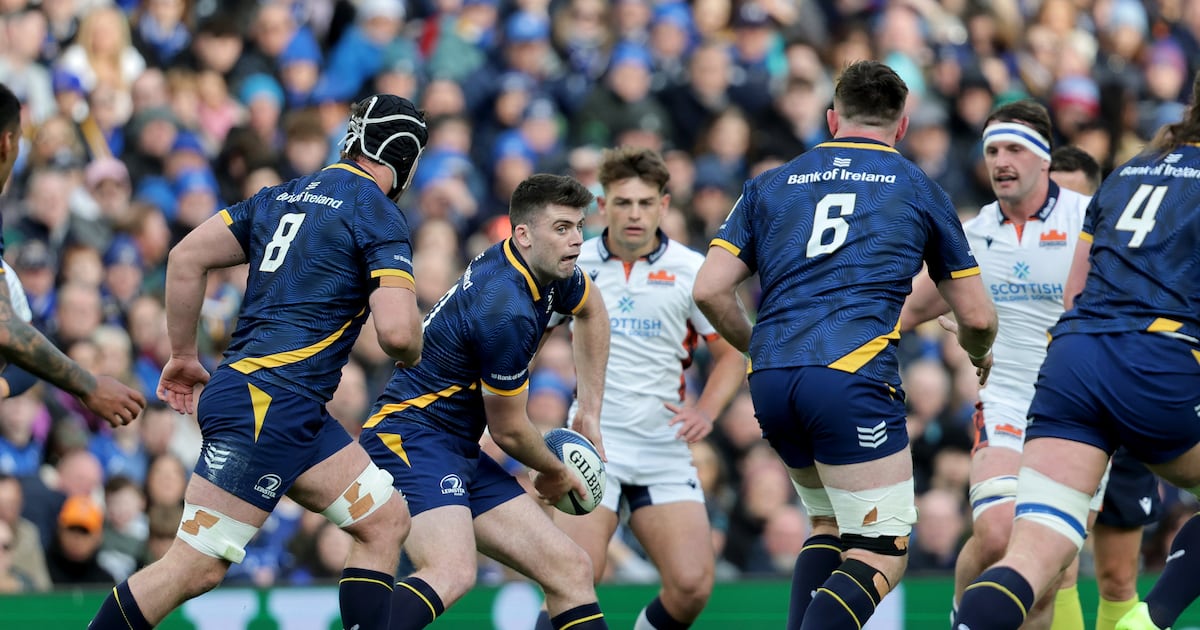
Harry Byrne took Rudyard Kipling’s advice. He kept his head when teammates were periodically losing theirs in a variety of guises, from decision-making to handling aberrations. The result of Sunday’s Champions Cup round-of-16 match against Edinburgh – a 49-31 victory, with seven tries on the board – will supersede other considerations in the immediate aftermath. Despite this, the post-game review won’t engender a warm, fuzzy feeling.
Leinster’s performance vacillated between the sublime and the sloppy. Slick rugby had been combining with slip-ups all too often, until the home side took a breath in the third quarter. From there, they focused on cold-eyed precision that eventually prised daylight on the scoreboard against a doughty Edinburgh side that had proved troublesome opponents.
Byrne, though, stood apart – his consistent excellence a beacon that illuminated the way. When the home side threatened to be submerged in a vortex of mistakes, the 26-year-old found a way to pull his team clear. He brought an attacking clarity to Leinster’s patterns. His range and timing of the pass put players into space. Equally, his lovely, delayed pull-back passes left defenders flat-footed.
His distribution contrasted sharply with teammates who tried to force a pass – giving a little early or late, or a tip-on ball to a recipient loitering without intent or expectation. Byrne was a conduit for line breaks, but it was the next phase or the one after where Leinster came a cropper at times, offloading or unloading indiscriminately.
Last week, the URC game against the Scarlets was arguably the first pinch-point for Leinster head coach Leo Cullen in stating a clear preference through selection for whom he favoured in the 10 jersey. He opted for Byrne and while aspects of the outhalf’s game sparkled, it wasn’t unequivocal in shutting down a debate.
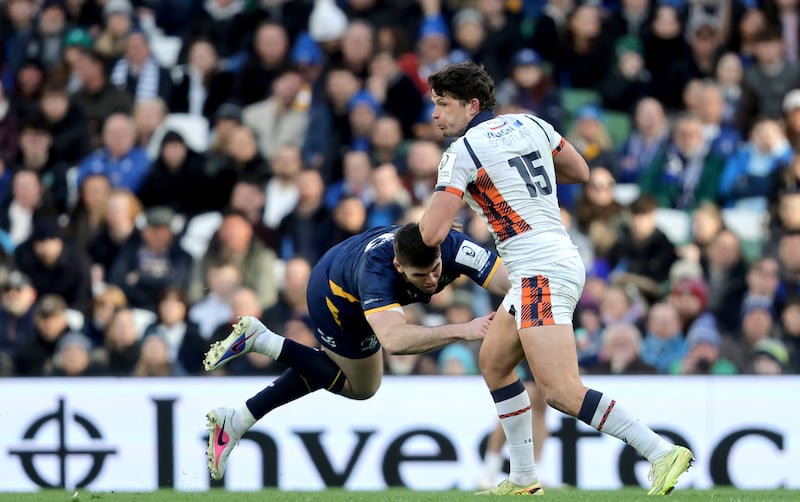 Leinster’s Harry Byrne tackles Piers O’Conor of Edinburgh. Photograph: Bryan Keane/Inpho
There are no such cavils after this performance against Edinburgh. He set the tempo from the get-go and had a conspicuous hand in his team’s first three tries.
Shoulders square to the line, he delayed his pass just a tad to get the defence to bite in. This opened a hole for Jimmy O’Brien to race through coming off the blindside wing. When the ball was recycled in the Edinburgh 22, the outhalf’s quick hands preserved the space for Tommy O’Brien to score in the corner.
Tommy O’Brien’s second try also had Byrne’s fingerprints on it. The outhalf threw a beautifully flighted pass to Rieko Ioane that enabled the Leinster centre to drift outside James Lang: the weight of the pass beat the defender. The problem for the home side was that few could replicate Byrne’s acuity.
Three intercept tries – no one should quibble over the description – for Edinburgh underscored that assertion. The Scottish side deserve credit for the homework they did in identifying their hosts’ wraparound ploys and pushing through into the passing lanes. It was a lucrative gamble that paid out handsomely.
There were times, though, when Leinster players didn’t help themselves – one player’s pass putting another under pressure and adding significant jeopardy. On other occasions, blue-shirted players got so close to one another, the intended receiver was easy to pick out and ultimately pick off.
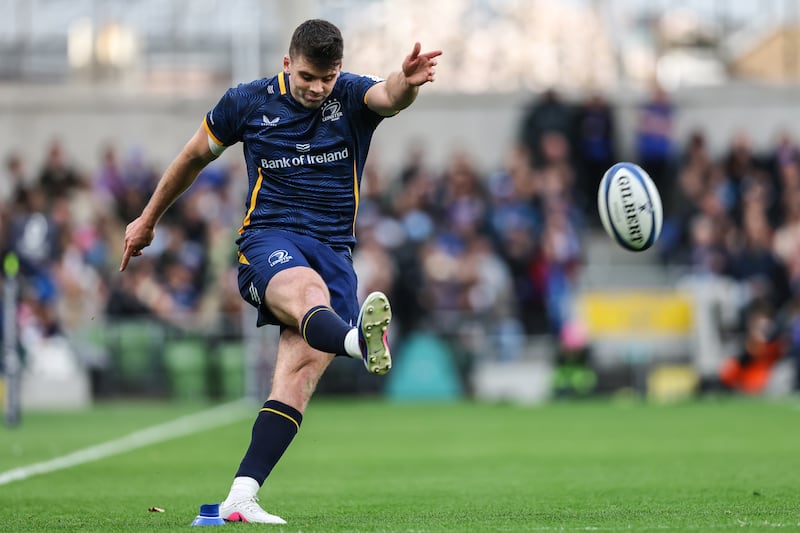 Leinster’s Harry Byrne kicks a conversion during Sunday’s Champions Cup match against Ediburgh. Photograph: Ben Brady/Inpho
There were other aspects to Byrne’s superb display, not least his place-kicking. Two of the first three conversions – he kicked a magnificent seven from seven attempts – were from the touchline on the wrong side.
When Darcy Graham scored Edinburgh’s fifth try, the visitors led 31-28. Byrne had kicked four from four, his counterpart Ross Thompson three from five. Small margins. At that point, 51 minutes in, the Aviva Stadium atmosphere was funereal. Leinster changed tack.
Byrne went to the kicking game, with Hugo Keenan as his primary aide-de-camp, the Leinster fullback brilliant in winning the aerial duels. That mixture of pragmatism and precision allowed the home side to get upfield in a hurry and win back possession. It was a beachhead for their three second-half tries.
When the outhalf departed on 68 minutes, he did so to a warm ovation, the gratitude of the Leinster supporters palpable. What Byrne had been challenged to do was to manage the game and he did so superbly. He doesn’t need to control any external narratives about who wears the 10 jersey. That’s a barstool debate.
He made the only statement required of him, his performance on the pitch.