
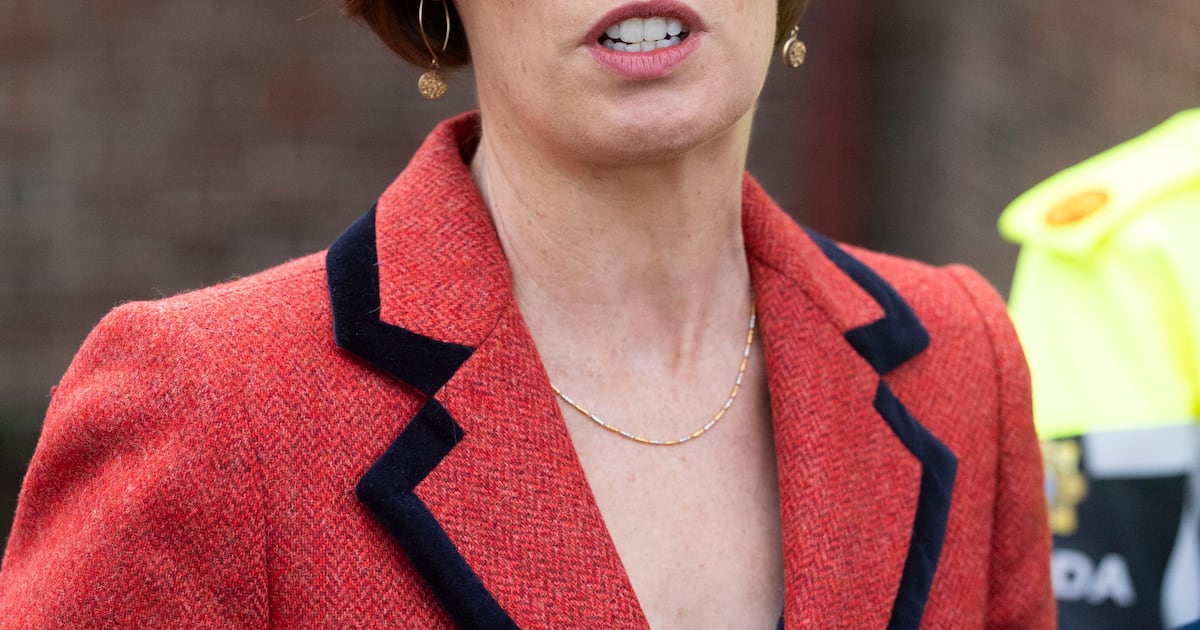
Minister for Education Hildegarde Naughton is seeking several hundred million euro in additional exchequer funding this year, to deal with soaring demand. She is also seeking agreement on a larger core sector budget from next year.
The Department of Education said this weekend that the Minister wanted to “reset the funding base” so it would be better aligned with a system that is based largely on demand. The additional money, the department believes, is needed in particular to address a growing requirement for special education services as well as for the school transport scheme.
However, the provision of additional money this year may cause problems for the Government, which has promised to ban such supplementary estimates.
Last year, the department required an additional €580 million; the year before that, it was €1.09 billion.
Naughton will on Monday address primary teachers at the annual conference of the INTO union, where she is expected to announce a new initiative that could mean the department facilitates a scheme for the reimbursement of medical bills for teachers injured in schools.
The Minister is likely to say more than 200 primary teachers were injured in the course at work in 2023 and 2024. An occupational injury scheme for teachers was introduced last year. However, Naughton is expected to say she wants a more uniform approach in how schools manage medical expenses.
“Officials in my department will also investigate if a facility can be put in place for the direct payment of such medical expenses through the relevant insurance providers, where appropriate, to further assist schools and teachers impacted by this issue,” the Minister is expected to say.
Unions are also likely to watch carefully the outcome of talks within Government on the education budget where a projected overrun of about €600 million had led to tensions with the Department of Public Expenditure and its Minister, Jack Chambers.
It is understood the Department of Public Expenditure has been concerned at the escalating costs, largely driven by the employment of additional staff as well as rising demand in the special education sector and the school transport scheme.
Chambers warned the Cabinet last month that if departments exceeded their allocations, they would be required to cut back on planned spending or, ultimately, a levy could be imposed on all Ministers’ budgets to offset overspending in particular departments.
However, it is understood that Naughton has argued that education is a constitutional right and has always been viewed within Government as being demand-led, with teacher allocation linked to pupil numbers.
A spokeswoman for Naughton said this weekend the Minister was “determined to ensure that the school system is properly funded”.
She said “good progress” had been achieved in recent talks to put ongoing funding requirements on a more sustainable basis.
It is understood Taoiseach Micheál Martin and Tánaiste Simon Harris decided that a scheduled meeting of the Cabinet subcommittee on education last Wednesday, which was attended by Naughton and Chambers, should have a special focus on the delivery and sustainability of education commitments in the programme for government agreed last year.
This pledge contains commitments to greater funding for schools to meet day-to-day running costs, to cut the pupil teacher ratio at primary level to 19:1, to expand the transport scheme to cover 100,000 more students by 2030, to establish more special schools and classes for children with special education needs and to hire additional teachers and special needs assistants in this area.
Senior Government sources said at the meeting on Wednesday, Ministers agreed further data was needed to adequately assess demand and to take appropriate measures to meet it in the short term and deliver the programme for government commitments in the longer term.
The Minister’s spokeswoman said in recent years additional funding had been required to support cost-of-living measures and meet increased demand for essential education services.
She said there were more than 200,000 additional children in the education system since 2003. She said in the last five years alone, there has been an increase of 38,000 students in classrooms, while there had been an unprecedented expansion of special education involving 16 new special schools, 4,000 new special classes, and thousands of additional teachers and special needs assistants.