
We are headed into a period of economic uncertainty as the impact of the war in Iran and the resulting rise in energy prices threaten a global economic slowdown, on top of the rise in inflation.
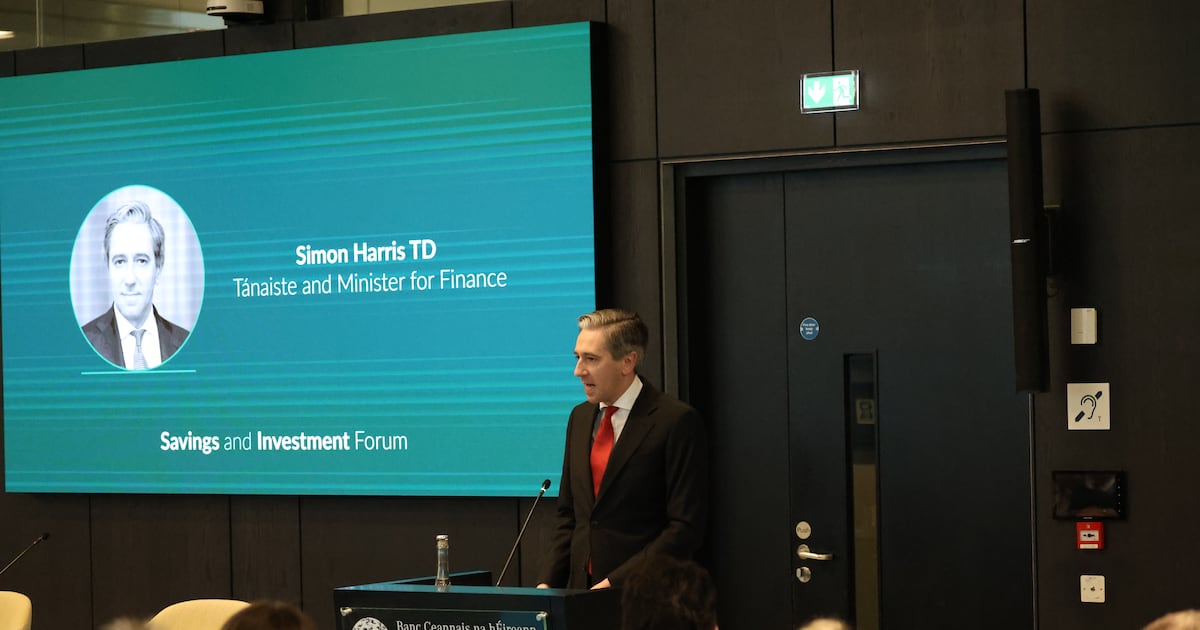
The Government will need to spend significant sums on protecting the most vulnerable households. It is inappropriate to introduce a new savings scheme next year – as is being proposed by Minister for Finance Simon Harris – that will have the effect of transferring scarce taxpayers’ money to rich people who hold bank deposits.
Figures from the Central Bank of Ireland show that Irish people hold most of their wealth in housing, and it is only the richest slice of the population who hold significant financial assets.
Some 80 per cent of bank deposits are held by the wealthiest 20 per cent of the population. Any problems for investors with the tax regime are thus problems for the rich, not for the “squeezed middle”.
The proposal is to offer a more favourable tax regime so that the owners of bank deposits can move them into higher yielding financial assets. As most of the returns from investing in shares come from capital gains, exempting such returns from capital gains tax would prove costly over time.
By exempting rich investors from tax, this would effectively be a transfer of resources from taxpayers – rich and poor – to those who are already in the richest segment of our society. In other words, tax cuts for the rich paid for by the rest of the population.
The Commission on Taxation and Welfare recommended that interest income from deposits should be treated like any other income, and taxed at a household’s marginal rate. They also recommended that the tax system on other financial assets should be rationalised and simplified.
They did not recommend cutting taxation on individuals with high incomes or exempting financial investments from capital gains tax. If the Government chooses to reject this expert advice, as is its prerogative, it should clearly explain the rationale for its preferred approach.
It appears two arguments are being made for the proposed scheme: that it would give citizens a better return on their savings; and that it would encourage investment in productive assets.
[ Lessons from abroad on Ireland’s new savings scheme for the ‘middle class’Opens in new window ]
It is argued that the large sums held by households on deposit in banks could be put to more productive use if the money was invested in other financial assets. However, this recommendation pays no attention to who owns the deposits, why the return to those owning deposits has been so low in recent years, and the reason why so much money is held on deposit.
Since the financial crash there has been little or no competition in banking in Ireland, with only three major domestic players. As a result, the deposit interest paid by Irish banks was consistently well below that available across the euro area.
If there were real competition here between banks, or if we had a genuine single market in banking allowing Irish people to easily deposit in higher-interest accounts in other European banks, Irish depositors would have been substantially better off. That would have been achieved at the expense of bank shareholders, not of Irish taxpayers.
Ireland isn’t short of savings – we are champion savers. The new scheme aims to turn us into retail investors, as if that will give investment a bigger boost than depending on banks and financial firms to put those savings to productive use.
The EU has expressed a real concern about the extent to which households hold their financial wealth as bank deposits rather than investing it directly in business. This is not an issue for Ireland as the really big businesses here are multinationals who fund themselves internationally, not from Irish banks or through the Dublin stock exchange.
However, across the EU, and here in Ireland, start-ups find it difficult to get early-stage funding.
Irish-founded start-ups like Stripe and Havok moved to the US to grow, taking advantage of the well-developed venture capital scene there.
Irish households are hardly likely to have the know-how to invest in start-ups. That needs specialist firms with the financial and sectoral expertise to pick winners, operating at a scale that can handle inevitable failures, while cashing in on the firms that make it big.
The answers to capital shortages for start-ups are first to complete the EU single market for finance, and second, to develop European-wide venture capital firms that can finance promising new EU companies to expand.
There are better ways to achieve the presumed objective of this investment scheme without making rich households even richer.