
Main PointsIran and the US have received a plan to end hostilities that could come into effect on Monday and reopen the Strait of Hormuz, a source aware of the proposals has told the Reuters news agency.US president Donald Trump, in a profane social media post on Sunday, threatened to escalate strikes on Iran unless it opens the Strait of Hormuz.A US service member who was missing since Iran shot down a fighter jet was rescued on Sunday.The current energy crisis is the “worst the world has ever seen,” but “this is not 2008”, according to Tánaiste Simon Harris.Key Reads
Reuters has further detail on the death of Majid Khademi
The head of the intelligence organisation of Iran’s elite Islamic Revolutionary Guard Corps (IRGC) was killed on Monday in a “terrorist attack by the American-Zionist (Israeli) enemy”, Iranian media said, citing a statement by the IRGC.
Khademi, who becomes the latest key figure killed in US-Israeli air strikes, took over in 2025 after Israeli air strikes killed his predecessor.
He spent decades in intelligence and counter-espionage roles while rising through Iran’s security apparatus.
Before his appointment, Khademi headed the IRGC’s Intelligence Protection Organisation, charged with internal surveillance and counter-intelligence, and held senior roles in Iran’s defence ministry.
The IRGC intelligence arm is one of Iran’s most powerful security bodies, with a central role in domestic surveillance to counter foreign influence, and often operating in parallel with the civilian intelligence ministry.
US forces on Kuwait’s Bubiyan island were targeted by Iran, the spokesperson of Iran’s Khatam al-Anbiya Central Headquarters said in a video statement shared by state media on Monday.
Reuters news agency reports that spokesman Ebrahim Zolfaqari said Iran targeted satellite equipment and munitions on the island with drones.
He added that US forces had relocated there from Arifjan camp after that base was repeatedly struck by Iran.
Bubiyan island is the largest of Kuwait’s coastal islands chain, in the northwest of the Gulf.
Six people were injured from debris falling in a residential area in northern Kuwait after an Iranian attack, Kuwait’s health ministry said earlier.
The death of Majid Khademi, the head of Iran’s Revolutionary Guards’ intelligence organisation, was announced on Monday by Iranian state media, without additional detail.
– Reuters
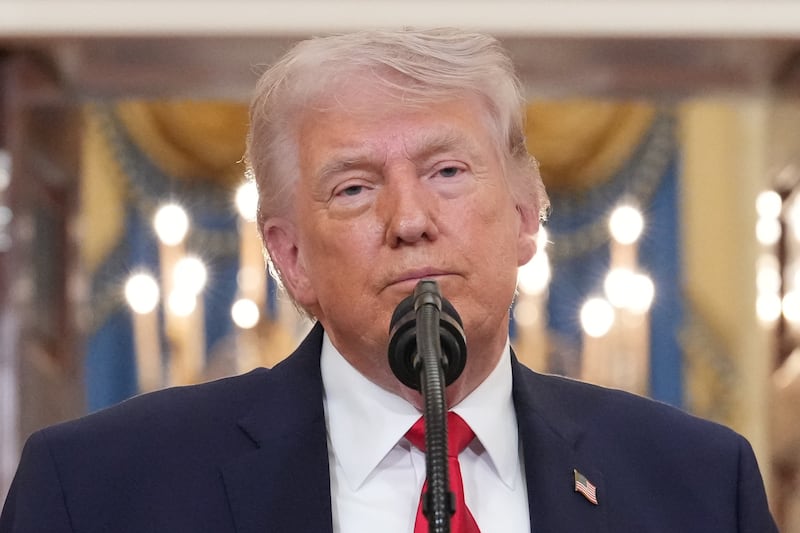 US president Donald Trump: threatened to attack Iranian power plants and bridges. Photograph: Alex Brandon/AP Iran accuses Trump of threatening ‘war crimes’
Iran’s deputy foreign minister has claimed Donald Trump’s threats to destroy Iranian power plants and bridges could amount to war crimes.
“The American president, as the highest official of his country, has publicly threatened to commit war crimes,” Kazem Gharibabadi said on X, citing provisions of international law that could be breached.
Trump used expletive-laden language to demand Iran agree – by Tuesday evening US time – to fully open the Strait of Hormuz or face the destruction of Iranian energy sites and bridges.
The US president posted on Truth Social: “Open the F**kin’ Strait, you crazy bastards, or you’ll be living in Hell.”
He was sharply rebuked by US politicians, with Republican former ally Marjorie Taylor Greene decrying “Trump’s madness”, Bernie Sanders calling it “dangerous and mentally unbalanced” and top Senate Democrat Chuck Schumer saying Trump was “ranting like an unhinged madman on social media”.
Iran, US receive plan for immediate ceasefire, source says
Iran and the United States have received a plan to end hostilities that could come into effect on Monday and reopen the Strait of Hormuz, a source has told the Reuters news agency.
A framework to end hostilities has been put together by Pakistan and exchanged with Iran and the US overnight, the source said, outlining a two-tier approach with an immediate ceasefire followed by a comprehensive agreement.
“All elements need to be agreed today,” the source said, adding the initial understanding would be structured as a memorandum of understanding finalised electronically through Pakistan, the sole communication channel in the talks.
Axios first reported on Sunday that the United States, Iran and regional mediators were discussing a potential 45-day ceasefire as part of a two-phase deal that could lead to a permanent end to the war, citing US, Israeli and regional sources.
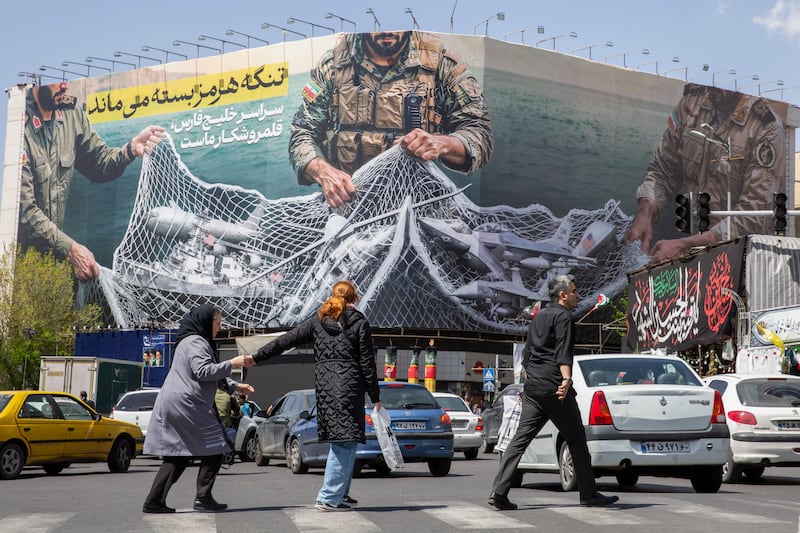 People walk in front of a billboard depicting captured US aircraft in a net in Tehran, Iran. Photograph: Arash Khamooshi/the New York Times
Reuters reports the source said Pakistan’s army chief, field marshall Asim Munir, has been in contact “all night long” with US vice-president JD Vance, special envoy Steve Witkoff and Iranian foreign minister Abbas Araqchi.
Under the proposal, a ceasefire would take effect immediately, reopening the Strait of Hormuz, with 15 to 20 days to finalise a broader settlement. The deal, tentatively dubbed the Islamabad Accord, would include a regional framework for the strait, with final in-person talks in Islamabad.
There was no immediate response from US and Iranian officials. Pakistan’s foreign office declined comment.
Iranian officials have previously told Reuters that Tehran was seeking a permanent ceasefire with guarantees they will not be attacked again by the US and Israel. They have said Iran has received messages from mediators including Pakistan, Turkey and Egypt.
The final agreement is expected to include Iranian commitments not to pursue nuclear weapons in exchange for sanctions relief and the release of frozen assets, the source said.
Two Pakistani sources said Iran has yet to commit despite intensified civilian and military outreach.
“Iran has not responded yet,” one source said, adding proposals backed by Pakistan, China and the United States for a temporary ceasefire have drawn no commitment so far.
There was no immediate response from Chinese officials to requests for comment. – Reuters
Iran threatens ‘much more devastating’ response if civilian targets hit
Iran’s central military command has warned of far more “devastating and widespread” retaliation if its adversaries hit Iranian civilian targets.
“If attacks on civilian targets are repeated, the next stages of our offensive and retaliatory operations will be much more devastating and widespread,” a spokesperson for the Khatam al-Anbiya Central Headquarters said in a statement posted by state broadcaster Irib on Telegram.
The warning, cited by AFP, came after Trump threatened to destroy Iran’s power plants and bridges if Tehran didn’t make a deal by Tuesday to fully reopen the strait of Hormuz.
In a message on Truth Social on Sunday, Trump said: “Tuesday will be Power Plant Day, and Bridge Day, all wrapped up in one, in Iran. There will be nothing like it!!! Open the F*****’ Strait, you crazy bastards, or you’ll be living in Hell – JUST WATCH! Praise be to Allah.” – Agencies
Late on Sunday, Binyamin Netanyahu suggested Israel assisted the US with its rescue of the downed airman in Iran. The Israeli prime minister said he had spoken to Trump and “congratulated him on his bold decision and a perfectly executed American mission”. “The president expressed his appreciation for Israel’s help,” Netanyahu said.
I spoke earlier with President @realDonaldTrump and personally congratulated him on his bold decision and a perfectly executed American mission to rescue the downed pilot from enemy territory.
The President expressed his appreciation for Israel’s help.
I am deeply proud that…
— Benjamin Netanyahu – בנימין נתניהו (@netanyahu) April 5, 2026
A US Air Force officer whose fighter jet had been shot down in Iran was rescued by US Special Operations forces in a risky mission Saturday night, president Donald Trump said on social media.
The rescue followed a life-or-death race between US and Iranian forces to reach the airman, a weapons system officer, that stretched over two days, officials said. There were no US casualties among the rescue team, Trump said. The rescued officer had “sustained injuries, but he will be just fine,” Trump added.
The two crew members on the plane, an F-15E Strike Eagle, were able to eject from it, US military officials said. The pilot was rescued soon afterward, and officials launched an urgent search for the other airman.
How the rescue unfolded
Navy SEAL Team 6 commandos rescued the weapons systems officer in an operation that involved hundreds of Special Operations troops and other military personnel working deep in enemy territory, current and former US officials said.
After ejecting from the F-15E, the officer hid in a mountain crevice. He evaded Iranian forces for more than 24 hours, at one point hiking up a 7,000ft ridgeline, a senior US military official said. His location was initially unknown to the US but officials found his hiding place via a beacon he was carrying.
The CIA also initiated a deception campaign to try to confuse Iranian forces and convince them the airman had already been rescued and was moving out of the country in a ground convoy.
After confirming the airman’s identity and that he was alone, senior military officials waited until dark to launch a rescue mission, which included Special Operations helicopters loaded with commandos.
US aircraft dropped bombs and opened fire on Iranian convoys to keep them away from where the airman was hiding. US commandos also opened fire to keep Iranian forces away from the rescue site as they converged on the airman.
The airman was taken by helicopter to a sandy, austere airstrip inside Iran that Special Operations forces had previously developed for possible rescues or other contingencies and where two C-130 aircraft waited to bring the crew and the airman to Kuwait. – New York Times
Air strikes on Iran kill more than 25
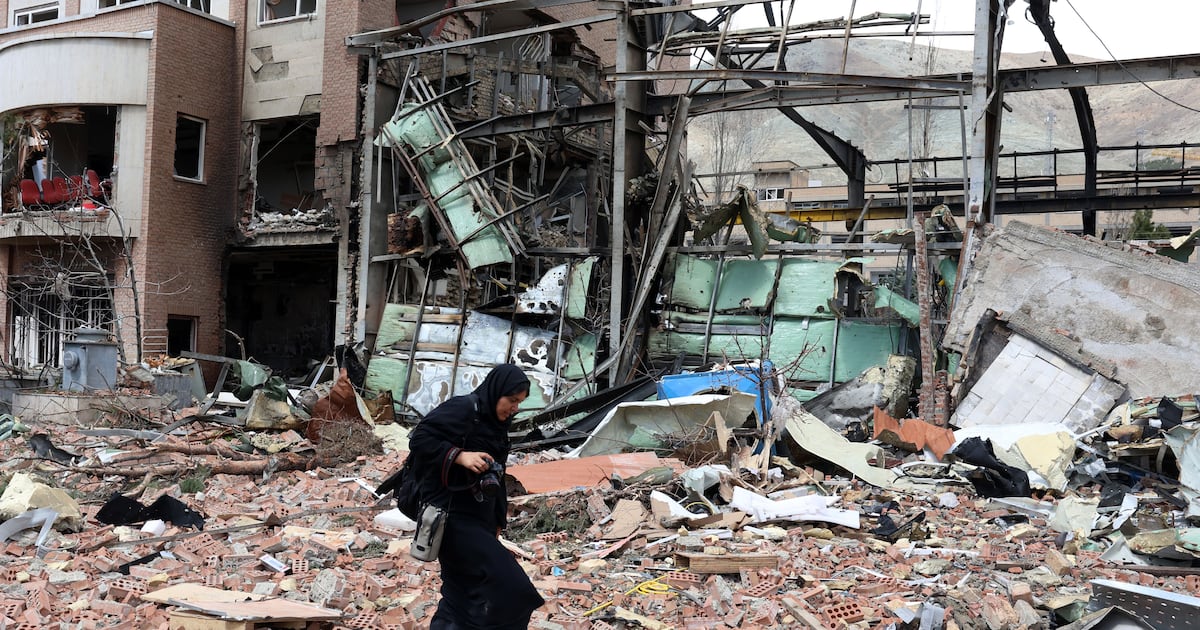
Israel and the US carried out a wave of attacks early on Monday which killed more than 25 people in Iran.
Tehran responded with missile fire on Israel and its Gulf neighbours as US president Donald Trump’s deadline for Tehran to reopen the Strait of Hormuz loomed.
Explosions rang out into the night in Tehran and low-flying jets could be heard for hours as the capital was pounded. Thick black smoke rose near the city’s Azadi Square after one airstrike hit the Sharif University of Technology grounds.
Two people were found dead in the rubble of a residential building in Haifa, according to Israeli authorities. The search was ongoing for two more even as new Iranian missile attacks hit the northern Israeli city early on Monday.
Kuwait and the United Arab Emirates both activated their air defence systems to intercept incoming Iranian missiles and drones, as Tehran kept up the pressure on its Gulf neighbours. – AP