
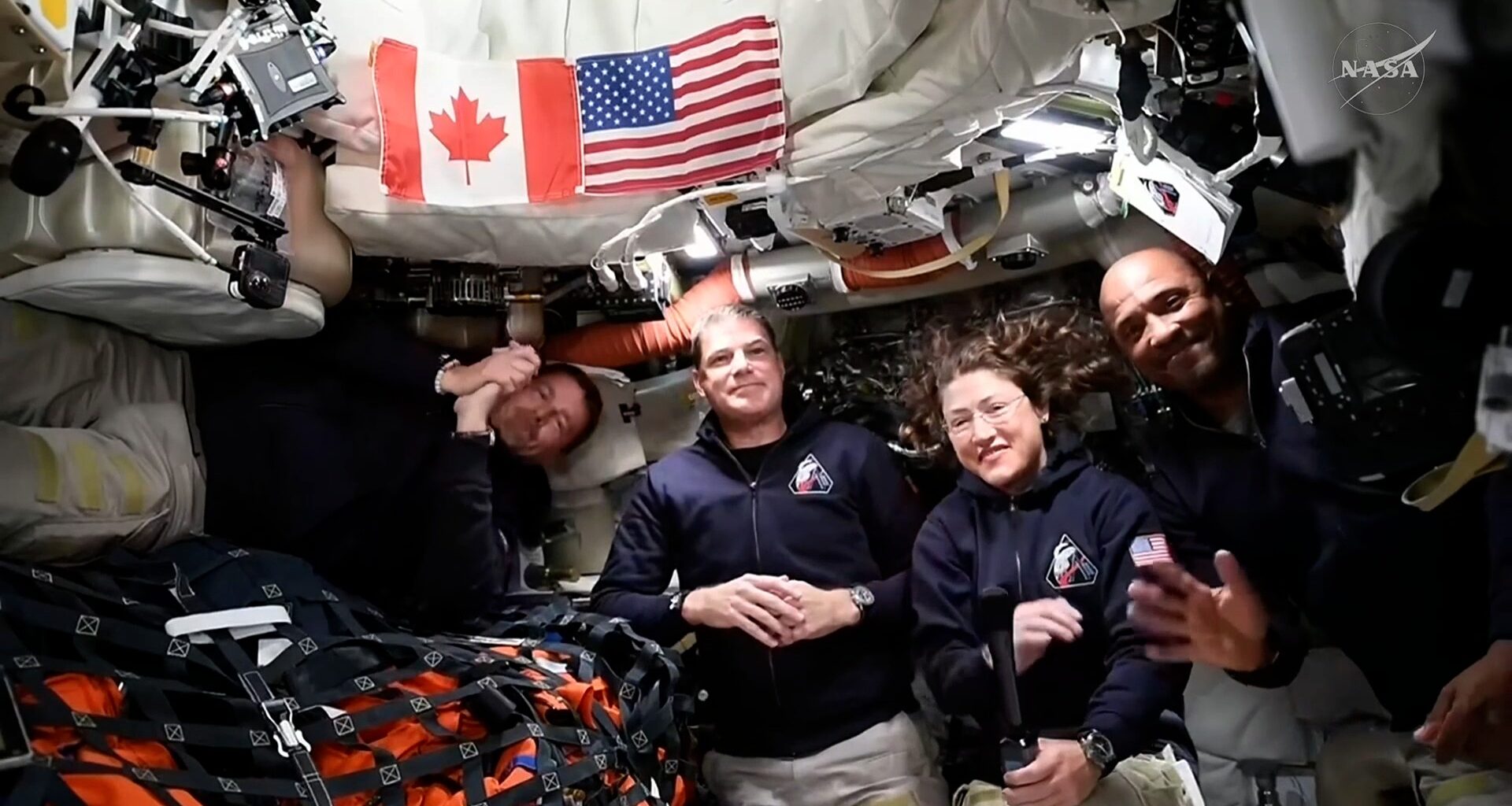
Saturday morning, April 4, 2026, marked a milestone for global space exploration and a true triumph for the Canadian Space Agency (CSA). As the Orion spacecraft steadily moved away from Earth, astronaut Jeremy Hansen established direct communication with the planet. This Q&A session marked the first event of its kind for Canada as part of its deep-space mission, highlighting the country’s new role in global space exploration.
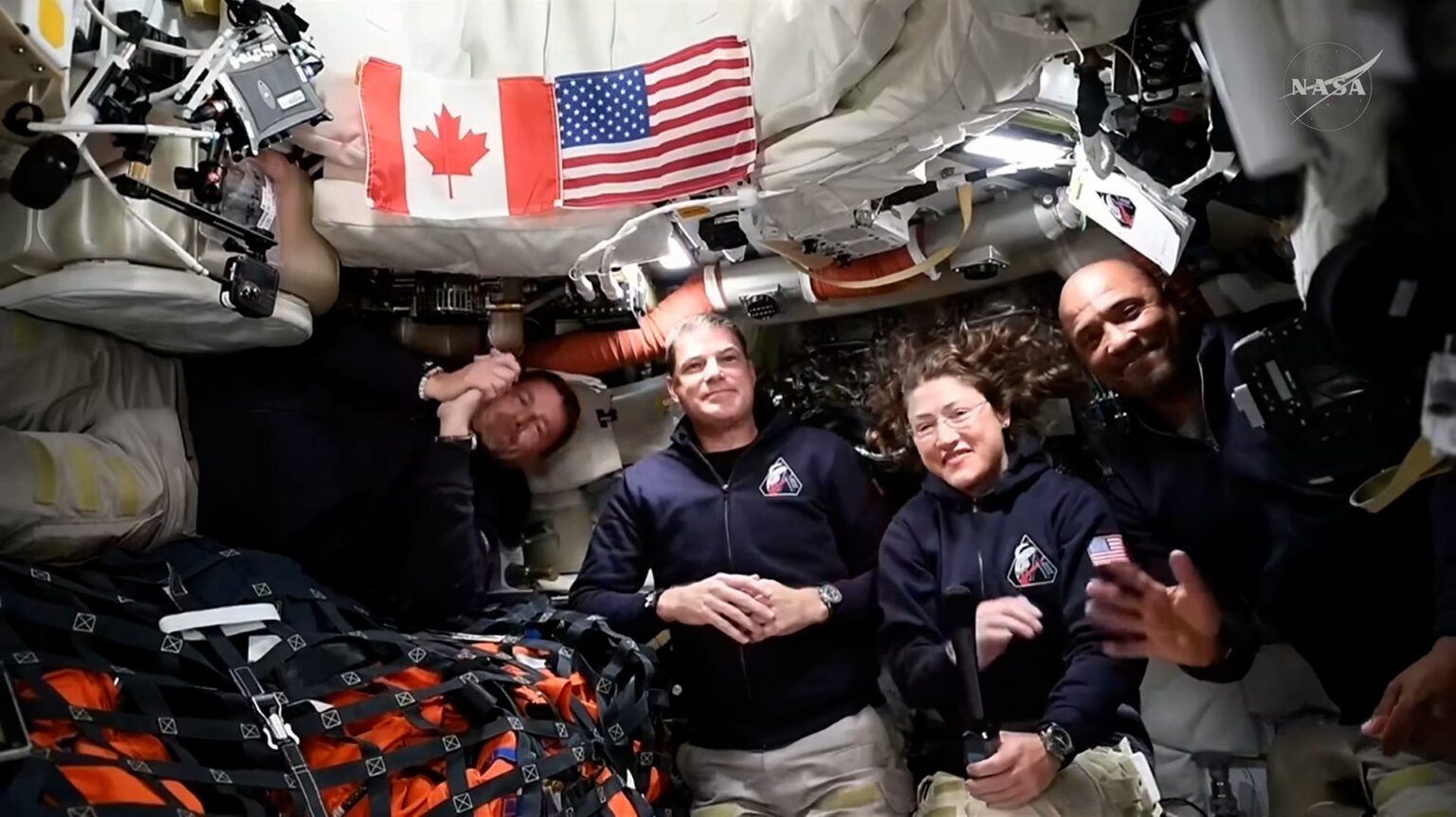 The Artemis II crew: NASA astronaut Reid Wiseman (far left), Canadian Space Agency (CSA) Jeremy Hansen (center left), and NASA astronauts Christina Koch (center right) and Victor Glover (right) participated in a live media event aboard the Orion spacecraft on the fourth day of the mission. Photo: NASA
On the third day of his 10-day trip, Hansen spoke to the audience via a virtual bridge coordinated by CSA President Lisa Campbell. For millions of viewers, this broadcast offered a rare opportunity to look inside the Orion living module and hear the genuine emotions of a person hundreds of thousands of kilometers from home. Jeremy Hansen, acting mission specialist for Artemis II, became the first Canadian to cross the boundary of low Earth orbit, automatically making him a national hero and a symbol of the country’s scientific progress.
A unique experience
One of the most interesting parts of the conversation was Hansen’s reflections on the contrast between training on Earth and the actual experience of flying. Although the crew had spent years training on the most advanced simulators, reality turned out to be far more intense. When asked what had impressed him most during the trip, the astronaut immediately recalled the moment of launch.
“Riding the rocket for us has just been extraordinary,” Hansen said. “We went through countless simulations where every sound and every vibration was meticulously calculated. But in real life, when the most powerful engines in history are roaring beneath you, it feels completely different. It’s a physical sensation of power that no simulator can ever replicate.”
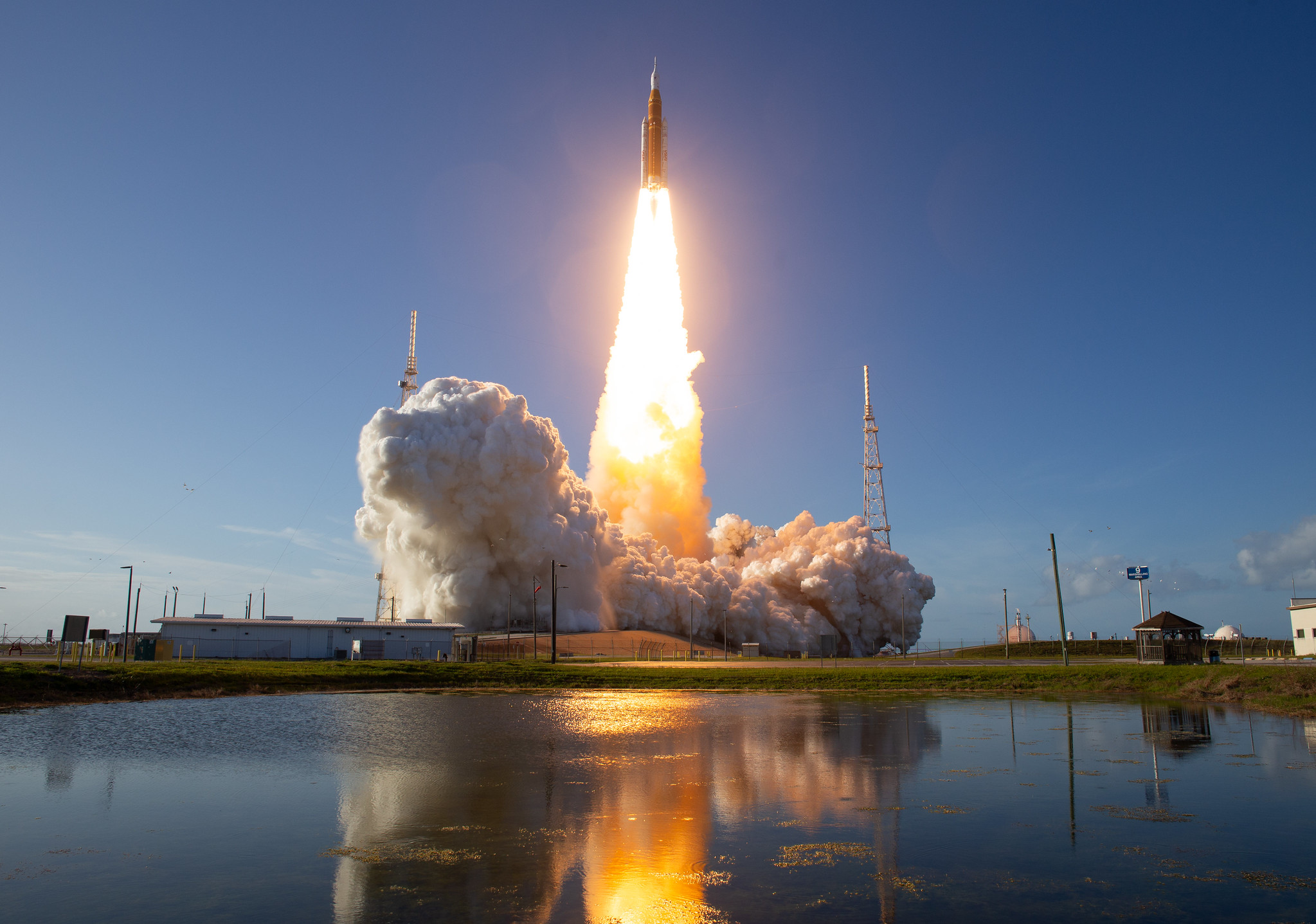 The Space Launch System rocket, carrying the Orion spacecraft and NASA astronauts, was launched as part of the Artemis II mission on April 1, 2026, from Launch Complex 39B at NASA’s Kennedy Space Center in Florida. Photo: NASA/Flickr
In addition to the flight dynamics, Hansen was struck by the visual aspect of the mission. Orion is now at such a distance that Earth no longer fills the entire horizon, but has become a delicate blue crescent. This view—known as “Earthrise” or “Crescent Earth”—is one of the rarest sights available to humanity, and Hansen emphasized that photographs cannot convey the depth and fragility one feels when looking at our planet from the darkness of space.
Scientific exclusive: a solar eclipse behind the Moon
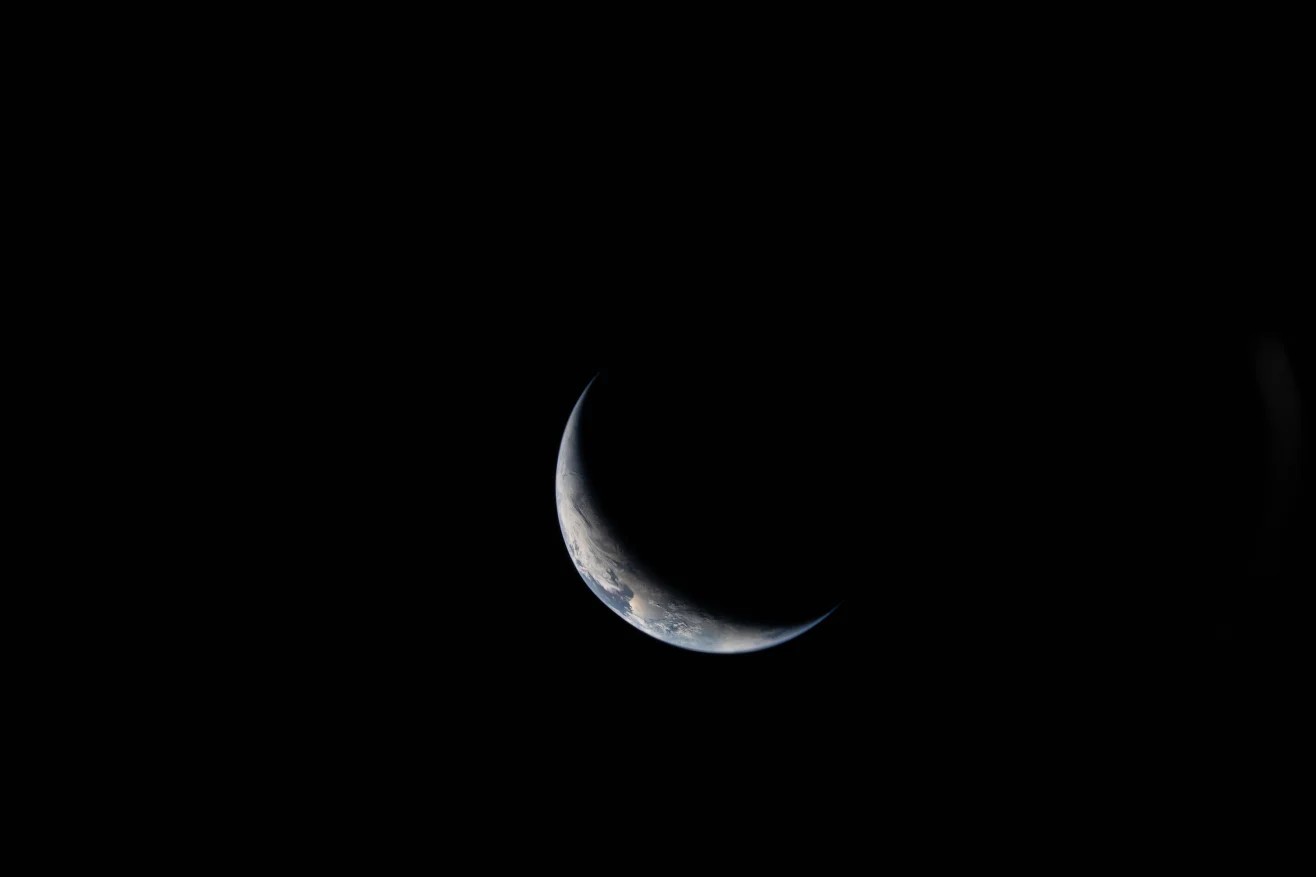 On the third day of the mission, Earth appears as a crescent. Photo: NASA
The Artemis II mission is not only a test of technology but also a unique platform for astronomical observations that cannot be made from ground-based observatories. During the broadcast, Jeremy Hansen revealed an interesting detail about the scientific program that the scientists had added to the crew’s schedule during their training.
When Orion reaches the far side of the Moon, the astronauts will have the opportunity to observe a solar eclipse caused by the Moon. “The scientists have given us another task: we’ll be able to observe a solar eclipse directly behind the Moon. It will be an incredible sight that will allow us to study the solar corona and the interaction of light with the lunar limb from a completely different perspective,” Hansen explained. Such observations are of great importance for understanding solar activity and its impact on space weather, which is critical for future missions to Mars.
Mission of inspiration
The launch on April 1, 2026, officially marked the beginning of a new chapter in human history, as it was the first crewed mission to the Moon in more than 50 years. Jeremy Hansen is part of NASA’s international “all-star” crew: Commander Ray Wiseman, Pilot Victor Glover, and Specialist Christina Koch. Together, they represent the new face of space exploration—one that is inclusive, multinational, and focused on a long-term presence in space.
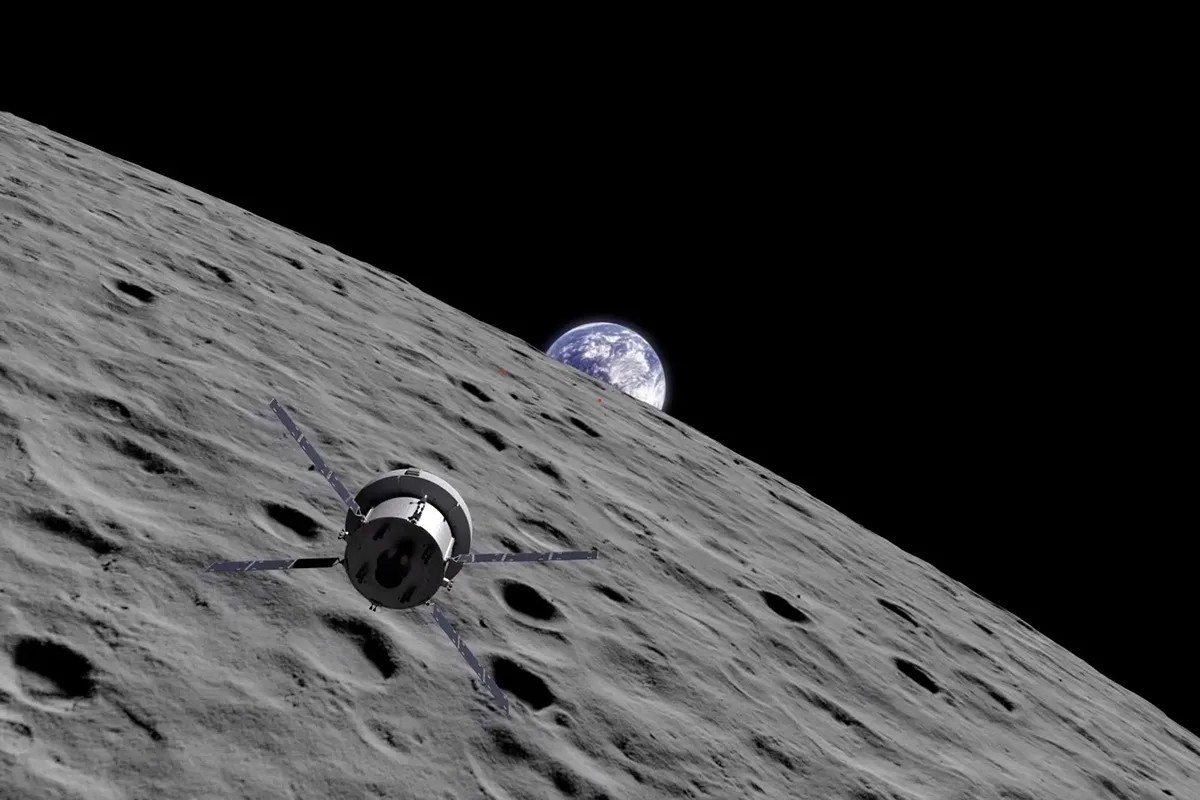 Illustration depicting NASA’s Artemis II spacecraft in orbit around the Moon. Credit: NASA
Hansen used part of his broadcast time to address young Canadians and all aspiring researchers. His message was simple but profound: “It’s important to find something that truly fascinates you.” But it’s just as important to share these passions with others. You’ll find out that the people around you are the ones who will help you make your dreams come true.
The astronaut emphasized that the success of the Artemis II mission is the result of the efforts of thousands of people on Earth, and that every young scientist can be part of the next step toward the stars.
We previously reported on how the Orion crew was preparing for its approach to the Moon.
According to CBC